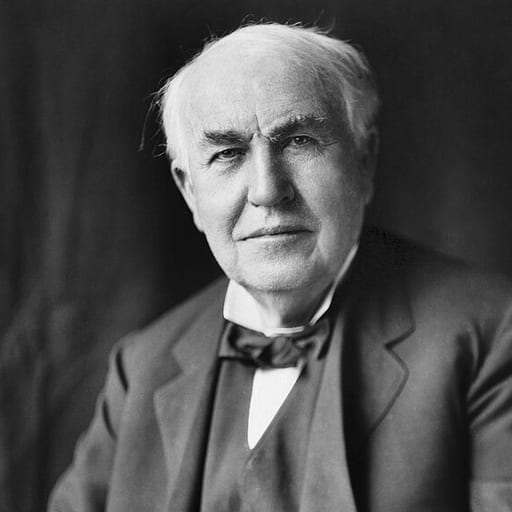
Hall of Masters

Thomas Edison

토머스 에디슨

Inventor and founder of the first industrial research laboratory

701 records in all

  • Principles 276
  • Episodes 377
  • Quotes 48
Ask with this master's words

3 free questions a day, no sign-up.

Photo: Louis Bachrach, Bachrach Studios, restored by Michel Vuijlsteke  Public domain  Original  cropped

Episodes

57 basic records of 377

Episodes are real events from public sources, summarised by us.

  • Inventing the Long Kiln

    Edison was dissatisfied with standard 60-foot kilns and designed a new 150-foot version to increase output by 400 percent. Despite initial struggles and skepticism from competitors, the kiln eventually exceeded its production goals.

    LessonRadical improvements in core technology can disrupt long-established industries.

  • Thriving on Snags

    Edison's associates noticed that he appeared happiest when encountering serious technical difficulties. These challenges seemed to strengthen his resolve and spark more creative ideas.

    LessonView major obstacles as opportunities to sharpen your focus and generate your best ideas.

  • Rapid Experimentation with X-rays

    뢴트겐이 X선을 발견하자 에디슨은 즉시 대규모 실험에 착수하여 최초의 형광 투시경을 만들었어요. 그는 적합한 재료를 찾기 위해 8,000개 이상의 다양한 결정을 수집하고 테스트하는 끈기를 보여주었어요.

    LessonSpeed and exhaustive testing are key when exploring the potential of a new discovery.

  • Adapting to External Failure

    Edison built a specialized room for delicate electrical measurements at great expense. However, the installation of a nearby trolley line created interference that made the room useless for its original purpose, so he repurposed it for motion-picture experiments.

    LessonWhen external factors ruin a specific plan, pivot the existing infrastructure to a new productive use rather than abandoning the investment.

  • Managing Staff Expectations

    에디슨은 직원들의 인간적인 실수는 너그럽게 이해해주었지만, 부주의로 인한 어처구니없는 실수에는 엄격하게 질책했어요. 하지만 화를 낸 후에는 이를 금방 잊고 다시 업무에 집중하는 태도를 보였어요.

    LessonA leader should demand absolute accuracy in execution while remaining quick to move past interpersonal friction.

  • 1911Team

    The Insomnia Squad

    During a five-week push to solve manufacturing issues for disc records, Edison and his team lived at the factory. They rarely went home, slept on tables, and focused entirely on investigating microscopic flaws caused by dust, temperature, and chemical actions.

    LessonSolving the most difficult technical hurdles sometimes requires a period of total, undistracted immersion by a dedicated team.

  • The Phonograph Voice Library

    Edison listened to thousands of singers to find the best voices for phonograph records, even sending a representative to Europe to record prominent opera stars. He kept detailed notebooks of his criticisms to ensure only the highest quality recordings were produced.

    LessonRigorous, documented testing of every component is necessary to maintain a high standard of product quality.

  • Electrification of Cities

    Edison developed the light bulb and subsequently built power plants and transmission systems. This initiative brought electricity into individual homes and transformed urban nightlife.

    LessonA product's success often depends on building the entire ecosystem and infrastructure required to use it.

  • The Cost of Work-Life Imbalance

    Edison was so consumed by his inventions and business that he neglected his family. His children struggled with failed businesses or fraud, and his son Charles remarked that he saw his father for less than a week in total throughout his life.

    LessonExtreme professional focus can lead to the breakdown of personal relationships and long-term family issues.

  • Homeschooling by Nancy Edison

    When a teacher called young Edison 'addled,' his mother withdrew him from school. She used her experience as a teacher to provide him with a superior education that fostered his love for reading.

    LessonA supportive mentor can turn a perceived failure in a rigid system into a lifelong intellectual advantage.

  • The Automatic Sixing Device

    Edison was required to send a signal every hour to prove he was awake. He rigged a notched wheel to a clock to send the signal automatically so he could sleep or study.

    LessonFounders should look for ways to automate low-value compliance tasks to free up time for deep work.

  • The Western Union Settlement

    Western Union used Edison's superior transmitter patents to compete with Bell. They eventually settled, receiving a 20 percent royalty on all Bell system earnings for years in exchange for exiting the telephone field.

    LessonA superior technical component can provide massive leverage in negotiations, even against a dominant rival.

  • The Prototype Bet

    Edison gave a sketch of the phonograph to his workman John Kruesi with a price of $18 marked on it. The shop foreman was so skeptical that he bet Edison a box of cigars the device would not work, a bet which Edison won.

    LessonEven skilled technicians may doubt a visionary idea until they see a working prototype.

  • The Bamboo Discovery

    While seeking a more homogeneous material than paper, Edison noticed a bamboo rim on a palm-leaf fan in his lab. He had an assistant carbonize it, and the resulting filament was so stable that he immediately sent a scout to Japan for more supplies.

    LessonThe solution to a complex technical problem can often be found in common, everyday objects if observed with a keen eye.

  • The Menlo Park Production Line

    Edison established a highly organized laboratory where ideas moved quickly from his sketches to John Kruesi's machine shop. Skilled mechanics like John Ott and Charles Batchelor then turned these concepts into working prototypes with extreme accuracy and speed.

    LessonA clear workflow between the visionary and the makers is essential for rapid prototyping.

  • 1887Team

    McGowan's Perilous Quest

    프랭크 맥고완은 남미의 험난한 야생에서 15개월 동안 질병과 굶주림을 견디며 대나무 샘플을 수집했어요. 그는 결국 우수한 재료를 찾아내는 데 성공했지만, 귀국 후 뉴욕에서 미스터리하게 실종되었어요.

    LessonBreakthroughs often require extreme physical and mental endurance from the team members involved.

  • 1921Wealth

    Critique of the Bond System

    Edison publicly supported Henry Ford's currency plan, arguing that the government should issue currency directly instead of interest-bearing bonds. He believed the current system unfairly enriched money brokers at the expense of those doing actual work.

    LessonFocus on systems that reward those who contribute actual value rather than those who merely manipulate capital.

You are seeing 108 basic records. Membership answers from all 701 of this master's records.

See membership

More masters in this field

See the whole field

Product and engineering

These records are our compilation of public statements and sources. We are not affiliated with or endorsed by Thomas Edison or any related company. If something should come down, tell us. Takedown request form