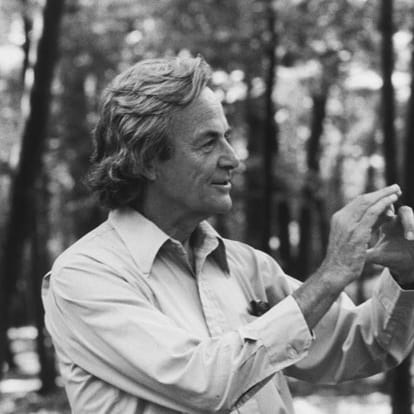
Hall of Masters

Richard Feynman

리처드 파인만

Nobel physicist and teacher; The Feynman Lectures on Physics

261 records in all

  • Principles 73
  • Episodes 84
  • Quotes 104
Ask with this master's words

3 free questions a day, no sign-up.

Photo: Copyright Tamiko Thiel 1984  CC BY-SA 3.0  Original  cropped

Episodes

13 basic records of 84

Episodes are real events from public sources, summarised by us.

  • Strategic Sabbatical in Brazil

    Feynman negotiated a move to Caltech that included a first-year sabbatical in Brazil. During this time, he taught physics, played samba music, and enjoyed a different culture before settling into his new role.

    LessonNegotiating for personal freedom and a change of environment during a career transition can prevent burnout and broaden perspectives.
  • The Feynman Lectures on Physics

    Feynman spent three years restructuring undergraduate physics courses at Caltech. While some freshmen found the material intimidating, the lectures were so profound that they attracted older students and faculty, eventually becoming world-renowned textbooks.

    LessonCreating high-quality content that provides deep understanding ensures long-term value even if it is not immediately adopted by the masses.

  • Young's Rat Maze Experiment

    A researcher named Young discovered that rats were navigating mazes by the sound of the floor rather than visual or olfactory clues. He systematically eliminated every other possible clue until he had to put the corridor in sand to truly test the rats' learning. Despite this breakthrough in methodology, subsequent researchers ignored his rigorous controls and continued with flawed experiments.

    LessonTo truly solve a problem, you must identify and control the actual variables at play, not just the ones you assume are important.

  • The Danz Lectures

    Feynman addressed students who felt conflicted between their religious upbringing and modern science. He suggested that science can exist without certainty and religion can exist without dogma, allowing them to coexist.

    LessonConflict can be resolved by removing the need for absolute certainty or rigid dogma in one's approach.

  • The Bowling Ball Demonstration

    Feynman stood against a wall with a heavy bowling ball touching his nose and let it swing across the room and back. He trusted the laws of physics so much that he didn't flinch as the ball stopped just short of his face. This was done to prove to his students that he truly believed in the principles he was teaching.

    LessonTrue leadership requires demonstrating a deep, personal conviction in the ideas you are selling or teaching.

  • Testing Content Through Public Lectures

    The book QED was based on a series of memorial lectures Feynman delivered at UCLA in 1983. This followed an earlier version of the lectures given in New Zealand in 1979, showing a process of refining the material through live delivery before final publication.

    LessonTest your ideas and messaging in front of a live audience to refine them before a major launch.

  • Independent Discovery of the Theorem

    Richard Feynman independently derived a fundamental theorem in quantum mechanics as part of his early work, which later became known as the Hellmann-Feynman theorem. This theorem allows for the calculation of forces in a molecular system using classical electrostatics once the electron distribution is known.

    LessonGreat insights often emerge when different thinkers independently arrive at the same fundamental truth from different angles.

  • The Mentor-Protégé Naming Revenge

    파인만의 지도교수였던 바야르타는 관례에 따라 논문에 자신의 이름을 먼저 올렸어요. 나중에 하이젠베르크가 그 논문을 인용하며 파인만의 이름을 마지막에 언급하자 파인만은 이를 즐거워하며 스승에게 농담을 건넸어요.

    LessonRecognition often comes in unexpected ways, and maintaining a sense of humor about hierarchy is valuable.

  • Cargo Cult Science Address

    파인만은 겉모습만 과학을 흉내 내는 '화물 숭배 과학'을 경계해야 한다고 강조했어요. 그는 자신을 속이지 않는 정직함이 과학적 사고의 제1원칙이며, 이를 지켜야 타인에게도 정직할 수 있다고 조언했어요.

    Lesson의사결정을 내릴 때 가장 경계해야 할 대상은 자기 자신을 속이는 편향이에요.

  • Accepting the Albert Einstein Award

    파인만은 오펜하이머의 보안 허가를 박탈한 루이스 스트라우스에 대한 반감으로 아인슈타인 상 수락을 망설였어요. 하지만 동료 라비의 조언을 듣고 결국 상을 받기로 결정했어요.

    LessonPersonal principles are important, but don't let them blind you to the value of recognition for your work.

  • The Messenger Lectures at Cornell

    Feynman delivered a series of seven lectures at Cornell University about the nature of physical laws. These lectures were recorded by the BBC and later turned into a successful book.

    LessonHigh-quality educational content can be repurposed across different mediums like video and print to increase its impact.

  • Lobbying for Acceptance

    When Feynman first introduced his diagrams, they confused many physicists who were used to traditional equations. He had to lobby hard to convince the scientific community of their utility as a superior bookkeeping device.

    LessonNew, efficient systems often face resistance from those comfortable with the status quo.

  • Solving the Infinity Problem

    Early applications of particle calculations often resulted in infinite values that were physically impossible. Feynman, along with others, implemented renormalization to eliminate these infinities, ensuring the diagrams matched experimental results.

    LessonRefining a model to eliminate errors is essential for its real-world reliability.

You are seeing 40 basic records. Membership answers from all 261 of this master's records.

See membership

More masters in this field

See the whole field

Science and first-principles thinking

These records are our compilation of public statements and sources. We are not affiliated with or endorsed by Richard Feynman or any related company. If something should come down, tell us. Takedown request form