Hall of Masters

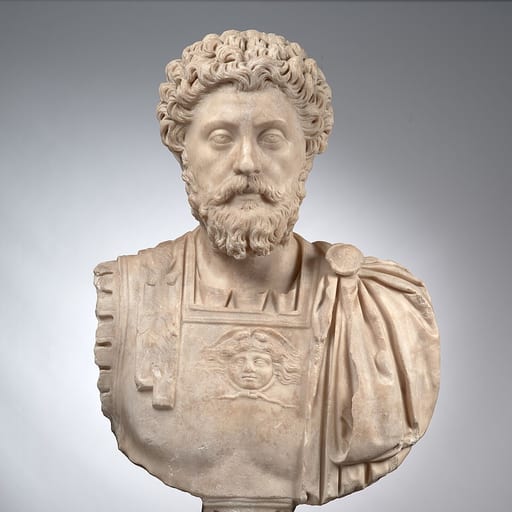
Marcus Aurelius

마르쿠스 아우렐리우스

Roman emperor and Stoic; author of Meditations

812 records in all

  • Principles 254
  • Episodes 188
  • Quotes 370
Ask with this master's words

3 free questions a day, no sign-up.

Photo: Daniel Martin  CC BY-SA 4.0  Original  cropped

Episodes

28 basic records of 188

Episodes are real events from public sources, summarised by us.

  • The Nine Rules of Conduct

    Marcus outlined nine specific mental exercises to handle offenses from others, focusing on human interconnectedness and the brevity of life. He treated these rules as a gift to maintain his composure while leading the empire.

    LessonA leader must have a pre-set mental framework to process conflict without losing their temper or focus.

  • The Metaphor of the Three-Act Play

    Marcus reflects on the idea that a life or a career does not need to reach five acts to be complete. He argues that the one who composed the drama determines its conclusion, and the individual should be content with the part they played.

    LessonSuccess is defined by the integrity of the work done, not by reaching an arbitrary finish line or duration.

  • Renan's New Synthesis of the Gospels

    M. Renan attempted to create a new construction of the Gospel stories after visiting the Holy Land. Although the author considers the attempt unsuccessful, he acknowledges its importance because it tried to view traditional data from a fresh perspective.

    LessonEven if a new approach fails, the act of reframing old data into a new synthesis is essential for solving complex problems.

  • The Contrast of Mothers

    The author compares the behavior of Galen's mother, who was known for her violent temper toward servants, with the mother of Marcus Aurelius. This comparison serves to challenge the idea that all pagans were inherently immoral or cruel.

    LessonIndividual character and upbringing can transcend the general reputation or stereotypes of a group.

  • Coleridge's Intellectual Stimulus in England

    Coleridge는 관습과 실용적 편의가 지배하던 영국 사회에서 사물의 진실을 파헤치려는 지적 노력을 멈추지 않았어요. 그의 이러한 태도는 다음 세대 지식인들에게 강력한 자극제가 되었고, 창업자와 같은 존경을 받게 되었어요.

    LessonA leader who challenges routine with deep thought can become a foundational source of progress for others.

  • Joubert's Critique of Voltaire

    Joubert analyzed Voltaire's influence, noting that while his style was charming and his wit mature, he lacked a moral sense. He concluded that Voltaire's work required an atmosphere of license to function and could be fascinating yet ultimately detestable to a wise observer.

    LessonBrilliance and wit without a moral foundation can lead to a product that fascinates but ultimately corrupts or fails to provide lasting value.

  • Spinoza's Critique of Scripture

    Spinoza analyzed the Bible not as an infallible document, but as a collection of historical texts with errors and conflicting sources. He argued that many events described as miracles were actually natural phenomena explained through the limited knowledge of the authors.

    LessonFounders should look past the 'miraculous' marketing of success stories to find the natural, logical causes behind them.

  • Identifying Anachronisms in Texts

    Spinoza pointed out that certain passages in the Pentateuch could not have been written by Moses because they refer to events and kings that existed long after his death. This evidence suggested that the books were compiled by a later editor, likely Ezra, using various fragments.

    LessonCritical analysis of data sources helps identify whether information is firsthand or a later, potentially biased, interpretation.

  • 0138Career

    Preparation for Governance

    Assisting his uncle in governing the Roman Empire at seventeen, Marcus studied law and military discipline. He aimed to use his knowledge to restrain the strong and assist the weak.

    LessonTechnical skills like law and strategy should be mastered to serve a higher purpose of fairness and benefit to others.

  • The Left Hand Analogy

    Marcus observed that the left hand is generally weaker and less effective for most tasks due to lack of use. However, because it is constantly used to hold the bridle while riding, it becomes stronger at that specific task than the right hand.

    LessonRepetition and practice can turn a natural weakness into a specialized strength.

  • Adopting the Philosopher's Lifestyle

    Under the influence of his teacher Diognetus, Marcus adopted a rigorous lifestyle. He wore a rough Greek cloak and even slept on the ground to practice self-discipline.

    LessonA mentor can introduce you to a completely new mindset that changes your daily habits and discipline.

  • Balancing Power and Family Tragedy

    마르쿠스는 군대와 지방에 대한 통치권을 부여받으며 권력의 정점에 다가갔지만, 동시에 첫 아이의 병치레와 죽음을 겪어야 했어요. 이후 수년간 여러 자녀를 잃는 고통 속에서도 공적인 책무를 수행했어요.

    LessonProfessional success does not insulate a leader from personal grief; resilience is required for both.

  • Accepting Unwanted Power

    마르쿠스는 철학적인 삶을 선호했기에 황제의 자리를 매력적으로 느끼지 않았고 권력을 맡는 것에 거부감을 보였어요. 하지만 스토아 학파로서의 훈련 덕분에 그것이 자신의 의무임을 깨닫고 황제직을 받아들였어요.

    LessonTrue leadership is often a burden accepted out of duty rather than a prize sought for ego.

  • Securing Military Loyalty

    Upon his accession, Marcus and Lucius promised the Praetorian Guard a massive bonus of 20,000 sesterces per man. This was double the size of previous bonuses and equivalent to several years' pay, ensuring the troops' protection during the transition.

    LessonInvesting heavily in the loyalty of key stakeholders during a leadership change can prevent costly opposition later.

  • Promoting Crisis Specialists

    Marcus replaced several major officials with men better suited for military and administrative challenges. For example, he appointed Titus Varius Clemens, a man with extensive frontier and provincial experience, to handle imperial correspondence during a time of crisis.

    LessonMatch your team's expertise to the specific nature of the current business environment.

  • Adapting to Failed Integration

    마르쿠스는 게르만 부족들을 이탈리아에 정착시켰으나, 그들이 반란을 일으키자 정책을 즉시 수정했어요. 그는 더 이상의 이주를 중단하고 기존 정착민들을 추방하며 안보를 우선시했어요.

    LessonWhen a strategy yields dangerous results, a leader must be willing to reverse course quickly.

  • Writing for Self-Improvement

    While leading military campaigns, Marcus wrote his 'Meditations' in Greek as a personal guide for his own improvement. He did not write it for publication, yet it became one of the most influential works of philosophy in history.

    LessonConsistent self-reflection and documenting one's principles can provide the mental clarity needed to lead through chaos.

  • The Founding of the Stoa

    Zeno studied various philosophical systems under Crates before opening his own school in a famous colonnade in Athens. This physical location, the Painted Porch, gave the Stoic movement its lasting name.

    LessonA founder should study existing systems deeply before synthesizing them into a unique and branded methodology.

You are seeing 122 basic records. Membership answers from all 812 of this master's records.

See membership

More masters in this field

See the whole field

Philosophy and wisdom traditions

These records are our compilation of public statements and sources. We are not affiliated with or endorsed by Marcus Aurelius or any related company. If something should come down, tell us. Takedown request form