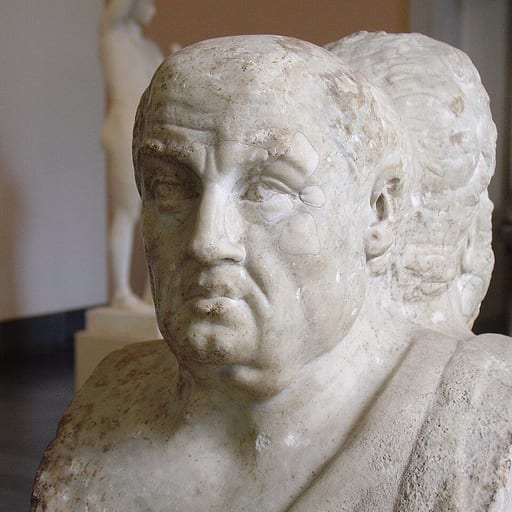
Hall of Masters

Seneca the Younger

세네카

Roman Stoic philosopher and statesman; Letters to Lucilius

1,047 records in all

  • Principles 346
  • Episodes 150
  • Quotes 551
Ask with this master's words

3 free questions a day, no sign-up.

Photo: Calidius  CC BY-SA 3.0  Original  cropped

Episodes

23 basic records of 150

Episodes are real events from public sources, summarised by us.

  • Advising the Emperor

    Seneca wrote 'De Clementia' to the young Emperor Nero, arguing that clemency is a necessary virtue for a ruler. He attempted to shape the leadership style of the most powerful man in Rome through his writing.

    LessonStrategic communication can be used to influence the behavior and values of powerful stakeholders or clients.
  • Learning from Sextius's Military Simile

    Seneca studied the works of the philosopher Sextius, who used the image of an army marching in a hollow square to describe the wise man's mindset. This taught Seneca that a prepared mind should have its defenses deployed on all sides to meet any sudden threat.

    LessonA founder must build a business that is resilient to shocks from any quarter, not just expected ones.

  • The Stoic School Structure

    Seneca describes the Stoic school as a group of free individuals where each person claims their own freedom of thought. Unlike other schools where every word is attributed to a single leader, Stoics contribute to a shared body of work where no single motto is credited to just one person.

    LessonA healthy organization encourages individual initiative and shared ownership rather than blind following of a single founder.

  • The Mountain Climbing Analogy

    Seneca compares moral and professional discipline to the physical act of navigating a mountain. He notes that descending requires leaning back to check momentum, while ascending requires leaning forward into the struggle.

    LessonGrowth requires a proactive forward lean into difficulty, while easy paths require constant braking to avoid a fall.

  • The Bankruptcy of the Epicure

    Seneca recalls gossip about a cookshop that was rushing into bankruptcy because it created an absurdly expensive and complex dish. The dish combined mussels, oysters, sea-urchins, and mullets into a single, jumbled mess.

    LessonOver-engineering a product to satisfy excessive luxury can lead to financial ruin and a degraded final result.

  • The Sudden Asthma Attack

    Seneca suffered a sudden and severe bout of shortness of breath that physicians likened to practicing for death. Despite the physical gasping and the feeling of a continued last gasp, he focused on maintaining brave thoughts.

    LessonIn a crisis that threatens your survival, your only immediate leverage is the management of your own mindset.

  • Seneca's self-reflection on aging

    Seneca observed that while his body was failing due to old age, his mind remained alert and even flourished. He used this time to audit his character and determine if his philosophical beliefs were genuine or just stage artifice.

    LessonPhysical decline or external setbacks can be used as a period of intense mental clarity and character auditing.

  • The Comparison of Human and Animal Traits

    Seneca observed that humans often waste energy trying to surpass animals in physical traits like speed or beauty. He argued that no matter how much a person trains, they will never outrun a hare or have a mane as thick as a lion's.

    LessonFocus your efforts on your unique human capacity for reason rather than competing in physical or superficial metrics where you are naturally outmatched.

  • Fabianus's Controlled Audience

    The philosopher Fabianus gave popular talks where the audience maintained self-control instead of erupting in empty applause. When they did cheer, it was a reaction to the greatness of the ideas rather than the speaker's style.

    LessonFocus your communication on the value of the message rather than the flashiness of the delivery.

  • The fall of great leaders

    Seneca recalls how Pompey's fate was decided by a boy and a eunuch, and how Crassus was defeated by the Parthians. Even Gaius Caesar, who ordered others to be executed, eventually offered his own throat to an assassin.

    LessonNo amount of power or status guarantees permanent safety from the whims of fortune.

  • The Critique of Specialized Arts

    Seneca observed that many people focused on specialized skills like astrology, wrestling, or stage mechanics without improving their character. He argued that these skills serve luxury or amusement rather than virtue.

    LessonTechnical expertise is a tool for life, but it should not be mistaken for the wisdom needed to lead or live well.

  • Seneca's daily practice

    Seneca focused on living each day as if it were his entire life. He prepared himself to face death with the same readiness as he faced his daily tasks.

    LessonTreating each business day as a complete unit helps maintain focus and prevents procrastination.

  • Cato's Indifference to Defeat

    On the day Marcus Cato was defeated in the elections, he reportedly played a game of ball instead of mourning his loss. He maintained this same character whether he was in power, under accusation, or facing death.

    LessonTrue resilience is shown by not letting external professional failures change your internal character or peace of mind.

  • The Slave's Ultimate Sacrifice

    Seneca describes a scenario where a slave sacrifices his life to buy time for his master to escape. This act of loyalty goes beyond mere service and becomes a profound benefit that the master can never truly repay.

    LessonTrue loyalty and exceptional performance can come from any level of an organization, regardless of formal rank.

  • The Appointment of Arrhidaeus

    Seneca reflects on why a seemingly unfit man like Arrhidaeus was given a throne. He concludes the power was not given for his own sake, but as a tribute to the greatness of his father and brother.

    LessonA leader's reputation can secure opportunities for their successors long after they are gone.

  • The Physician's Dual Role

    Seneca observes that a physician does not just provide medicine but also gives practical advice on lifestyle to ensure the cure sticks. He uses this to argue that philosophy must provide both deep principles and daily rules.

    LessonA leader must provide both the strategic vision and the tactical guidance to help their team succeed.

You are seeing 158 basic records. Membership answers from all 1,047 of this master's records.

See membership

More masters in this field

See the whole field

Philosophy and wisdom traditions

These records are our compilation of public statements and sources. We are not affiliated with or endorsed by Seneca the Younger or any related company. If something should come down, tell us. Takedown request form