Hall of Masters

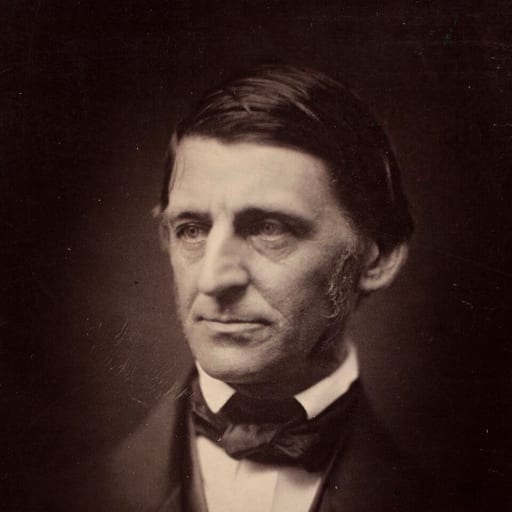
Ralph Waldo Emerson

랠프 월도 에머슨

Essayist and lecturer; author of Self-Reliance

1,253 records in all

  • Principles 399
  • Episodes 233
  • Quotes 621
Ask with this master's words

3 free questions a day, no sign-up.

Photo: Josiah Johnson Hawes  Public domain  Original  cropped

Episodes

35 basic records of 233

Episodes are real events from public sources, summarised by us.

  • The Rise of Economic Inventions

    In 19th-century America, Emerson noted that ruling passions for equality and lucrative callings led to the creation of the telegraph, insurance companies, and schools. While these were seen as superficial wants, they prepared the soil for future national education.

    LessonThe dominant passions of an era dictate which institutions and technologies will flourish.
  • The Young Soldier's Resolution

    A young soldier admitted to his sister that he lacked natural courage but resolved never to let anyone find out. He forced himself to enter every dangerous place and do exactly what he feared to overcome his infirmity.

    LessonCourage is not the absence of fear but the dogged resolution to act despite it.

  • 1799Career

    William Emerson's Career Shift

    Ralph Waldo Emerson's father, William, moved from a small town ministry in Harvard to the First Church in Boston. While he was highly respected in the city for his attractive manner and melodious voice, he had struggled to find perfect sympathy with the people in the quieter town of Harvard.

    LessonYour talents may be better suited for a specific market or demographic than for a general one.

  • 1833Career

    Transition to Public Lecturing

    After returning from Europe, Emerson began a new career as a lecturer. He initially chose popular and intelligible topics like 'Water' to introduce himself pleasantly to the public before moving to more philosophical subjects.

    LessonStarting with accessible offerings helps build the necessary platform and audience trust for more ambitious projects later.

  • Carlyle's Endorsement

    Thomas Carlyle received the book and recognized it as a foundational 'ground-plan' for Emerson's future work. He shared it with his intellectual circle, finding that it resonated deeply with those who had a sense for spiritual truths.

    LessonFinding a small, high-quality audience that understands your vision is more important than immediate mass-market approval.

  • Winter Lecture Series and Health Setback

    Emerson planned a series of twelve lectures on human life for the winter of 1838-39. However, he was forced to stop after ten lectures because of a severe lung inflammation.

    LessonPhysical resilience is a prerequisite for consistent creative output and professional delivery.

  • Advocating for American Independence

    In his 1844 address 'The Young American', Emerson urged Americans to move beyond European social systems. He believed in the unique future of the American race and its potential for a new social state.

    LessonTrue independence requires moving past the censures and social structures of established competitors.

  • Publication of Second Essays

    Emerson published his second series of essays in 1844, covering topics like 'The Poet' and 'Experience'. These writings reflected a less tranquil state of mind and a focus on honesty regarding human limitations.

    LessonHonesty in acknowledging one's lack of control can lead to more profound and authentic creative work.

  • Advocating for Women's Rights

    에머슨은 여성 권리 대회에서 강연하며 교육의 평등한 기회와 재산권 보장을 주장했어요. 그는 여성이 공적 업무에 참여할 의사가 있는지는 법적 장애물을 제거한 후에 여성 스스로 결정해야 한다고 강조했어요.

    LessonTrue progress involves removing barriers and allowing individuals to determine their own roles and participation in society.

  • Emerson's Poetic Standards

    Emerson held an exalted view of the poetic function, believing that true art should be free and clear rather than merely decorative. He argued that a great creator must strike chords 'rudely and hard' to convey deep secrets of the universe, rather than relying on trivial or jingling arts.

    LessonTrue impact comes from bold, uncompromising expression rather than pleasing everyone with superficial polish.

  • The American Scholar Address

    Emerson delivered a landmark speech at Harvard to the Phi Beta Kappa Society. He called for an end to America's intellectual dependence on Europe and urged scholars to find original inspiration.

    LessonA leader must recognize when it is time to stop following established models and start creating original value.

  • The Failure of Travel as Escape

    Emerson describes the experience of traveling to places like Naples or Rome to escape sadness, only to find that his internal problems followed him. He realized that the 'stern fact' of his own self remained identical regardless of the location.

    LessonChanging your location won't solve business or personal problems if you don't change your mindset first.

  • The Decay of European Monarchs

    Emerson notes that by 1805, many legitimate monarchs in Europe had become weak or ineffective. He uses this to show that inherited status eventually rots without the infusion of new, raw power from the 'fields'.

    LessonSuccess is not permanent; businesses must constantly recruit fresh talent and energy to avoid institutional decay.

  • The Tragedy of Imprudent Genius

    Emerson observed many talented individuals who ignored financial and physical laws, leading to a life of misery. These people struggled for years with small debts and eventually became exhausted and unproductive.

    LessonIgnoring the basic rules of money and health will eventually sabotage even the greatest talent.

  • Emerson's Social Struggle

    Emerson often felt he lacked the 'animal spirits' or high energy required for general society and direct action. He noted this personal limitation in his private journals while observing others.

    LessonSelf-awareness of one's temperament helps in understanding which roles or environments are most suitable for one's energy levels.

You are seeing 188 basic records. Membership answers from all 1,253 of this master's records.

See membership

More masters in this field

See the whole field

Philosophy and wisdom traditions

These records are our compilation of public statements and sources. We are not affiliated with or endorsed by Ralph Waldo Emerson or any related company. If something should come down, tell us. Takedown request form