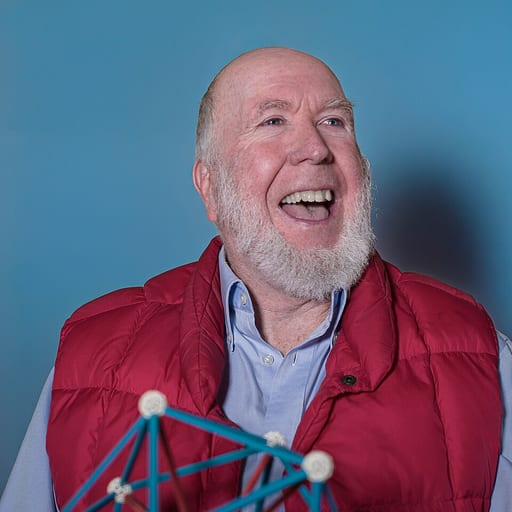
Kevin Kelly
케빈 켈리
Founding executive editor of Wired, author of the essay 1,000 True Fans
1,832 records in all
- Principles 683
- Episodes 339
- Quotes 810
3 free questions a day, no sign-up.
Photo: Cmichel67 CC BY-SA 4.0 Original cropped
Quotes
122 basic records of 810
Quotes are word for word from the source.
Crowdsourcing feedback
I want to thank the many, many folks here who commented on bits and pieces of book as I posted them. I read every comment and in some way or another each had an influence on the final text.
Our noteKevin Kelly explains how his blog audience helped shape his book draft.
AI Truth Bias
Truth itself is a coherent system. LLMs map that coherence, and rely on it to give you answers and solutions. Truth is sort of a gradient, almost a weight in itself in this network.
Our noteKelly describes how AI models use the coherence of truth to generate reliable answers.
Control and happiness
We do find happiness in having some control of our time and work, a chance for real leisure, in the escape from the uncertainties of war, poverty, and corruption
Our noteHe lists the specific benefits of affluence that lead to human satisfaction.
Preserving the past
A prudent society keeps at least one specimen of all it makes, forever.
Our noteKelly emphasizes the importance of archiving physical copies of human creations.
Invention vs Discovery
To find something is the same as making it. To make something is the same as finding it.
Our noteKevin Kelly explains that the process of creating something new is identical to finding it.
Giving reliable advice
I only put pieces of advice that I felt I could really stand by, and there were times when I doubted my own certainty about it.
Our noteKevin explains why he excluded certain topics like marriage counseling from his book.
Following idiosyncratic interests
I'm reluctant to assign any large general thesis to all the things I'm interested in, because I think it's just a pure reflection of my own idiosyncratic interest in the world.
Our noteKevin talks about how his diverse projects are driven by personal curiosity rather than a single grand plan.
Traveling with children
if your kids don't seem to appreciate it, it doesn't matter. They'll probably appreciate it later on.
Our noteKevin gives advice to parents who worry their children aren't gaining enough from travel.
Reframing Technology
I was taking my travel metaphor, and it was called " Network Nation ." That was the thing that flipped my idea about technology and seeing a different face to it.
Our noteKevin describes how he used his travel background to understand the early internet.
The Power of Simulation
Developing a robust simulation will become a fundamental part of science in every field.
Our noteKelly predicts that simulations will become as standard as mathematical equations for testing hypotheses.
Democratization of travel
Travel is no longer a luxury of the rich, but an expectation of the middle class.
Our noteKevin Kelly discusses how global travel has shifted from an elite expedition to a common experience.
Intentional destination choice
It is easier to arrive but you have to choose where you arrive with more care.
Our noteKelly explains that finding unique experiences now requires more deliberate planning than in the past.
AI reasoning process
The model isn't reasoning privately and then writing it down - the writing-it-down is the reasoning.
Our noteExplaining that LLMs generate thoughts and words simultaneously rather than translating pre-formed ideas.
AI as specimen
The latent space thus becomes a specimen: something you dissect to extract discoveries.
Our noteKevin Kelly explains how latent spaces allow us to find patterns humans haven't detected yet.
Personal AI branding
The brand would be You+AI; it would derive its distinctiveness from making your own personal latent space.
Our noteKelly describes the future of personal branding through custom-trained AI models.
Platform as infrastructure
The model was a phone company, which didn't produce any content - and didn't censor what was said either - but merely allowed its paying customers to connect with each other.
Our noteExplaining how the WELL functioned as a facilitator rather than a content creator.
Exploiting existing success
The first mode, exploiting and perfecting, rewards efficiency and optimization. It has diminishing returns, becoming more difficult as fitness and perfection is increased. But it is reliable and low risk.
Our noteKelly explains the nature of optimizing what already works in a business or craft.
Creative risk taking
To win future fans the artist has to explore rather than merely exploit. They have to take up a new instrument, or develop a new style, or invent new characters, which is risky.
Our noteKelly discusses why successful creators must risk their current reputation to grow.
Evolving economic views
I once thought the idea of a world without money was the most ridiculous and naive idea I had ever heard in my life.
Our noteKevin reflects on his changing perspective regarding money-less economies.
Cost of Innovation
Science is costly for an individual. Sharing results is a marginal benefit if you are chiefly seeking a better tool for today.
Our noteKelly explains why science requires a surplus of resources to thrive.
Choosing Mentors
Don't ever work for someone you don't want to become.
Our noteHe advises on how to choose employers or partners based on personal character.
Future of Text
Paper favors fixity, electrons favor fluidity. There is nothing to prevent us from inventing another technology of text, a third way, that might be "in-between" paper and electrons
Our noteKevin Kelly discusses the technological drivers behind physical books and ebooks.
AI cost efficiency
The cost of AI will make a huge difference, diverting use to lower cost, less powerful, but good enough models.
Our noteKevin discusses how tokenomics and costs are shifting AI usage toward more affordable models.
Superiority of lost tech
HyperCard lost out to the WWW but it was superior in many ways.
Our noteKevin Kelly reflects on the historical competition between HyperCard and the early web.
Future of Efficiency
the universe provides us with a picture of the ultimate end-point of technological development. In the Great Silence, we see the future of technology, and it lies in achieving greater and greater efficiencies
Our noteKevin discusses the long-term trajectory of technological advancement toward perfect efficiency.
Creating welcoming environments
It's a subtle signal, but the color is one of the reasons most visitors remark on how welcoming the studio feels, even when we are drenched in fog, which is often.
Our noteHow using a specific color in his office design influenced the mood and feedback of visitors.
Physical objects as macros
Most of the objects in your household have a very specific weight which remains unchanged for long periods. This weight, reckoned to several decimal points, can be used as a macro.
Our noteKevin Kelly explains how physical objects can trigger digital actions based on their unique weight.
Technological adjacency
There are thousands of sophisticated technologies the Greeks could have produced with their tools, but did not because the tech was too many steps removed from everything else they were doing.
Our noteExplaining why potential inventions are often missed if they don't fit the current cultural context.
Nature of AI
AI: Works better than you think, not as good as you'd like, but always getting better.
Our noteKevin Kelly describes the current state and trajectory of AI image generation tools.
Innovation potential
The notion that China is incapable of inventing world-class innovation is wrong.
Our noteChallenging the stereotype that China only copies and cannot innovate.
You are seeing 275 basic records. Membership answers from all 1,832 of this master's records.
See membershipMore masters in this field
See the whole fieldContent and audience


These records are our compilation of public statements and sources. We are not affiliated with or endorsed by Kevin Kelly or any related company. If something should come down, tell us. Takedown request form