Hall of Masters

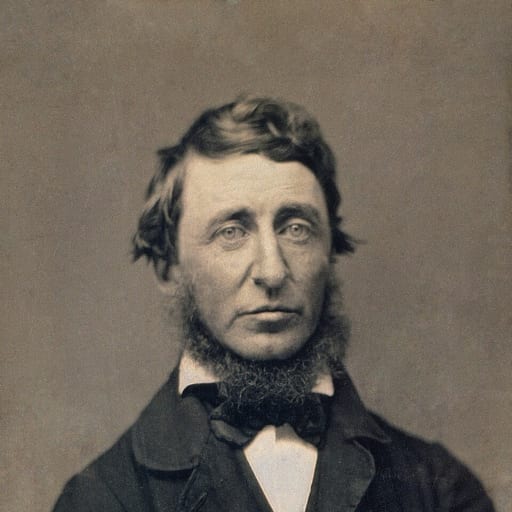
Henry David Thoreau

헨리 데이비드 소로

Author of Walden and Civil Disobedience

909 records in all

  • Principles 298
  • Episodes 287
  • Quotes 324
Ask with this master's words

3 free questions a day, no sign-up.

Photo: Benjamin D. Maxham active 1848 - 1858  Public domain  Original  cropped

Episodes

43 basic records of 287

Episodes are real events from public sources, summarised by us.

  • The Rejection of Trivial News

    Thoreau attempted to read one newspaper a week but found it distracting and detrimental to his connection with nature. He concluded that the mind should be a sacred space for thought rather than a public arena for gossip.

    LessonA founder must limit information intake to avoid 'lumbering' the mind with insignificant details that hinder deep work.
  • The Metaphor of the Shield

    Thoreau reflects on the sixth champion against Thebes who carried a solid brass shield with no device or logo on it. He chose this because his goal was to actually be just rather than merely appearing so to others.

    LessonFocus on the actual quality and utility of your work instead of spending energy on branding a false image.

  • The observation of the bugle

    Thoreau listened to the sound of a bugle in the stillness of the night. He observed how the sound seemed to reorder the stars and find a resonance in the entire heavens, changing his perception of the environment.

    LessonA single bold action or 'note' can harmonize a chaotic environment and establish a new order.

  • 1840Focus

    The Call to Action

    Thoreau reflected on the tendency of people to delay their true work and potential. He urged an immediate commitment to one's life mission, comparing it to a soldier taking his post at the sound of a signal gun.

    LessonDo not wait for the perfect moment to start your most important work; the signal to begin has already been given.

  • Canoeing Through Rough Waves

    During a lake crossing, the wind rose and waves began to swamp the canoe. The guide stood up and used his strength to time the movements so the canoe always hit the crest of the waves where their force was spent.

    LessonIn a crisis, active and precise steering is required to prevent being overwhelmed by external forces.

  • The Efficiency of Camp Division

    Thoreau and his companions divided camp duties into three roles: fire and food, woodcutting, and tent pitching. This specialization allowed them to have a hot meal ready within twenty minutes of landing.

    LessonClear role definition speeds up complex operations in high-pressure environments.

  • The Broken Log Bridge

    Thoreau and his companion encountered a ruined bridge made of logs tied with cedar bark. They had to find their own way across the stream as the bridge was the only evidence of a path.

    LessonWhen established systems fail, you must rely on your own resourcefulness to maintain your direction.

  • Navigating the Dammed Lakes

    While searching for the outlet of Chamberlain Lake, Thoreau found the natural shores destroyed by dams built to float timber. The water levels were raised, creating a belt of dead trees that made the shore nearly inaccessible.

    LessonShort-term industrial gains can create long-term obstacles and destroy the natural infrastructure of a region.

  • The High Cost of Wilderness Sugar

    Thoreau ran out of sugar because his guide used it heavily in coffee. He had to buy more at a remote farm where they charged a premium price due to the difficulty of getting supplies there.

    LessonScarcity and logistics justify higher margins in remote or niche markets.

  • Navigating the Stormy Lake

    Faced with a violent storm and a harborless shore, the group decided to keep coasting rather than risk landing among submerged trees. They pushed through the twilight to reach a safe clearing before the next storm hit.

    LessonSometimes the safest path is to keep moving forward through a difficult situation rather than stopping in a dangerous spot.

  • The Encounter with Daniel Webster

    The guide recounted a visit to Daniel Webster in Boston where he was treated rudely and ignored for a long time. When Webster finally approached, he was gruff and dismissive, leading the guide to lose all respect for him.

    LessonArrogance and poor treatment of others can permanently damage your reputation and brand, regardless of your professional success.

  • The Moose Hide Business

    Polis, the guide, killed a moose and immediately began processing the hide. He explained that his wealth came from his speed and skill, sometimes killing ten moose in a day and earning high wages for the processed skins.

    LessonTrue wealth often comes from mastering a specific, labor-intensive niche that others cannot do as quickly.

  • The Rejection of Economic Dogma

    Thoreau and his circle viewed economic theories like supply and demand as temporary rather than perpetual laws. They believed that a poet's intuition could see through the limitations of a 'banker's mind' in political economy.

    LessonDo not let rigid economic formulas limit your understanding of value and human potential.

  • Thoreau's Definition of True Hunger

    Thoreau observed that Emerson's work was a courageous attempt to satisfy a deep, lifelong spiritual hunger rather than merely pleasing the immediate palate. He valued the pursuit of profound truths over easy, superficial satisfaction.

    LessonFocus your product or service on solving deep, fundamental needs rather than chasing fleeting trends.

  • The Gift of the Spinet-Piano

    Sophia Thoreau gave a small spinet-piano to the Alcott children. This instrument became a central part of their home life, where they practiced classical music and found joy despite their lack of material wealth.

    LessonSimple tools and shared resources can foster a culture of creativity and high-level skill development.

  • The Contrast of Emerson and Poe

    Thoreau observes that Emerson's work is almost entirely composed of 'substance,' while Poe's work focuses on 'manner.' He concludes that Emerson's value is higher because substance represents a more profound spiritual reality and optimism.

    LessonA product's long-term impact depends more on its underlying truth and spirit than on its stylistic execution.

  • The Most Delivered Lecture

    Thoreau first delivered his lecture 'Walking' at the Concord Lyceum in 1851. He went on to read this specific piece ten times, which was more frequent than any of his other presentations.

    LessonRepetition and refinement of a core message can turn a simple observation into a signature philosophy.

You are seeing 137 basic records. Membership answers from all 909 of this master's records.

See membership

More masters in this field

See the whole field

Philosophy and wisdom traditions

These records are our compilation of public statements and sources. We are not affiliated with or endorsed by Henry David Thoreau or any related company. If something should come down, tell us. Takedown request form