Hall of Masters

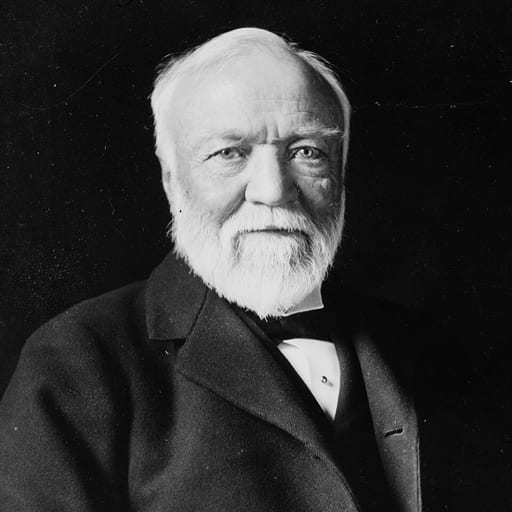
Andrew Carnegie

앤드루 카네기

Steel industrialist and philanthropist; author of The Gospel of Wealth

1,019 records in all

  • Principles 330
  • Episodes 309
  • Quotes 380
Ask with this master's words

3 free questions a day, no sign-up.

Photo: Theodore C. Marceau  Public domain  Original  cropped

Episodes

46 basic records of 309

Episodes are real events from public sources, summarised by us.

  • The Kettle Observation

    As a young boy, James Watt sat for an hour silently watching steam lift the lid of a tea kettle and condense into drops. His aunt scolded him for being idle, not realizing he was studying the physical properties of steam.

    LessonWhat looks like wasting time can actually be the deep observation required for a breakthrough.

  • The Gift of Tools

    Watt's father provided him with a set of small tools and access to a workshop among professional workmen. This allowed the boy to develop extraordinary manual dexterity and build complex models that amazed experienced laborers.

    LessonProviding the right tools and environment early on allows natural talent to flourish into professional mastery.

  • The Journey to London

    Recognizing that Glasgow lacked advanced training, Professor Dick advised Watt to go to London. Watt traveled twelve days on horseback to seek better instruction and opportunities.

    LessonBe willing to travel to the center of your industry to find the best possible instruction.

  • The University's Protection

    When the guilds blocked Watt, Glasgow University used its ancient charter to grant him a workshop within its walls. The professors recognized his superior skill from a previous repair job and provided him the shelter needed to continue his work.

    LessonWhen traditional markets are closed, seeking institutional partners who value skill over credentials can save a career.

  • The Necessity of Pot-Boilers

    Watt's high-end scientific instruments sold slowly because ships could not reach Glasgow at the time. To survive, he pivoted to making and repairing common items like fiddles, flutes, and fishing tackle.

    LessonPracticality and cash flow are necessary to sustain a genius while they work on bigger innovations.

  • The First Steam Engine Model

    Watt rented an old cellar to build a working model of his invention. He struggled to find capable mechanics, as only clumsy blacksmiths were available, but he labored for six months to ensure the construction was as perfect as possible.

    LessonExecution is often harder than planning, especially when the required infrastructure or skill does not yet exist.

  • Learning German for Research

    Watt found a vital book on mine-working methods, but it was written in German, which he did not know. Despite being in a state of despair, he immediately hired a tutor and mastered both the language and the book's contents.

    LessonA true founder removes any barrier to necessary knowledge, including learning an entire language if required.

  • Boulton's Ethical Restraint

    Before they were partners, Boulton stopped working on his own pumping engine because he didn't want to use ideas he learned from a conversation with Watt without his consent. He believed it would not be right to profit from another's knowledge without a formal agreement.

    LessonHigh ethical standards and a sense of honor build the reputation necessary to lead in industry.

  • The Bow Engine Failure

    An engine sent to London failed because the operator got drunk and broke the delicate valves. Watt had to personally travel to London to fix the defects and protect the company's reputation.

    LessonComplex products require not just good design, but also highly trained and disciplined operators.

  • 1779Cash

    Boulton's Financial Sacrifice

    매튜 볼턴은 회사의 자금난을 해결하기 위해 아내에게 물려받은 부동산과 아버지의 재산 대부분을 매각하고 나머지는 담보로 잡혔어요. 그는 너무 많은 사업을 벌여 자원이 분산된 상태였지만, 이 자금을 통해 파트너인 와트의 연구와 회사를 지탱했어요.

    LessonFounders must sometimes risk their personal assets to keep a high-potential venture alive during lean years.

  • Humphrey Potter's Automatic Valves

    A boy named Humphrey Potter was hired to manually turn stop cocks on a Newcomen engine. To get time to play, he tied cords from the engine's moving beam to the cocks so they would open and shut automatically.

    LessonThe desire to escape drudgery can lead to the creation of labor-saving automation.

  • 1802Life

    Watt's Scientific Retirement

    In his old age, Watt focused on scientific pursuits in his garret and traveled extensively. He purchased and improved a beautiful property in Wales, finding joy in nature and gardening.

    LessonTrue success includes the ability to transition from work to personal passions and nature gracefully.

  • 1816Wealth

    Greenock Scientific Library Donation

    Watt donated funds to his hometown of Greenock to start a scientific library for young people. He hoped this would inspire others to contribute and help his townsmen become eminent in knowledge.

    LessonInvesting in local infrastructure for learning creates a lasting legacy of enterprise and knowledge.

  • The Deacon's Failed Oration

    A deacon was chosen to present a robe to a minister but forgot his long, prepared speech due to nerves. He simply said, 'Mr. Broon, Here's the goon,' which Carnegie noted was likely better than the original.

    LessonWhen under pressure, simple and direct communication is more effective than struggling with complex plans.

  • The Blenheim Library Auction

    While visiting the magnificent library at Blenheim Palace, Carnegie learned that its treasures had been sold at auction. He viewed this as a sign of the degeneracy of hereditary rank and the failure of heirs to protect cultural legacies.

    LessonHereditary privilege does not guarantee the stewardship of valuable assets or values.

  • Vision for an American Art Record

    Andrew Carnegie conceived the idea of a museum to document the progress of pictorial art in America. He wanted to create a lasting record of how art was evolving in the United States.

    LessonA clear long-term vision helps define the purpose and scope of a major project from the start.

  • 1899Brand

    Discovery of Diplodocus carnegii

    The museum's scientists unearthed a major dinosaur fossil that was later named after Carnegie himself. This discovery brought significant international prominence to the institution.

    LessonInvesting in top-tier talent and research can lead to breakthrough discoveries that define a brand.

  • 1848Career

    First Job in America

    12세의 나이에 미국으로 이민 온 카네기는 면직물 공장에서 보빈 보이로 일하기 시작했어요. 주당 1.20달러를 받으며 하루 12시간씩 주 6일을 일하는 고된 노동이었어요.

    Lesson가장 낮은 곳에서 시작하는 고된 경험이 미래의 성공을 위한 회복탄력성을 길러줄 수 있어요.

  • Acquisition of Homestead Steel Works

    카네기는 경쟁사였던 홈스테드 제강소를 인수하여 생산 시설뿐만 아니라 석탄, 철광석 산지, 철도, 증기선까지 확보했어요. 이를 통해 원자재 공급부터 운송까지 수직 계열화를 완성했어요.

    Lesson공급망 전체를 소유하면 비용을 통제하고 경쟁 우위를 점할 수 있어요.

  • Formation of Carnegie Steel Company

    카네기는 1892년에 자신과 동업자들의 흩어져 있던 자산들을 통합하여 카네기 철강 회사를 출범시켰어요. 이 회사는 세계 최대 규모의 선철, 강철 레일, 코크스 생산 능력을 갖추게 되었어요.

    Lesson분산된 자산을 하나로 통합하면 운영 효율성을 극대화하고 시장 지배력을 강화할 수 있어요.

You are seeing 153 basic records. Membership answers from all 1,019 of this master's records.

See membership

More masters in this field

See the whole field

Founders and company builders

These records are our compilation of public statements and sources. We are not affiliated with or endorsed by Andrew Carnegie or any related company. If something should come down, tell us. Takedown request form