Hall of Masters

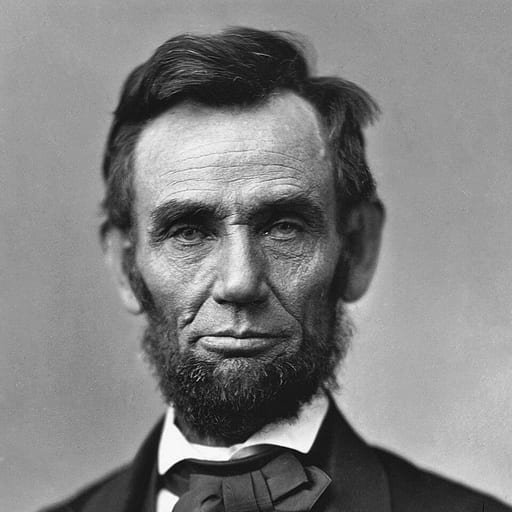
Abraham Lincoln

에이브러햄 링컨

16th US president; led the Union through the Civil War

990 records in all

  • Principles 338
  • Episodes 201
  • Quotes 451
Ask with this master's words

3 free questions a day, no sign-up.

Photo: Alexander Gardner  Public domain  Original  cropped

Episodes

30 basic records of 201

Episodes are real events from public sources, summarised by us.

  • 1864Hiring

    The Blair Resignation Dispute

    Congress questioned the military status of Frank Blair, who had resigned to join the House but was later reinstated to command a corps. Lincoln provided a detailed timeline of verbal agreements and formal orders to maintain transparency with the legislature.

    LessonClear documentation and transparency are essential when handling complex personnel transitions that involve multiple stakeholders.
  • Revoking Family Privilege

    Lincoln's sister-in-law, Emily T. Helm, used a protection paper he gave her to avoid arrest for disloyal acts. Lincoln immediately informed General Burbridge that the paper was not a license for misconduct and instructed him to treat her like anyone else.

    LessonLeaders must ensure that personal relationships do not exempt individuals from the standard rules of the organization.

  • 1854Brand

    The Springfield Forgery

    In 1854, a set of radical resolutions was falsely attributed to Lincoln to damage his reputation. The editor of the State Register and two politicians were implicated in substituting genuine convention proceedings with fraudulent ones.

    LessonFounders must be vigilant against competitors who use fabricated data or false associations to damage a brand's market position.

  • The Lecompton Constitution Debate

    Lincoln challenged Judge Douglas's claim of being the primary force behind defeating the Lecompton Constitution. He pointed out that while Douglas provided three votes, the Republicans provided twenty, making the victory a collective effort rather than a solo one.

    LessonIn business, ensure your brand's contribution to a market shift is recognized so competitors don't monopolize the narrative.

  • The Challenge of Successor Ambition

    Lincoln reflected on how the founding generation found glory in building the country, but warned that future leaders would not be satisfied just maintaining it. He predicted that a 'towering genius' would eventually try to overturn the system to gain personal distinction.

    LessonLeaders must build systems robust enough to withstand the disruptive ambitions of talented successors.

  • 1855Career

    Self-Taught Success

    Lincoln shared that he did not study law under a mentor in a large city. Instead, he read and studied law books on his own while living in New Salem, a small town of fewer than three hundred people.

    LessonFounders do not need elite environments to master a craft if they have the books and the resolve to understand them.

  • 1860Brand

    The Cooper Union Address

    Lincoln delivered a powerful speech in New York to define the Republican position on slavery. He argued that the founding fathers intended for the federal government to prohibit slavery in new territories.

    LessonA leader must use historical precedents and clear logic to frame their arguments and win over a skeptical audience.

  • 1860Focus

    The Republican Party's Focus

    Lincoln acknowledged that while many administrative tasks like tariffs and land management were important, the issue of slavery had become so overwhelming that no other national question could get a hearing. He argued that the party must first address this central conflict before it could attend to general 'national housekeeping.'

    LessonA leader must identify and resolve the one primary obstacle that blocks all other progress.

  • Refusing Personal Worship

    When a man attempted to kneel before him in Richmond, Lincoln immediately stopped him. He insisted that the man should only kneel to God and that he was merely an instrument of liberty.

    LessonTrue leaders maintain humility and ensure that the focus remains on the principles of liberty rather than their own person.

  • 1861Team

    The Secession Precedent Warning

    Lincoln warned that if a minority chooses to secede whenever they lose a vote, they create a precedent that will eventually destroy their own new organization. He argued that a new confederacy would soon face its own internal secessions for the same reasons.

    LessonAllowing team members to quit or bypass rules whenever they disagree sets a cultural precedent that leads to total organizational collapse.

  • The Struggle Against Douglas

    Lincoln analyzed Judge Douglas's tactic of attacking only the leaders of the Republican party to win over the rank-and-file members. He warned his supporters that endorsing Douglas would effectively 'harness' them to the opposition's agenda.

    LessonBe wary of competitors who try to divide your team by praising the staff while attacking the leadership.

  • Replacing Inefficient Leadership

    After reports of inefficiency and profiteering in the War Department, Lincoln replaced Simon Cameron with Edwin Stanton. Stanton proved to be a highly effective partner, and the two worked closely together to conduct the war effort.

    LessonAddress management failures quickly by replacing ineffective leaders with those who possess high operational discipline.

  • Fighting Fraud with Incentives

    링컨은 전쟁 중 발생하는 사기 행위를 막기 위해 부정청구방지법(False Claims Act)에 서명했어요. 이 법은 민간인이 정부를 대신해 소송을 제기하고 회수금의 일부를 보상으로 받을 수 있게 하여 시민들을 감시자로 활용했어요.

    LessonCreate systems where private interests align with organizational integrity to effectively police misconduct.

You are seeing 149 basic records. Membership answers from all 990 of this master's records.

See membership

More masters in this field

See the whole field

Leaders in history and crisis

These records are our compilation of public statements and sources. We are not affiliated with or endorsed by Abraham Lincoln or any related company. If something should come down, tell us. Takedown request form