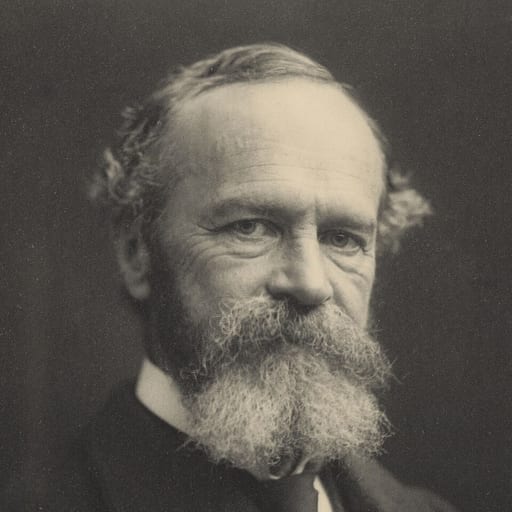
William James
윌리엄 제임스
Psychologist and pragmatist philosopher who wrote on habit
1,168 records in all
- Principles 407
- Episodes 213
- Quotes 548
3 free questions a day, no sign-up.
Photo: Notman Studios (photographer) Public domain Original cropped
Quotes
82 basic records of 548
Quotes are word for word from the source.
Practicality of Concepts
The function of concepts is practical rather than theoretical
Our noteJames argues that ideas should be tools for action rather than just abstract theories.
Character drives vision
A philosophy is the expression of a man's intimate character, and all definitions of the universe are but the deliberately adopted reactions of human characters upon it.
Our noteJames explains that our fundamental outlook is shaped more by our character than by abstract logic.
The Each Form
Think of the universe as existing solely in the each-form, and you will have on the whole a more reasonable and satisfactory idea of it than if you insist on the all-form being necessary.
Our noteJames argues that viewing the world as a collection of individual parts is more practical than monism.
Trusting direct experience
May not the flux of sensible experience itself contain a rationality that has been overlooked, so that the real remedy would consist in harking back to it more intelligently
Our noteHe suggests that truth is found in raw experience rather than abstract conceptual substitutes.
Degrees of coherence
There are surely degrees in rationality that might be discriminated and described. Things can be consistent or coherent in very diverse ways.
Our noteHe criticizes the idea that something must be either perfectly rational or completely irrational.
Independence of parts
The absolute as such has _objects_, not constituents, and if the objects develop selfhoods upon their own several accounts, those selfhoods must be set down as facts additional to the absolute consciousness
Our noteJames explains that individual entities should be viewed as additional facts, not just parts of a whole.
Ambition in learning
To a mind content with little, the much in the universe may always remain hid.
Our noteHe warns that a lack of intellectual or practical curiosity prevents one from seeing the full picture.
Individual components
In the physical world taken by itself there _is_ thus no 'all,' there are only the 'eaches'--at least that is the 'scientific' view.
Our noteHe distinguishes between physical groupings and mental realizations of a whole.
Enduring truths
What won't stay buried must have some genuine life.
Our noteHe argues that ideas that persist despite criticism contain essential value.
The inner crisis
The resolve to turn the deaf ear is the inner crisis or 'catastrophe' of which M. Bergson's disciple whom I lately quoted spoke.
Our noteJames discusses the difficulty of ignoring traditional logic to embrace raw experience.
Unlearning for reality
It is putting off our proud maturity of mind and becoming again as foolish little children in the eyes of reason.
Our noteHe describes the humility required to perceive reality beyond abstract concepts.
Limited Human Perspective
We may be in the universe as dogs and cats are in our libraries, seeing the books and hearing the conversation, but having no inkling of the meaning of it all.
Our noteJames uses an analogy to explain that humans may only perceive a fraction of reality.
Flexibility in connections
Without losing its identity a thing can either take up or drop another thing, like the log I spoke of, which by taking up new carriers and dropping old ones can travel anywhere with a light escort.
Our noteJames explains how pluralism allows for changing relationships without losing core identity.
Practical analysis
The naturalist answer is that the environment kills as well as sustains us, and that the tendency of raw experience to extinguish the experient himself is lessened just in the degree in which the elements in it that have a practical bearing upon life are analyzed out
Our noteJames explains why we must intellectualize raw experience to survive and react effectively.
Test of truth
Only in so far as they lead us, successfully or unsuccessfully, into sensible experience again, are our abstracts and universals true or false at all.
Our notePragmatism defines truth by how well an idea leads back into practical experience.
Professional duty
The academic career also has its heroic obligations, so I stand here without further deprecatory words.
Our noteJames overcomes his hesitation to lecture in Edinburgh by viewing it as a duty.
Criteria for value
When we think certain states of mind superior to others, is it ever because of what we know concerning their organic antecedents? No! it is always for two entirely different reasons.
Our noteJames explains that we judge ideas by their results, not their biological causes.
Holistic Understanding
To understand a thing rightly we need to see it both out of its environment and in it, and to have acquaintance with the whole range of its variations.
Our noteJames explains why studying extreme or unusual cases helps us understand normal phenomena.
Defining total reaction
Religion, whatever it is, is a man's total reaction upon life, so why not say that any total reaction upon life is a religion?
Our noteJames defines religion as a person's fundamental attitude toward existence.
Deep perspective
To get at them you must go behind the foreground of existence and reach down to that curious sense of the whole residual cosmos as an everlasting presence
Our noteThe author describes looking past daily tasks to understand one's core worldview.
Inevitability of failure
But the athletic attitude tends ever to break down, and it inevitably does break down even in the most stalwart when the organism begins to decay
Our noteJames warns that pure willpower is an unsustainable strategy for long-term resilience.
Nature of reality
the feeling of reality may be something more like a sensation than an intellectual operation properly so‐called.
Our noteJames discusses how the sense of reality functions as a direct perception rather than a logical conclusion.
Belief before logic
Our impulsive belief is here always what sets up the original body of truth, and our articulately verbalized philosophy is but its showy translation into formulas.
Our noteJames describes how intellectual frameworks are often just secondary justifications for primary internal feelings.
Internal chaos
The higher and the lower feelings, the useful and the erring impulses, begin by being a comparative chaos within us
Our noteHe explains that everyone starts with a disorganized set of competing desires and values.
Actual vs Ideal
The man's interior is a battle‐ground for what he feels to be two deadly hostile selves, one actual, the other ideal.
Our noteHe describes the psychological tension between who we are and who we want to be.
The subconscious reservoir
Our whole past store of memories floats beyond this margin, ready at a touch to come in; and the entire mass of residual powers, impulses, and knowledges that constitute our empirical self stretches continuously beyond it.
Our noteJames describes how our past experiences and hidden powers exist just outside our immediate focus.
Inevitability of relapse
Men lapse from every level - we need no statistics to tell us that.
Our noteJames acknowledges that people often fail to maintain their highest standards.
The drive for correctness
The concrete man has but one interest - to be right. That to him is the art of all arts, and all means are fair which help him to it.
Our noteExploring the fundamental human desire to be correct in one's opinions and actions.
Importance of forgetting
In the practical use of our intellect, forgetting is as important a function as recollecting.
Our noteHe argues that selective memory is essential for efficient thinking.
Self-worth and action
So our self-feeling in this world depends entirely on what we back ourselves to be and do.
Our noteJames links our sense of self to our chosen goals and commitments.
You are seeing 175 basic records. Membership answers from all 1,168 of this master's records.
See membershipMore masters in this field
See the whole fieldMindset and resilience

These records are our compilation of public statements and sources. We are not affiliated with or endorsed by William James or any related company. If something should come down, tell us. Takedown request form