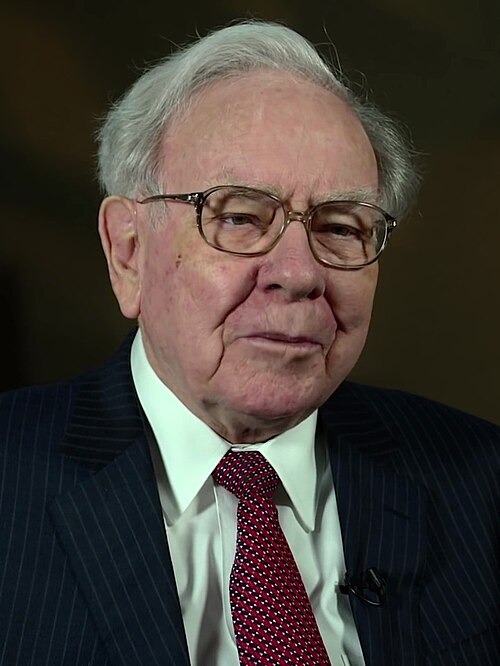
Warren Buffett
워런 버핏
Longtime leader of Berkshire Hathaway who practiced long-term compounding by investing within his circle of competence in businesses with durable economic moats and margins of safety.
1,409 records in all
- Principles 389
- Episodes 279
- Quotes 741
3 free questions a day, no sign-up.
Photo: USA International Trade Administration Public domain Original cropped
Quotes
111 basic records of 741
Quotes are word for word from the source.
Evaluating Long-term Performance
While we believe it is improper to include capital gains or losses in evaluating the performance of a single year, they are an important component of the longer term record.
Our noteHe distinguishes between annual operating earnings and the long-term impact of capital gains.
Investment criteria
We get excited enough to commit a big percentage of insurance company net worth to equities only when we find (1) businesses we can understand, (2) with favorable long-term prospects, (3) operated by honest and competent people, and (4) priced very attractively.
Our noteBuffett outlines the four essential requirements for making a significant equity investment.
Survival over returns
That reduces our returns in 99 years out of 100. But we will survive in the 100 th while many others fail.
Our noteThe rationale behind maintaining high cash levels despite lower short-term returns.
Difficulty of Inactivity
We try to avoid compromise of these standards, although we find doing nothing the most difficult task of all.
Our noteBuffett reflects on the discipline required to wait for the right investment opportunity.
Market Convergence
If we are correct in expectations regarding the business, the market eventually will follow along.
Our noteDiscussing how market value eventually reflects the true value of a company.
Businesslike Investing
Investment is most intelligent when it is most businesslike.
Our noteBuffett quotes Ben Graham to emphasize that investing should follow sound business principles.
Conventional Failure Risk
Failing conventionally is the route to go; as a group, lemmings may have a rotten image, but no individual lemming has ever received bad press.
Our noteBuffett explains why most managers avoid unconventional decisions to protect their careers.
Long term vision
I try to look out ten or twenty years when making an acquisition, but sometimes my eyesight has been poor.
Our noteBuffett discusses his long-term approach to buying businesses and admits his forecasting isn't perfect.
Stock Market Advantage
The businesses we are offered by the stock market every day - in small pieces, to be sure - are often far more attractive than the businesses we are concurrently being offered in their entirety.
Our noteBuffett explains why buying common stocks is a strategic alternative to full acquisitions.
Ownership mindset
Buy into a company because you want to own it, not because you want the stock to go up.
Our noteBuffett emphasizes the importance of long-term business ownership over short-term stock speculation.
The burden of possessions
Too often, a vast collection of possessions ends up possessing its owner.
Our noteBuffett reflects on why he prefers a simpler life despite his immense wealth.
Avoiding complacency
The biggest thing that kills them is complacency. ... The danger would always be that you rest on your laurels.
Our noteWarren Buffett talked about why businesses fail.
Competitive Advantage
There's a reason NetJets is the runaway leader: It offers the ultimate in safety and service.
Our noteBuffett explains why NetJets dominates the fractional aircraft ownership market.
Emotional decision making
I bristled at Stanton's behavior and didn't tender. That was a monumentally stupid decision.
Our noteWarren Buffett reflects on his emotional reaction to a CEO lowering an agreed-upon price.
Timing of gains
Security profits in a given year bear similarities to a college graduation ceremony in which the knowledge gained over four years is recognized on a day when nothing further is learned.
Our noteBuffett explains why reported annual capital gains don't reflect that year's actual performance.
Long Term Alignment
We feel the long-term economic prospects for these businesses - and, thus, for ourselves as owners - are enhanced by the arrangements.
Our noteBuffett discusses why he voluntarily restricted his voting rights to support management.
Source of profits
The reason media businesses have been so outstanding in the past was not physical growth, but rather the unusual pricing power that most participants wielded.
Our noteAnalyzing why the media industry's economic dominance was beginning to erode.
Limits of History
Beware of past-performance "proofs" in finance: If history books were the key to riches, the Forbes 400 would consist of librarians.
Our noteHe cautions against relying solely on historical data to predict future financial success.
Executive compensation accounting
Many corporations have been able to reduce their overhead expenses substantially by paying a large part of their executive salaries in the form of options to buy stock, which carry no charge against earnings.
Our noteBuffett is satirically describing how companies use stock options to hide real compensation costs from their earnings.
Direct Shareholder Communication
To build a compatible shareholder population, we try to communicate with our owners directly and informatively.
Our noteBuffett explains their philosophy on investor relations and avoiding media sound-bites.
Options as expense
If options aren't a form of compensation, what are they? If compensation isn't an expense, what is it?
Our noteBuffett summarizes the simple reality that stock options are a business expense.
You are seeing 211 basic records. Membership answers from all 1,409 of this master's records.
See membershipMore masters in this field
See the whole fieldInvesting and capital allocation

These records are our compilation of public statements and sources. We are not affiliated with or endorsed by Warren Buffett or any related company. If something should come down, tell us. Takedown request form