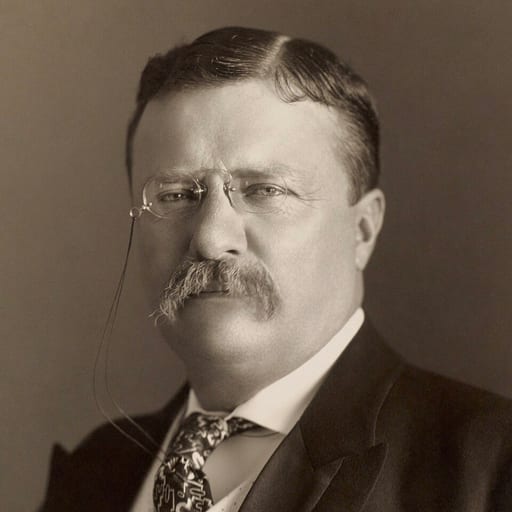
Theodore Roosevelt
시어도어 루스벨트
26th US president; author of The Strenuous Life
1,147 records in all
- Principles 361
- Episodes 266
- Quotes 520
3 free questions a day, no sign-up.
Photo: Pach Brothers; restored by Adam Cuerden Public domain Original cropped
Quotes
78 basic records of 520
Quotes are word for word from the source.
Individual Character
Nothing can take the place of this individual factor.
Our noteRoosevelt emphasizes that character is the chief factor in a man's success or failure.
Strength and civility
If a man continually blusters, if he lacks civility, a big stick will not save him from trouble; and neither will speaking softly avail, if back of the softness there does not lie strength, power.
Our noteHe explained why both polite speech and actual power are necessary for success.
Integrity in action
Let us further make it evident that we use no words which we are not prepared to back up with deeds, and that while our speech is always moderate, we are ready and willing to make it good.
Our noteRoosevelt emphasized the need for consistency between a leader's words and their actions.
Resilience after failure
We shall make mistakes; and if we let these mistakes frighten us from our work we shall show ourselves weaklings.
Our noteHe spoke about the inevitability of errors when performing great tasks.
Efficiency in justice
We must show that the law is adequate to deal with crime by freeing it from every vestige of technicality and delay.
Our noteAdvocating for legal reforms to prevent excuses for vigilante violence.
Happiness through duty
Happiness can not come to any man capable of enjoying true happiness unless it comes as the sequel to duty well and honestly done.
Our noteHe addressed the relationship between fulfilling one's duty and achieving true happiness.
Honesty and efficiency
Be honest, and remember that honesty counts for nothing unless back of it lie courage and efficiency.
Our noteHe emphasized that moral virtues must be paired with practical competence to be effective.
Protecting brand value
Any use which tends to cheapen it, and, above all, any use which tends to secure its being treated in a spirit of levity, is free from every standpoint profoundly to be regretted.
Our noteHe explains why putting a sacred motto on common coins cheapens its meaning.
Future oriented thinking
neither man nor nation can prosper unless, in dealing with the present, thought is steadily taken for the future.
Our noteDiscussing rural life and conservation policies in an article.
Dangers of soft living
The things that will destroy America are prosperity-at-any-price, peace-at-any-price, safety-first instead of duty-first, the love of soft living and the get-rich-quick theory of life.
Our noteSpeaking in Oyster Bay about the virtues that sustain a nation.
Rejecting cynicism
There is no more unhealthy being, no man less worthy of respect, than he who either really holds, or feigns to hold, an attitude of sneering disbelief toward all that is great and lofty
Our noteWarning against the temptation of intellectual aloofness and cynicism.
Human rights priority
human rights must have the upper hand, for property belongs to man and not man to property.
Our noteDiscussing the relationship between property rights and human rights.
Regulating industry combinations
The way out lies, not in attempting to prevent such combinations, but in completely controlling them in the interest of the public welfare.
Our noteAcknowledging that industrial combinations are inevitable but must be regulated.
Sustainable development
Conservation means development as much as it does protection.
Our noteExplaining that resources should be used wisely, not just locked away.
Power of self-help
The collective power of the State can help; but it is the individual's own power of self-help which is most important.
Our noteEmphasizing individual responsibility alongside government action.
Avoid destructive visionaries
The agitator who preaches hatred and practices slander and untruthfulness, and the visionary who promises perfection and accomplishes only destruction, are the worst enemies of reform
Our noteWarning against extreme rhetoric and unrealistic promises in business and social reform.
Necessity of Corporations
Corporations are necessary to the effective use of the forces of production and commerce under modern conditions. We cannot effectively prohibit all combinations without doing far-reaching economic harm; and it is mere folly to do as we have done in the past
Our noteHe explains why large business combinations are an economic reality.
Evils of Overcapitalization
Overcapitalization in all its shapes is one of the prime evils; for it is one of the most fruitful methods by which unscrupulous men get improper profits
Our noteHe warns against financial manipulation and improper profits.
Judging by conduct
True Americanism demands that we judge each man on his conduct, that we so judge him in private life and that we so judge him in public life.
Our noteRoosevelt emphasizes judging individuals based on their actions rather than their background.
Duty over rights
First and foremost let us all resolve that in this country hereafter we shall place far less emphasis upon the question of right and much greater emphasis upon the matter of duty.
Our noteHe explains the principles necessary to secure a strong national life.
Efficiency and patriotism
they and we shall understand that efficiency is as essential as patriotism; one is useless without the other.
Our noteHe discusses the need for organized infrastructure and patriotic duty in national defense.
Common language necessity
No man can be a good citizen if he is not at least in process of learning to speak the language of his fellow-citizens.
Our noteEmphasizing the importance of a shared language for national unity and individual success.
Purpose over comfort
Our aim must be, not to make life easy and soft, not to soften soul and body, but to fit us in virile fashion to do a great work for all mankind.
Our noteRoosevelt spoke about the national character and the need for a strong, active citizenry.
Innovation versus tradition
Just so far as this mediæval element obtained, the movement failed. All that there was of good and of permanence in it was due to the new elements.
Our noteHe argues that the success of the English revolution came from its forward-looking ideas, not old ones.
Avoiding extremes
Between the Scylla of despotism and the Charybdis of anarchy there is but little to choose; and the pilot who throws the ship upon one is as blameworthy as he who throws it on the other.
Our noteRoosevelt warns against the dangers of both absolute power and total chaos.
Principles vs Specifics
Cromwell was far more concerned in righting specific cases of oppression than in advancing the great principles of constitutional government which alone make possible that orderly liberty which is the bar to such individual acts of wrong-doing.
Our noteRoosevelt critiques focusing on individual problems rather than the systemic principles that prevent them.
Dangers of impatience
He was too impatient to found the kind of legal and constitutional system which could alone prevent the recurrence of such evils.
Our noteRoosevelt critiques the failure to build lasting systems due to a desire for quick results.
Optimizing core assets
He soon saw that the true weapon of the cavalryman was the horse; and, discarding the carbines with which his troop had first been armed, he taught them to rely upon the shock of a charging, close-knit mass
Our noteRoosevelt describes how Cromwell pivoted from firearms to the physical momentum of horses.
Trusting the process
Unlike Cromwell, he saw that the safety of the people lay in working out their own salvation, even though they showed much wrong-headedness and blindness, not merely to morality, but to their own interests
Our noteRoosevelt compares George Washington's trust in the people to Cromwell's desire for control.
Achieving Permanent Results
in the long run a man can do nothing of permanence, save by joining his zeal to sound judgment, moderation, and the desire to accomplish practical results.
Our noteThe essential qualities needed to make a lasting impact in leadership.
You are seeing 172 basic records. Membership answers from all 1,147 of this master's records.
See membershipMore masters in this field
See the whole fieldLeaders in history and crisis
These records are our compilation of public statements and sources. We are not affiliated with or endorsed by Theodore Roosevelt or any related company. If something should come down, tell us. Takedown request form