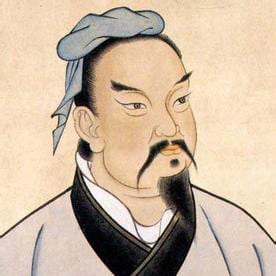
Sun Tzu
손자
Chinese general, traditional author of The Art of War
565 records in all
- Principles 212
- Episodes 101
- Quotes 252
3 free questions a day, no sign-up.
Photo: Unknown author Public domain Original cropped
Quotes
38 basic records of 252
Quotes are word for word from the source.
Purpose of force
Military weapons are the means used by the Sage to punish violence and cruelty, to give peace to troublous times, to remove difficulties and dangers, and to succour those who are in peril.
Our noteSsŭ-ma Ch'ien explains that military strength is a necessary tool for restoring order and protecting the vulnerable.
Psychological Warfare
Pretend to be weak, that he may grow arrogant.
Our noteManipulating the opponent's ego to create strategic openings.
Preserve value
the best thing of all is to take the enemy's country whole and intact; to shatter and destroy it is not so good.
Our noteWinning without destroying the market or the asset is the highest form of success.
Unified team spirit
He will win whose army is animated by the same spirit throughout all its ranks.
Our noteThe importance of alignment and shared vision within an organization.
Control and opportunity
To secure ourselves against defeat lies in our own hands, but the opportunity of defeating the enemy is provided by the enemy himself.
Our noteInternal discipline prevents failure, while external market gaps provide victory.
Winning with ease
What the ancients called a clever fighter is one who not only wins, but excels in winning with ease.
Our noteThe highest skill is winning without struggle by preparing so well that the result is inevitable.
Invincible positioning
Hence the skilful fighter puts himself into a position which makes defeat impossible, and does not miss the moment for defeating the enemy.
Our noteSuccess comes from securing your own position first so that you cannot lose.
Controlling Enemy Movement
Thus one who is skilful at keeping the enemy on the move maintains deceitful appearances, according to which the enemy will act.
Our noteStrategic deception forces the opponent to react based on the appearances you create.
First Mover Advantage
Whoever is first in the field and awaits the coming of the enemy, will be fresh for the fight
Our noteBeing early to a market or situation allows you to be prepared and rested.
Neutralizing superior rivals
Though the enemy be stronger in numbers, we may prevent him from fighting.
Our noteSun Tzu asserts that strategy can overcome a competitor's superior resources.
Visible tactics hidden strategy
All men can see the tactics whereby I conquer, but what none can see is the strategy out of which victory is evolved.
Our noteSun Tzu explains that while individual moves are obvious, the underlying plan remains invisible to others.
Avoid strength hit weakness
So in war, the way is to avoid what is strong and to strike at what is weak.
Our noteThis is the fundamental rule of engagement: focus resources where the opponent is most vulnerable.
Importance of logistics
We may take it then that an army without its baggage-train is lost; without provisions it is lost; without bases of supply it is lost.
Our noteThe necessity of having a solid infrastructure and resources before taking action.
Strategic alliances
We cannot enter into alliances until we are acquainted with the designs of our neighbours.
Our noteThe importance of due diligence before entering into partnerships.
Strategic Exit Strategy
When you surround an army, leave an outlet free.
Our noteSun Tzu explains why cornering an opponent completely is dangerous.
Tempered expectations
If our expectation of advantage be tempered in this way, we may succeed in accomplishing the essential part of our schemes.
Our noteConsidering potential downsides helps ensure the primary objective is actually met.
Root of failure
When an army is overthrown and its leader slain, the cause will surely be found among these five dangerous faults.
Our noteSun Tzu identifies specific character flaws in leadership that lead to organizational ruin.
Divide and conquer
It will be best to let half the army get across, and then deliver your attack.
Our noteAttacking when the enemy is divided by a natural barrier increases the chance of victory.
Strategic Restraint
On dispersive ground, therefore, fight not. On facile ground, halt not. On contentious ground, attack not.
Our noteSun Tzu advises on what actions to avoid based on the specific environment.
Unified Command
Thus the skilful general conducts his army just as though he were leading a single man, willy-nilly, by the hand.
Our noteA leader should make the organization move as one cohesive unit with ease.
Commitment to Action
At the critical moment, the leader of an army acts like one who has climbed up a height and then kicks away the ladder behind him.
Our noteSun Tzu explains the necessity of making a decisive move that prevents retreat.
Unpredictable Leadership
焚舟破釜若驅羣羊而往驅而來莫知所之 He burns his boats and breaks his cooking-pots; Omitted in the _T'u Shu_. like a shepherd driving a flock of sheep, he drives his men this way and that, and none knows whither he is going.
Our noteA leader must maintain control and secrecy to ensure the team follows the path to victory.
Resource readiness
The material for raising fire should always be kept in readiness.
Our noteSuccess depends on having the necessary tools and materials before the opportunity arises.
Proactive action
If it is possible to make an assault with fire from without, do not wait for it to break out within, but deliver your attack at a favourable moment.
Our noteDon't wait for internal failure if you have the power to disrupt from the outside.
Benevolent management
They cannot be properly managed without benevolence and straightforwardness.
Our noteEffective leadership of secret agents requires a balance of kindness and integrity to ensure loyalty.
Strategic timing
In military matters, the Sage's rule is normally to keep the peace, and to move his forces only when occasion requires.
Our noteThe passage explains that force should only be used when absolutely necessary.
Logical Structure
the sayings are bound together in strict logical sequence, though this has been obscured by commentators who have probably failed to grasp their meaning.
Our noteOu-yang Hsiu explains that Sun Tzu's work is a systematic and logical whole.
Strategic anticipation
the highest form of generalship is to baulk the enemy's plans
Our notePreventing an opponent's move before it happens is better than reacting to it.
Signs of exhaustion
If the enemy sees an advantage to be gained and makes no effort to secure it, the soldiers are exhausted.
Our noteA lack of response to obvious opportunities reveals the internal weakness of a competitor.
Strategic restraint
Move not unless you see an advantage; use not your troops unless there is something to be gained; fight not unless the position is critical.
Our noteHe emphasizes that every action and conflict must serve a clear, advantageous purpose.
You are seeing 85 basic records. Membership answers from all 565 of this master's records.
See membershipMore masters in this field
See the whole fieldStrategy and mental models


These records are our compilation of public statements and sources. We are not affiliated with or endorsed by Sun Tzu or any related company. If something should come down, tell us. Takedown request form