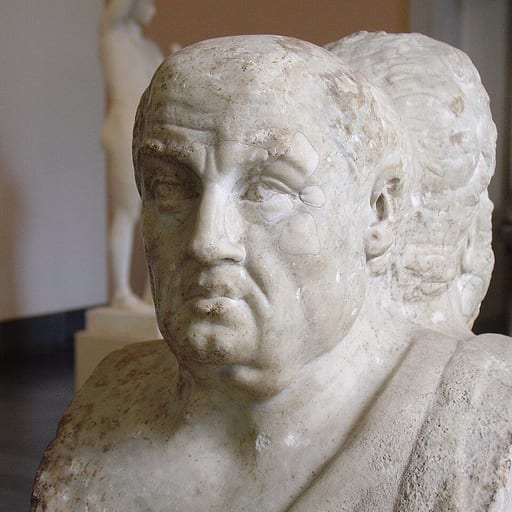
Seneca the Younger
세네카
Roman Stoic philosopher and statesman; Letters to Lucilius
1,047 records in all
- Principles 346
- Episodes 150
- Quotes 551
3 free questions a day, no sign-up.
Photo: Calidius CC BY-SA 3.0 Original cropped
Quotes
83 basic records of 551
Quotes are word for word from the source.
Anticipate the worst
That which has been long expected comes more gently.
Our noteHe explains that mental preparation reduces the impact of sudden setbacks.
Anxiety of guilt
crimes can be well guarded; free from anxiety they cannot be.
Our noteHe notes that even successful wrongdoers live in constant fear of being discovered.
Nature of guilt
But it is the property of guilt to be in fear.
Our noteSeneca defines the psychological state of someone who has compromised their integrity.
Avoid the crowd
To consort with the crowd is harmful; there is no person who does not make some vice attractive to us, or stamp it upon us, or taint us unconsciously therewith.
Our noteSeneca warns Lucilius about the corrupting influence of large groups of people.
Temporary ownership
Survey everything that lies about you, as if it were luggage in a guest-chamber: you must travel on.
Our noteSeneca reminds us that material possessions are temporary tools for a journey.
Power of examples
Consider how much we are helped by good example; you will thus understand that the presence of a noble man is of no less service than his memory.
Our noteSeneca emphasizes the lasting impact of role models on our behavior.
Ownership and freedom
We should belong to ourselves, if only these things did not belong to us.
Our noteSeneca reflects on how pursuing possessions can lead to a loss of personal freedom.
Productive solitude
my object in shutting myself up and locking the door is to be able to help a greater number. I never spend a day in idleness; I appropriate even a part of the night for study.
Our noteSeneca explains that his withdrawal from public life is actually a way to do more meaningful work.
Danger of complacency
What hinders us most of all is that we are too readily satisfied with ourselves
Our noteComplacency prevents growth and the pursuit of true excellence.
Flattery and ego
We agree with those who declare us to be the best and wisest of men, although we know that they are given to much lying.
Our noteThe risk of believing false praise instead of seeking honest feedback.
False paths to joy
if you expect to reach your goal while you are in the midst of riches and official titles, - in other words, if you seek joy in the midst of cares.
Our noteSeneca warns that external status and wealth often bring more anxiety than the actual joy people seek.
Self-sufficiency of virtue
Virtue suffers no space in us to be unoccupied; it takes possession of the whole soul and removes all sense of loss. It alone is sufficient; for the strength and beginnings of all goods exist in virtue herself.
Our noteSeneca explains how internal character provides resilience against the loss of external things like friends or family.
Security in self
That man is happiest, and is secure in his own possession of himself, who can await the morrow without apprehension.
Our noteHe explains that true security comes from being ready for life to end at any moment.
The nature of prosperity
Prosperity is a turbulent thing; it torments itself. It stirs the brain in more ways than one, goading men on to various aims, - some to power, and others to high living.
Our noteSeneca explains why constant pursuit of worldly success can be mentally exhausting.
Substance over popularity
Aristo [ 2 ] used to say that he preferred a youth of stern disposition to one who was a jolly fellow and agreeable to the crowd.
Our noteSeneca discusses why a serious, focused character is better for long-term growth than being a people-pleaser.
Integrity of character
Believe me, it is a great rôle - to play the rôle of one man.
Our noteSeneca argues that most people constantly change their masks instead of being one person.
Defining value
That which the good man alone can possess, is a Good
Our noteSeneca defines true goods by their exclusivity to virtuous character.
Action over words
Why then do you occupy me with the words rather than with the works of wisdom?
Our noteSeneca demands practical results from learning rather than mere semantic debates.
Power of contentment
To have whatsoever he wishes is in no man's power; it is in his power not to wish for what he has not, but cheerfully to employ what comes to him.
Our noteHe discusses the importance of being satisfied with what is available rather than craving more.
Desiring the wrong things
For sometimes we seek with effort that which we should decline if offered voluntarily. Call that fickleness or call it pettishness, [ 3 ] - we must punish the habit by ready compliance.
Our noteSeneca discusses how people often pursue burdens they later regret having requested.
True Value Assessment
Let us banish rumour and set a value upon each thing, asking what it is and not what it is called.
Our noteSeneca advises on how to evaluate possessions and status without being misled by public opinion.
Quality over quantity
For mere living is not a good, but living well. Accordingly, the wise man will live as long as he ought, not as long as he can.
Our noteSeneca discusses why the quality of one's life matters more than its mere duration.
Fear of failure
It is folly to die through fear of dying.
Our noteSeneca warns against letting fear dictate one's final actions.
Detached living
Live in it as if you were about to leave it. Keep thinking of the fact that some day you will be deprived of this tenure
Our noteSeneca advises Lucilius on how to maintain mental freedom while still inhabiting the body.
Single purpose
let us struggle with a single purpose, lest, when we are left behind, we comprehend too late the speed of quick-flying time, whose course we cannot stay.
Our noteHe emphasizes focusing on one's main goal before time runs out.
Efficient physical exercise
Now there are short and simple exercises which tire the body rapidly, and so save our time; and time is something of which we ought to keep strict account.
Our noteSeneca suggests quick exercises to save time for intellectual pursuits.
Avoid slippery places
In so far as we are able, let us step back from slippery places; even on dry ground it is hard enough to take a sturdy stand.
Our noteSeneca suggests avoiding tempting or unstable situations entirely rather than testing one's strength.
Maintaining mental composure
Yet in the midst of my difficult breathing I never ceased to rest secure in cheerful and brave thoughts.
Our noteSeneca describes his mental state during a severe and sudden asthma attack.
Gauging character
If you mark them carefully, all acts are always significant, and you can gauge character by even the most trifling signs.
Our noteObserving small behaviors to understand a person's true nature.
Urgency in execution
Hasten ahead, then, dearest Lucilius, and reflect how greatly you would quicken your speed if an enemy were at your back, or if you suspected the cavalry were approaching
Our noteHe encourages his friend to act with the urgency of someone being pursued by an enemy.
You are seeing 158 basic records. Membership answers from all 1,047 of this master's records.
See membershipMore masters in this field
See the whole fieldPhilosophy and wisdom traditions
These records are our compilation of public statements and sources. We are not affiliated with or endorsed by Seneca the Younger or any related company. If something should come down, tell us. Takedown request form