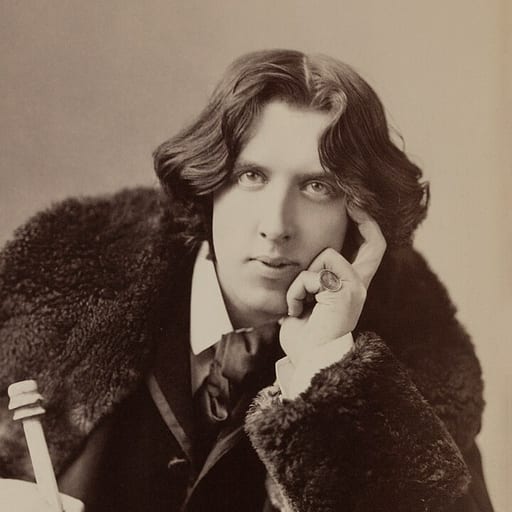
Oscar Wilde
오스카 와일드
Irish playwright and wit
1,054 records in all
- Principles 331
- Episodes 298
- Quotes 425
3 free questions a day, no sign-up.
Photo: Napoleon Sarony / Adam Cuerden Public domain Original cropped
Quotes
64 basic records of 425
Quotes are word for word from the source.
Being over having
The true perfection of man lies, not in what man has, but in what man is.
Our noteWilde argues that personal growth is more important than the accumulation of property.
Resistance to novelty
The one thing that the public dislike is novelty. Any attempt to extend the subject matter of art is extremely distasteful to the public; and yet the vitality and progress of art depend in a large measure on the continual extension of subject-matter.
Our noteAnalyzing why the public fears new ideas and progress.
Limits of teaching
Education is an admirable thing. But it is well to remember from time to time that nothing that is worth knowing can be taught.
Our noteWriting maxims for the instruction of the over-educated.
Complexity of truth
The truth is rarely pure and never simple. Modern life would be very tedious if it were either, and modern literature a complete impossibility!
Our noteAlgernon discussing the nature of truth in modern life.
Time management
When one pays a visit it is for the purpose of wasting other people's time, not one's own.
Our noteObserving the social dynamics of visiting others.
Destruction of passion
Yet each man kills the thing he loves By each let this be heard, Some do it with a bitter look, Some with a flattering word, The coward does it with a kiss, The brave man with a sword!
Our noteReflecting on how people inadvertently destroy what they value most in life.
Facing harsh reality
I know not whether Laws be right, Or whether Laws be wrong; All that we know who lie in gaol Is that the wall is strong; And that each day is like a year, A year whose days are long.
Our noteDescribing the experience of being trapped by systems and unyielding barriers.
Iterative improvement
The principle of the dress is good, and, though it is not by any means perfection, it is a step towards it.
Our noteWilde discusses the merits of the divided skirt as a functional innovation.
Principles of beauty
Beauty, in fact, is to be got only from the perfection of principles; and in "the ideal dress" of Mr. Huyshe there are no ideas or principles at all, much less the perfection of either.
Our noteWilde explains that true beauty in design comes from adhering to sound principles rather than mere visual appeal.
Market interest in novelty
English people are far more interested in American barbarism than they are in American civilization.
Our noteWilde observes that the public is often more drawn to raw, exotic energy than to refined imitation.
Value of execution
Their pathetic intentions are of no value to us, but their realized creations only.
Our noteHe emphasizes that the market and the audience value finished products, not the effort or desire behind them.
Against Consistency
Who wants to be consistent? The dullard and the doctrinaire, the tedious people who carry out their principles to the bitter end of action
Our noteVivian rejects the idea that one must always be consistent in thought and action.
The trap of modernity
modernity of form and modernity of subject-matter are entirely and absolutely wrong. We have mistaken the common livery of the age for the vesture of the Muses
Our noteWilde argues against focusing on contemporary issues or realistic forms in creative work.
Power of imagination
He forgets that when Art surrenders her imaginative medium she surrenders everything.
Our noteWilde criticizes artists who prioritize literal realism over imaginative expression.
Aim to delight
For the aim of the liar is simply to charm, to delight, to give pleasure.
Our noteWilde redefines the 'liar' as a creative storyteller whose goal is audience delight.
Perception and Art
Things are because we see them, and what we see, and how we see it, depends on the Arts that have influenced us.
Our noteWilde argues that our very perception of reality is a product of the art we consume.
Being over doing
But then it is only the Philistine who seeks to estimate a personality by the vulgar test of production. This young dandy sought to be somebody, rather than to do something.
Our noteWilde argues that a person's character and style are more important than their mere output.
Power of egotism
In literature mere egotism is delightful. It is what fascinates us in the letters of personalities so different as Cicero and Balzac, Flaubert and Berlioz, Byron and Madame de Sévigné.
Our noteWilde explains why personal, self-focused writing is often more engaging than objective accounts.
Narrative over fact
To be suggestive for fiction is to be of more importance than a fact.
Our noteWilde suggests that the potential for creative interpretation is more valuable than dry historical accuracy.
Risks of biography
Every great man nowadays has his disciples, and it is always Judas who writes the biography.
Our noteGilbert warns that those closest to a leader are often the ones who misrepresent or betray their legacy.
Posing the questions
he could not answer his own problems, he could at least put problems forth, and what more should an artist do?
Our noteWilde suggests that the role of a creator is to present problems rather than solve them.
Bias in passion
It is difficult not to be unjust to what one loves.
Our noteGilbert admits that deep affection for a subject makes objective criticism nearly impossible.
Action over thought
Thought is wonderful, but adventure is more wonderful still.
Our noteGilbert encourages Ernest to stop talking and go out into the night for an adventure.
The oral test
writing has done much harm to writers. We must return to the voice. That must be our test
Our noteGilbert argues that literature should be judged by how it sounds to the ear, not just how it looks.
Universal Art Principles
To know the principles of the highest art is to know the principles of all the arts.
Our noteUnderstanding the core of one discipline allows a creator to understand the mechanics of others.
Deliberate creative choice
All fine imaginative work is self-conscious and deliberate. No poet sings because he must sing. At least, no great poet does. A great poet sings because he chooses to sing.
Our noteWilde argues that great art is a product of conscious choice rather than mere raw impulse.
Effort behind simplicity
Every century that produces poetry is, so far, an artificial century, and the work that seems to us to be the most natural and simple product of its time is always the result of the most self-conscious effort.
Our noteExplaining that the appearance of simplicity in art is actually achieved through intense, conscious labor.
Against self-denial
Self-denial is simply a method by which man arrests his progress, and self-sacrifice a survival of the mutilation of the savage
Our noteHe criticizes the traditional virtues that hinder individual growth.
Criticism as art
Criticism is itself an art. And just as artistic creation implies the working of the critical faculty, and, indeed, without it cannot be said to exist at all, so Criticism is really creative
Our noteWilde argues that the analytical process is as creative as the act of making art.
Subjectivity over objectivity
the proper aim of Criticism is to see the object as in itself it really is. But this is a very serious error, and takes no cognisance of Criticism's most perfect form
Our noteWilde rejects the idea that criticism should be purely objective or factual.
You are seeing 159 basic records. Membership answers from all 1,054 of this master's records.
See membershipMore masters in this field
See the whole fieldCraft, arts and performance
These records are our compilation of public statements and sources. We are not affiliated with or endorsed by Oscar Wilde or any related company. If something should come down, tell us. Takedown request form