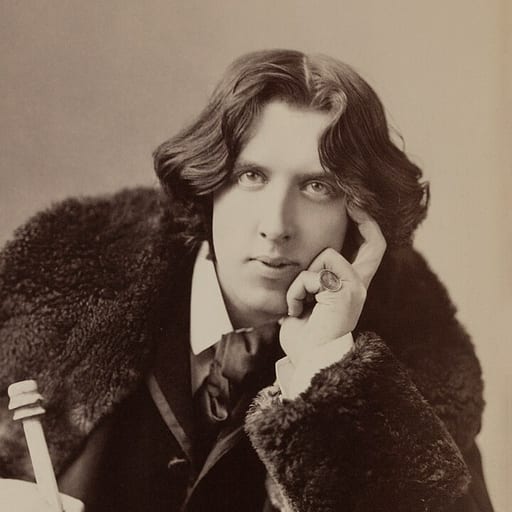
Oscar Wilde
오스카 와일드
Irish playwright and wit
1,054 records in all
- Principles 331
- Episodes 298
- Quotes 425
3 free questions a day, no sign-up.
Photo: Napoleon Sarony / Adam Cuerden Public domain Original cropped
Quotes
64 basic records of 425
Quotes are word for word from the source.
Subjective value
the meaning of any beautiful created thing is, at least, as much in the soul of him who looks at it, as it was in his soul who wrought it.
Our noteWilde explains that the audience's interpretation is as vital as the creator's intent.
Understanding Through Individualism
If you wish to understand others you must intensify your own individualism.
Our noteWilde argues that a strong personal perspective is necessary to truly interpret the work of others.
Control over time
We can choose our day and select our hour.
Our noteThe author emphasizes the autonomy art provides over one's personal schedule and focus.
Difficulty of contemplation
to do nothing at all is the most difficult thing in the world, the most difficult and the most intellectual.
Our noteWilde challenges the idea that action is harder or more valuable than pure thought.
Dangers of overwork
We live in the age of the overworked, and the under-educated; the age in which people are so industrious that they become absolutely stupid.
Our noteHe criticizes the societal obsession with constant industry at the expense of intellectual development.
Intentions and results
It is always with the best intentions that the worst work is done.
Our noteGilbert explains why hard work and good intentions don't guarantee quality in art or business.
Modernizing Classics
A great work of dramatic art should not merely be made expressive of modern passion by means of the actor, but should be presented to us in the form most suitable to the modern spirit.
Our noteWilde discusses how art must adapt its presentation to fit the contemporary audience's spirit.
Endurance of art
That 'Art is long and life is short' is a truth which every one feels, or ought to feel
Our noteWilde reflects on the lasting nature of creative work versus human life.
Meaning in design
He is an imaginative colourist too, knowing that all colour is no mere delightful quality of natural things, but a 'spirit upon them by which they become expressive to the spirit
Our noteWilde discusses how Burne-Jones uses color to convey deeper meaning.
Human connection matters
As a study of colour it is superb, but it is difficult to feel a human interest in this Egyptian peasant.
Our noteWilde discusses a painting that is technically beautiful but fails to engage the viewer emotionally.
Appreciating Art Directly
Nor, in looking at a work of art, should we be dreaming of what it symbolises, but rather loving it for what it is.
Our noteWilde explains that art should be valued for its own sake rather than its symbolic meaning.
Pursuing the Impossible
Well, that is so: but then it is only the impossible things that are worth doing nowadays!
Our noteWilde responds to critics who claim absolute perfection is impossible to achieve.
Consistency in production
No ornament or illustration should be used in a book which cannot be printed in the same way as the type.
Our noteWilde emphasizes the importance of technical harmony between different components of a product.
Value of quality
By doing good work we raise life to a higher plane
Our noteThe lecturer argues that high-quality craftsmanship has an ethical and spiritual impact on life.
Mastery Over Tools
Art depends on Life. We cannot get it from machines. And yet machines are bad only when they are our masters. The printing press is a machine that Art values because it obeys her.
Our noteWilde discusses the relationship between human creativity and mechanical tools.
Authentic Creative Style
She refused to sandpaper her muse. She disliked facile smoothness and artificial polish. In her very rejection of art she was an artist.
Our noteWilde describes Elizabeth Barrett Browning's deliberate choice to avoid over-polishing her work.
Controversy attracts attention
The English public, as a mass, takes no interest in a work of art until it is told that the work in question is immoral
Our noteWilde observes how moral outrage often drives public interest in art.
Role of publishers
No publisher should ever express an opinion of the value of what he publishes. That is a matter entirely for the literary critic to decide.
Our noteWilde argues that publishers should remain neutral middlemen rather than praising their own products.
Pure Aesthetic Value
The primary aesthetic impression of a work of art borrows nothing from recognition or resemblance.
Our noteWilde argues that art should be judged by its own qualities, not by how well it mimics nature.
Artistic independence
I have never written a play for any actor or actress, nor shall I ever do so. Such work is for the artisan in literature--not for the artist.
Our noteWilde clarifies that his play Salome was not written for Sarah Bernhardt.
Representative sampling
'a single drop from a full cask will be enough to disclose the nature of the whole contents.'
Our noteWilde explains how a single representative fact can reveal the character of an entire era.
Timeless Innovation
Across the drear waste of a thousand years the Greek and the modern spirit join hands.
Our noteWilde highlights the direct connection between ancient rationalism and modern scientific methods.
Avoid abstract formulas
I will not try to give you any abstract definition of beauty--any such universal formula for it as was sought for by the philosophy of the eighteenth century
Our noteWilde rejects the idea of a one-size-fits-all formula for artistic beauty.
Timeless perspective
he who seems to stand most remote from his age is he who mirrors it best, because he has stripped life of what is accidental and transitory
Our noteWilde suggests that focusing on eternal truths allows a creator to better represent their own time.
Ubiquity of art
he who does not love art in all things does not love it at all, and he who does not need art in all things does not need it at all.
Our noteWilde asserts that true appreciation of beauty must apply to every aspect of life and every object.
Grace in labor
I have never watched a man do anything useful who has not been graceful at some moment of his labour; it is only the loafer and the idle saunterer who is as useless and uninteresting to the artist as he is to himself.
Our noteWilde explains that real work and utility are the true sources of artistic inspiration.
Localize your design
Unless you can make as beautiful a design in painted china or embroidered screen or beaten brass out of your American turkey as the Japanese does out of his grey silver-winged stork, you will never do anything.
Our noteWilde challenges creators to use their own local environment for inspiration.
Breaking the monotony
Congratulate yourself if you have done something strange and extravagant and broken the monotony of a decorous age.
Our noteWilde celebrates non-conformity and the courage to be different in a conventional society.
The burden of property
Property not merely has duties, but has so many duties that its possession to any large extent is a bore. It involves endless claims upon one, endless attention to business, endless bother.
Our noteWilde discusses how managing large amounts of private property can distract an individual from self-realization.
Freedom of work
Every man must be left quite free to choose his own work. No form of compulsion must be exercised over him. If there is, his work will not be good for him, will not be good in itself, and will not be good for others.
Our noteWilde argues that forced labor destroys the quality of the output and the spirit of the worker.
You are seeing 159 basic records. Membership answers from all 1,054 of this master's records.
See membershipMore masters in this field
See the whole fieldCraft, arts and performance


These records are our compilation of public statements and sources. We are not affiliated with or endorsed by Oscar Wilde or any related company. If something should come down, tell us. Takedown request form