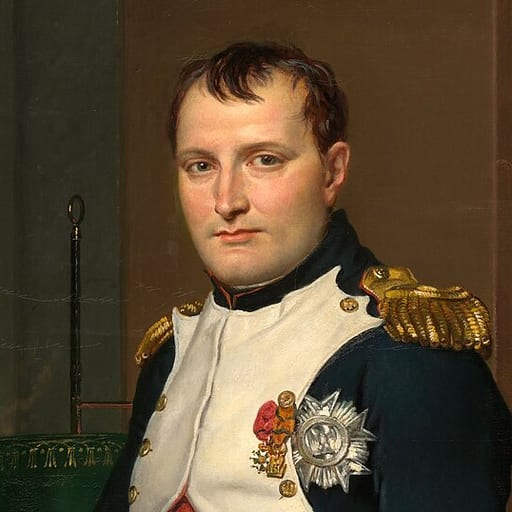
Napoleon Bonaparte
나폴레옹 보나파르트
French general and emperor
919 records in all
- Principles 307
- Episodes 410
- Quotes 202
3 free questions a day, no sign-up.
Photo: Jacques-Louis David Public domain Original cropped
Quotes
30 basic records of 202
Quotes are word for word from the source.
Concise communication
Whenever he could use a short, compact word he did so.
Our noteNapoleon preferred brevity and exactness in his speech and writing to ensure clarity and impact.
Motivation and Purpose
I prize honour since you prize it, I prize victory since it pleases you; without that I should leave everything in order to fling myself at your feet.
Our noteNapoleon explains how his drive for victory is fueled by his desire to please Josephine.
Influence and power
You to whom nature has given intelligence, tenderness, and beauty, you who alone can rule my heart, you who doubtless know only too well the unlimited power you hold over me!
Our noteNapoleon writes to Josephine about the emotional influence she holds over him.
Operational Satisfaction
I am in very fair health, and satisfied with what I see.
Our noteNapoleon reports on his health and his inspection of the coastal defenses.
Thriving on work
I am wonderfully well, and thrive on hard work.
Our noteNapoleon described how his intense workload actually improved his health and spirits.
Sacrifice for destiny
All my life long I have sacrificed everything to my destiny--peace of mind, personal advantage, happiness.
Our noteNapoleon reflects on the personal cost of his career and ambitions.
Controlling the narrative
In my retreat I intend to substitute the pen for the sword. The history of my reign will gratify the cravings of curiosity. Hitherto, I have only been seen in profile; I will now show myself in full to the world.
Our noteNapoleon plans to write his memoirs to explain his actions.
When to Fight
A battle is to be sought, when there is reason to hope for victory, or when an army runs the risk of being ruined without fighting
Our noteNapoleon outlines the specific conditions that justify engaging in a major conflict.
Managing Reserves
never to bring your reserves into action except in the last extremity; and even then to preserve some support, behind which the broken corps may rally.
Our noteHe advises on the disciplined use of backup resources during a crisis.
Prioritizing victory
The first consideration with a general who offers battle, should be the glory and honor of his arms; the safety and preservation of his men is only the second
Our noteNapoleon discusses the mindset a leader must have when deciding to engage in battle.
Indirect approach
One consequence deducible from this principle is, never to attack a position in front which you can gain by turning.
Our noteNapoleon advises on the efficiency of flanking maneuvers over frontal assaults.
Boldness in adversity
a great captain supplies all deficiencies by his courage, and marches boldly to meet the attack. By this means he disconcerts his adversary
Our noteNapoleon discusses how a leader should react when surprised in a bad position.
Safe Positioning
establish your cantonments at the most distant and best-protected point from the enemy, especially where a surprise is possible.
Our noteNapoleon emphasizes the importance of distance to allow time for regrouping before an attack.
Total resource commitment
When you have resolved to fight a battle, collect your whole force. Dispense with nothing. A single battalion sometimes decides the day.
Our noteThe importance of bringing every available resource to a decisive moment.
Keys to Success
Success on these occasions depends on secrecy, on the rapidity of the manœuvres, and the punctual execution of the orders given for the movements of each division.
Our noteNapoleon discusses the critical factors for successfully crossing a river in the presence of an enemy.
Need for Innovation
It must be admitted, at the same time, that the principles of field-fortification require improvement. This important branch of the art of war has made no progress since the time of the ancients.
Our noteHe points out that certain technical fields have stagnated and need modern updates.
Concentration of Force
A few battalions dispersed about a town, inspire no terror; but shut up in the more narrow outline of a citadel, they assume an imposing attitude.
Our noteNapoleon explains why concentrating resources in a defensible core is better than spreading them thin.
Follow up success
The most decisive battles lose half their value to the conqueror, when the want of cavalry prevents him from following up his success, and depriving the enemy of the power of rallying.
Our noteNapoleon highlights the importance of having resources ready to capitalize on a victory.
Essential equipment
There are five things the soldier should never be without--his musket, his ammunition, his knapsack, his provisions (for at least four days), and his entrenching-tool.
Our noteNapoleon lists the fundamental tools every individual must carry to remain self-sufficient and ready.
Contextual obedience
a blind obedience is due only to a military command given by a superior present on the spot at the moment of action.
Our noteExplaining why distant orders shouldn't be followed without question.
Leadership and Experience
Generals-in-chief must be guided by their own experience, or their genius.
Our noteNapoleon discusses the primary guides for a high-level commander.
Ineffectiveness of coercion
The barbarous custom of having men beaten who are suspected of having important secrets to reveal must be abolished. It has always been recognized that this way of interrogating men, by putting them to torture, produces nothing worthwhile.
Our noteNapoleon wrote to Louis Alexandre Berthier about the futility of torture in interrogation.
Meritocracy in hiring
My maxim was, la carrière est ouverte aux talents, without distinction of birth or fortune.
Our noteNapoleon explains his principle of promoting people based on their abilities.
Focus in negotiation
You cannot treat with all the world at once.
Our noteNapoleon comments on the necessity of focused diplomacy and dealing.
Value of audacity
Audacity succeeds as often as it fails; in life it has an even chance.
Our noteNapoleon weighs the risks and rewards of bold actions.
Power of success
Success is the most convincing talker in the world.
Our noteNapoleon reflects on how results speak louder than any words.
Directing events
The skillful accept events, take strong hold of them and direct them.
Our noteNapoleon discusses how to handle changing political and business circumstances.
Seizing the moment
There is only one favorable moment in war; talent consists in knowing how to seize it.
Our noteNapoleon explains the importance of timing in military success.
Trust in character
He conceived that the English people were more bound by a conduct which was, on his part, frank, noble, and full of confidence, than they would have been by the most solemn treaties.
Our noteNapoleon explains why he chose to trust the British people over formal treaties.
Resilience in Adversity
Napoleon at St. Helena, in the midst of persecutions of every description, to which he opposes nothing but serenity, is greater, more sacred, and more venerable
Our noteThe text describes Napoleon's stoic mindset while facing harsh treatment in exile.
You are seeing 138 basic records. Membership answers from all 919 of this master's records.
See membershipMore masters in this field
See the whole fieldLeaders in history and crisis
These records are our compilation of public statements and sources. We are not affiliated with or endorsed by Napoleon Bonaparte or any related company. If something should come down, tell us. Takedown request form