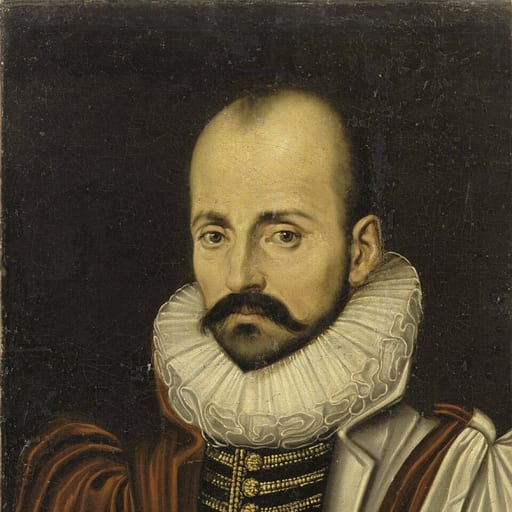
Michel de Montaigne
미셸 드 몽테뉴
French writer who invented the essay
1,105 records in all
- Principles 358
- Episodes 243
- Quotes 504
3 free questions a day, no sign-up.
Photo: Unknown author Public domain Original cropped
Quotes
76 basic records of 504
Quotes are word for word from the source.
Internal Passions
Whereas the passions which wholly reside in the soul, as ambition, avarice, and the rest, find the reason much more to do, because it cannot there be helped but by its own means
Our noteHe notes that mental desires like ambition are harder to control than physical ones because they have no physical limit.
Moderation and resolution
Never had man more moderation in his victory, nor more resolution in his adverse fortune.
Our noteA summary of the ideal temperament for handling both extreme success and failure.
Visibility in leadership
He was always wont to wear rich garments, and of a shining colour in battle, that he might be the more remarkable and better observed.
Our noteMontaigne describes how Julius Caesar used his appearance to be a visible leader on the battlefield.
Value present loyalty
We should willingly give them leave to laugh after we are dead, provided they will smile upon us whilst we are alive.
Our noteThe author argues that genuine affection during life is more valuable than performative grief after death.
Substance over style
I know very well, that when I hear any one dwell upon the language of my essays, I had rather a great deal he would say nothing: 'tis not so much to elevate the style as to depress the sense
Our noteMontaigne expresses his preference for readers to focus on his ideas rather than his prose.
Avoiding premature aging
I had rather be a less while old than be old before I am really so.
Our noteMontaigne discusses the folly of anticipating life's inconveniences before they actually arrive.
Source of creativity
Who will deprive the Muses of amorous imaginations, will rob them of the best entertainment they have, and of the noblest matter of their work
Our noteMontaigne discusses how love and passion fuel artistic and creative work.
Managing commitment
Tis in vain to kick, when a man has once put on his fetters: a man must prudently manage his liberty
Our noteMontaigne advises that once a commitment is made, one must act responsibly within its boundaries.
Value of goodwill
The obligation of a benefit wholly relates to the good will of those who confer it
Our noteThe true value of a gift or service is measured by the giver's intent.
Avoid useless investigation
Curiosity is vicious throughout; but 'tis pernicious here. 'Tis folly to examine into a disease for which there is no physic that does not inflame and make it worse
Our noteMontaigne warns against digging into private matters that only cause pain once discovered.
Discretion in affairs
The sharps, as well as the sweets of marriage, are kept secret by the wise
Our noteHe emphasizes the importance of keeping internal struggles private to maintain dignity.
Moderation in oversight
There should be moderation in these things; one must leave a great deal of their conduct to their own discretion
Our noteHe reflects on the effectiveness of strict versus moderate supervision of subordinates.
Endless desire
If there be no end to avarice and ambition, there is doubtless no more in desire
Our noteHe observes that human desires naturally extend beyond what is currently possessed.
Philosophy of moderation
Philosophy does not contend against natural pleasures, provided they be moderate, and only preaches moderation, not a total abstinence; the power of its resistance is employed against those that are adulterate and strange.
Our noteMontaigne clarifies that philosophy supports natural pleasures when they are kept within reasonable bounds.
Flexible exploration
he had no settled course, and that he merely proposed to himself to pay visits to places which he had not seen, and so long as they could not convict him of traversing the same path twice
Our noteHe defends his wandering travel style against those who prefer a direct, beaten path.
Peace over cleverness
I prefer to be quiet rather than clever: give me content, even if I am not to be so wide in my range.
Our noteMontaigne discusses why he prefers mental peace over the restless pursuit of overly subtle reasoning.
Integrity in conduct
the vice of falsehood is one very unbecoming in gentleman, let it assume what guise it will.
Our noteMontaigne discusses the importance of truthfulness in one's reputation and speech.
Specialization and mastery
Naturally each workman feels himself more strong in some special part his art, and those are to be regarded as most fortunate, who lay hands on the noblest
Our noteMontaigne comments on how different creators excel in different aspects of their craft.
clemency over force
It is always seen that they are surmounted by their magnitude and difficulty; it not being found easy to complete the conquest by arms and force, the end has been accomplished by clemency and generosity
Our noteHe suggests that winning hearts through kindness is more effective than using raw power.
Authentic creative intent
I have had no consideration at all either to thy service or to my glory. My powers are not capable of any such design.
Our noteMontaigne explains that he did not write for fame or to serve the public.
Importance of goals
No wind serves him who addresses his voyage to no certain, port.
Our noteThe necessity of having a clear objective to make use of opportunities.
Strategic alignment
The archer ought first to know at what he is to aim, and then accommodate his arm, bow, string, shaft, and motion to it
Our noteAligning tools and actions toward a specific target.
Definition of wisdom
wisdom is a regular government of the soul, which is carried on with measure and proportion, and for which she is to herself responsible.
Our noteMontaigne defines wisdom as the balanced and responsible self-governance of one's own mind.
extreme accountability
Nothing can be added to the beauty of the death of the wife of Fulvius, a familiar favourite of Augustus
Our noteHe describes the story of a wife who took responsibility for her husband's fatal mistake.
words versus action
Many enough approved this high resolution, but few imitated it
Our noteMontaigne notes that while many agree with a brave plan, few have the courage to execute it.
Deep learning
We must not attach knowledge to the mind, we have to incorporate it there.
Our noteDiscussing the proper way to educate and internalize knowledge.
Risk preparation
it is better to prepare with fine assurance for the worst that can happen, and derive some consolation from the fact that we are not sure that it will happen.
Our noteAdvising on how to handle uncertainty and potential accidents.
Internal inconsistency
There is as much difference between us and ourselves as between us and others.
Our noteObserving the inconsistency of human actions and character over time.
Facing fortune
It is the part of cowardice, not of courage, to go and crouch in a hole under a massive tomb, to avoid the blows of fortune.
Our noteCritiquing those who hide from life's challenges instead of facing them.
Human equality
The souls of emperors and cobblers are cast in the same mold.
Our notePointing out that all humans share the same fundamental nature regardless of status.
You are seeing 166 basic records. Membership answers from all 1,105 of this master's records.
See membershipMore masters in this field
See the whole fieldPhilosophy and wisdom traditions
These records are our compilation of public statements and sources. We are not affiliated with or endorsed by Michel de Montaigne or any related company. If something should come down, tell us. Takedown request form