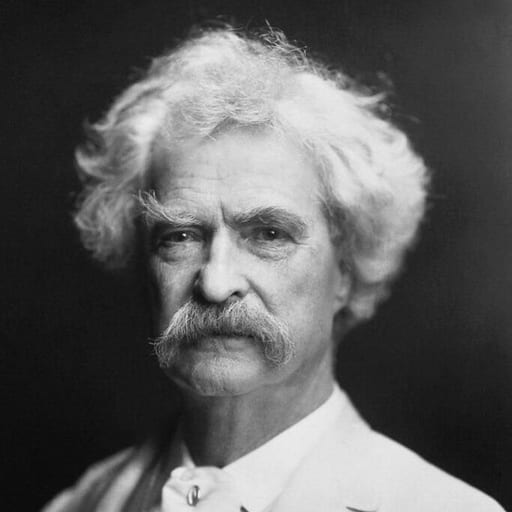
Mark Twain
마크 트웨인
American writer and humorist
1,104 records in all
- Principles 367
- Episodes 315
- Quotes 422
3 free questions a day, no sign-up.
Photo: A.F. Bradley, New York Public domain Original cropped
Quotes
63 basic records of 422
Quotes are word for word from the source.
Strict discipline
It would seem natural to step from under a descending sword unconsciously, and against one's will and intent--yet this unconsciousness is not allowed.
Our noteTwain describes the extreme self-control required in German student duels.
Know your audience
I always hate to fool away a humorous thing on a person who has no perception of humor
Our noteTwain expressed frustration when his sarcastic suggestions were taken literally by a serious opponent.
The envy of rest
I hate a man who goes to sleep at once; there is a sort of indefinable something about it which is not exactly an insult, and yet is an insolence
Our noteTwain expresses his frustration with insomnia while his companion sleeps soundly.
Cultural communication styles
The Germans are very conscientious, and this trait makes them very particular. Therefore if you tell a German you want a thing done immediately, he takes you at your word; he thinks you mean what you say
Our noteTwain reflects on how literal-mindedness in different cultures affects business and service expectations.
Delegating the work
I called in my agent and instructed him to go without delay and make a careful examination of these noted places, on foot, and bring me back a written report
Our noteTwain delegates the physically demanding task of scouting locations to his agent.
The Power of Extremes
None of us like mediocrity, but we all reverence perfection. This girl's music was perfection in its way; it was the worst music that had ever been achieved on our planet by a mere human being.
Our noteTwain was describing a bride playing a piano so poorly that it became a spectacle.
Defining market limits
That man may claim the distinction of owning the end of the world, for if there is any definite end to the world he has certainly found it.
Our noteTwain reflects on a man living in a desolate, remote Alpine location.
Resilience in desolation
She seemed to say, "Cheer up!--as long as we are here, let us make the best of it.
Our noteTwain finds a small flower blooming in a harsh, rocky environment.
Discarding outdated habits
It is still clinging to one or two things which were useful once, but which are not useful now, neither are they ornamental.
Our noteTwain critiques the persistence of unnecessary traditions like loud church bells in a modern age.
Adapting to roles
A round man cannot be expected to fit in a square hole right away. He must have time to modify his shape.
Our noteTwain discussed the process of personal modification and fit in his book.
Definition of classic
Definition of a classic - something that everybody wants to have read and nobody wants to read.
Our noteHe was discussing the disappearance of literature in a speech in New York.
The right word
A powerful agent is the right word. Whenever we come upon one of those intensely right words in a book or a newspaper the resulting effect is physical as well as spiritual, and electrically prompt.
Our noteHe was writing an essay about the literary style of William Dean Howells.
Action over noise
Thunder is good, thunder is impressive; but it is lightning that does the work.
Our noteTwain emphasizes the importance of effective action over mere showmanship.
Desire for approval
It may be called the Master Passion - the hunger for Self-Approval.
Our noteTwain identifies the primary driving force behind human behavior.
Testing character interest
Surely the test of a novel's characters is that you feel a strong interest in them and their affairs - the good to be successful, the bad to suffer failure.
Our noteTwain critiques a book by evaluating how much the reader cares about the characters.
The master impulse
the _compulsion_ that moves a man - and there is but the one - is the necessity of securing the contentment of his own spirit.
Our noteTwain defines the core driver of all human behavior as the necessity of spiritual contentment.
The sole impulse
we ignore and never mention the Sole Impulse which dictates and compels a man's every act: the imperious necessity of securing his own approval, in every emergency and at all costs.
Our noteExplaining the fundamental psychological drive behind all human actions.
Adaptation to surroundings
He is a chameleon; by the law of his nature he takes the color of his place of resort.
Our noteTwain describes how humans naturally mirror the values of their social circles.
Constant external training
A man is never anything but what his outside influences have made him. They train him downward or they train him upward - but they _train _him
Our noteTwain argues that we are products of the constant stream of external inputs we receive.
Self interest in transactions
In _all _transactions, the Interior Master looks to it that _you get the first profit. _Otherwise there is no transaction.
Our noteTwain explains that every human action is driven by a primary desire for personal satisfaction.
Definition of thought
She put this and that together - and that is all that thought _is _ - and out of them built her logical arrangement of inferences.
Our noteTwain explains that thinking is simply the process of connecting observations to draw logical inferences.
Learning through observation
I conceive that all animals that can learn things through teaching and drilling have to know how to observe, and put this and that together and draw an inference
Our noteHe argues that the ability to learn is rooted in the capacity to observe and infer.
Seeking Spiritual Contentment
In _all _cases it seeks a _spiritual _contentment, let the _means _be what they may. Its desires are determined by the man's temperament - and it is lord over that.
Our noteTwain describes how temperament dictates what an individual finds satisfying, whether money or books.
Power of Influence
outside influences moved your interior Master to give the order; stronger outside influences deterred him.
Our noteTwain discusses how external factors determine whether an idea is acted upon or suppressed.
Attention to detail
he is paying no attention to his work; or he would see that there is nothing to laugh at
Our noteTwain argues that lazy writing stems from a lack of genuine attention to the scene's logic.
Systemic consistency
But you can't change the phonographic spelling; there isn't any way._ It will always follow the SOUND. If you want to change the spelling, you have to change the sound first.
Our noteTwain argues that a system based on natural laws like sound is more stable than arbitrary rules.
Difficulty of maxims
It is more trouble to make a maxim than it is to do right.
Our noteTwain reflects on the effort required to create moral rules versus following them.
Power of custom
As far back as Noah's time it became law that ships must be constantly painted and fussed at when at sea; custom grew out of the law, and at sea custom knows no death
Our noteTwain discusses why ship crews continue to paint even when it inconveniences passengers.
Value of clarity
I had a fair knowledge of his subject - layman's knowledge - to begin with, but it was his teachings which crystalized it into scientific form and clarity - in a word, gave it value.
Our noteTwain explains how expert teaching can turn raw information into valuable, structured knowledge.
Value of information
Anybody who has an old fact in stock that is no longer negotiable in the domestic market will let him have it at his own price.
Our noteTwain notes how locals pass off outdated or exaggerated information to unsuspecting travelers.
You are seeing 165 basic records. Membership answers from all 1,104 of this master's records.
See membershipMore masters in this field
See the whole fieldCraft, arts and performance



These records are our compilation of public statements and sources. We are not affiliated with or endorsed by Mark Twain or any related company. If something should come down, tell us. Takedown request form