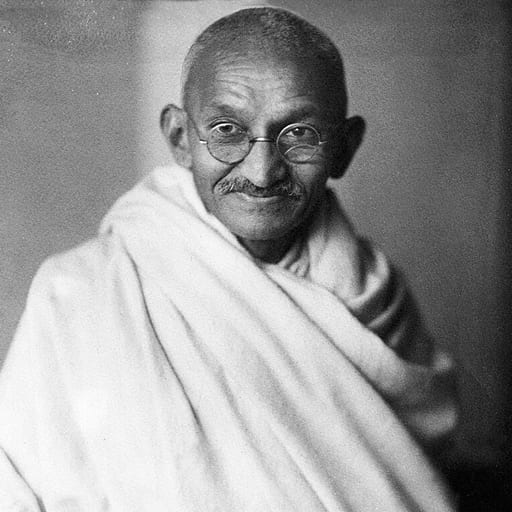
Mahatma Gandhi
마하트마 간디
Leader of India's nonviolent independence movement
1,081 records in all
- Principles 326
- Episodes 328
- Quotes 427
3 free questions a day, no sign-up.
Photo: Elliott & Fry Public domain Original cropped
Quotes
64 basic records of 427
Quotes are word for word from the source.
Commitment to duty
Those only will be faithful, who consider it their duty to devote their spare hours to doing what is to-day the most useful work for the country.
Our noteGandhi discusses who will remain consistent in their work versus those following a temporary craze.
Empathy through labor
I cannot imagine anything nobler or more national than that for say one hour in the day we should all do the labour that the poor must do
Our noteGandhi suggests that shared physical labor builds a connection with the poor.
Utilizing idle time
The problem is how to utilise these billions of hours of the nation without disturbing the rest. Restoration of the spinning wheel is the only possible answer.
Our noteHe discusses the economic efficiency of turning wasted time into productive labor.
Product quality standards
The wheel must turn easily, freely, and noiselessly.
Our noteGandhi describes the mechanical requirements for a functional and efficient spinning wheel.
Value of methodical work
But whatever the pecuniary value of their work might be, method in work itself will be an acquisition beyond all price.
Our noteGandhi emphasizes that learning a disciplined process is more valuable than the immediate financial output.
Quality control visits
The spinners should be visited at their work from time to time, and proper instructions as to the required twist and test to be given to the yarn should be imparted to them.
Our noteHe emphasizes the need for active supervision and training to ensure product quality.
Incentivizing quality
The payment of a reasonably higher wage than the present is another way of improving the yarn.
Our noteGandhi suggests that fair compensation is directly linked to the quality of the output.
Conditions for success
Effort and sacrifice are the necessary conditions of real stable emancipation.
Our noteHe asserts that true independence cannot be granted by others but must be earned.
Integrity in leadership
I would be unworthy of the position I claim, if I did not support Indian Mussalmans in their struggle to maintain the Khilafat in accordance with their religious belief.
Our noteGandhi discusses the necessity of supporting his countrymen's just causes to maintain his moral authority.
Long term impact
The method of violence cannot do good in the long run.
Our noteHe emphasizes that violent tactics fail to produce lasting positive results.
Duty to resist
every nation and every individual has the right and it is their duty, to rise against an intolerable wrong.
Our noteHe speaks on the necessity of standing up against systemic injustice.
Action Over Rhetoric
That task will not be performed by platform rhetoric or resolutions merely. Stern action is required on out part if we are to make any headway
Our noteHe emphasizes that real change comes from action rather than just talking or passing resolutions.
Strategic compromise
And the drawing up of a new constitution enabled me to show that where there was no question of principle I was desirous of agreeing quickly with my opponents in opinions.
Our noteHe reflects on his willingness to compromise on non-essential points to maintain unity.
Respecting Differences
the true beauty of Hindu-Mahomedan Unity lies in each remaining true to his own religion and yet being true to each other.
Our noteHe argues that true partnership comes from mutual respect rather than losing one's identity.
Deep Alignment
The union that we want is not a patched up thing but a union of hearts based upon a definite recognition of the indubitable proposition
Our noteGandhi emphasizes that lasting cooperation must be built on sincere commitment, not just convenience.
Risks of Retaliation
In my opinion, retaliation is a double-edged weapon. It does not fail to hurt the user if it also hurts the party against whom it is used.
Our noteGandhi discusses why systematic retaliation against the British government is a dangerous and ineffective strategy.
Principled Cooperation
I would co-operate a thousand times with this Government to wean it from its career of crime but I will not for a single moment co-operate with it to continue that career.
Our noteExplaining the boundary between helpful cooperation and complicity in wrongdoing.
Duty vs Punishment
What I have ventured to suggest is not a punishment, but the performance of a sacred duty, a measure of self-denial from ourselves, and therefore it is effective from its very inception
Our noteGandhi distinguishes between punishing others and practicing self-discipline for a cause.
Persuasion Through Reason
Each party seeks to convert the other or draw the uncertain element towards its side by pure argument and reasoning.
Our noteGandhi describes the civilized way to handle disagreements and win over the undecided.
Managing risk
But violence is a certainty without, violence is only a possibility with non-co-operation.
Our noteHe explains that non-violent non-cooperation is a safer alternative to the inevitable violence of despair.
Severing Toxic Ties
I can retain neither respect nor affection for such a Government.
Our noteGandhi declares his total loss of faith in the Imperial Government's morality.
Focus on fundamentals
How strange (and yet how true) it is that we know much less about things near at hand than things at a distance.
Our noteGandhi observes that people often ignore essential internal knowledge for trivial external facts.
Health and productivity
In those days, I had not a _third_ of my present capacity for work, in spite of the fact that I was then in the prime of youth.
Our noteReflecting on how poor eating habits diminished his professional output.
Hidden industry tactics
Very few people are aware of the many tricks employed by the cigarette-manufacturers to bring us more and more under its influence.
Our noteGandhi warns about the manipulative marketing and additive strategies used by the tobacco industry.
Supply chain ethics
if we enquire minutely into the methods of preparation of all our articles of food, we shall have to give up 90% of them!
Our noteReflecting on the unethical labor practices involved in the production of common commodities.
Aiming for ideals
It is only when we know what the ideal kind of diet is that we shall be able more and more to approximate our actual to the ideal.
Our noteHe explains why defining an ideal is necessary even if it is hard to reach.
Avoiding temptation
If we want to avoid the sin of over-eating, we should take a vow never to have anything to do with feasts of all kinds.
Our noteHe suggests avoiding social environments that encourage excessive consumption.
Work before eating
As soon as we get up in the morning we should prepare to work rather than to eat. We should take our meal only after working for three hours.
Our noteGandhi discusses the benefits of delaying breakfast to prioritize morning productivity.
Balanced work nature
Our work should be neither exclusively physical nor exclusively mental, nor such as ministers merely to the pleasure of the moment.
Our noteGandhi advocates for a balance between physical and mental labor for overall well-being.
Self discipline power
The hidden strength that God has given us should be conserved by rigid self-discipline, and transmitted into energy and power,--not merely of body, but also of mind and soul.
Our noteHe explains how self-control leads to greater mental and spiritual power.
You are seeing 162 basic records. Membership answers from all 1,081 of this master's records.
See membershipMore masters in this field
See the whole fieldLeaders in history and crisis



These records are our compilation of public statements and sources. We are not affiliated with or endorsed by Mahatma Gandhi or any related company. If something should come down, tell us. Takedown request form