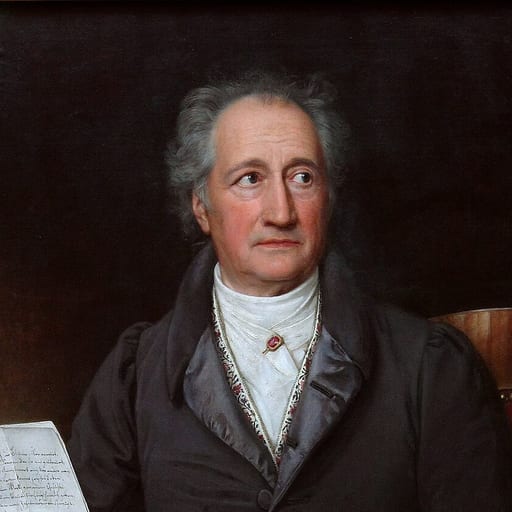
Johann Wolfgang von Goethe
요한 볼프강 폰 괴테
German poet, novelist and polymath; author of Faust
945 records in all
- Principles 342
- Episodes 267
- Quotes 336
3 free questions a day, no sign-up.
Photo: Joseph Karl Stieler Public domain Original cropped
Quotes
50 basic records of 336
Quotes are word for word from the source.
Importance of planning
it was not well composed as a whole, because it had been produced in this gradual manner; and he had perpetrated a blunder in the outset, in not at least devising a general plan
Our noteGoethe reflects on a painter's realization that working without a master plan leads to a disjointed final product.
Know your objective
they should not be introduced where the object is to excite pleasure.
Our noteA painter explains why certain unpleasant details should be omitted when the goal is to please the audience.
The drive for independence
Thus, at certain epochs, children part from parents, servants from masters, _protégés_ from their patrons; and whether it succeed or not, such an attempt to stand on one's own feet, to make one's self independent, to live for one's self, is always in accordance with the will of nature.
Our noteGoethe views the act of striking out on one's own as a natural and necessary stage of life.
Self doubt in work
This uncertainty of taste and judgment disquieted me more and more every day, so that at last I fell into despair.
Our noteGoethe describes the mental struggle he faced when evaluating his early creative works.
Pivoting and renunciation
I found myself in the miserable situation in which one is placed when a complete change of mind is required,--a renunciation of all that one has hitherto loved and found good.
Our noteHe reflects on the difficulty of abandoning old ideas to make room for growth.
Clarity and brevity
I perceived through conversation, through examples, and through my own reflections, that the first step in delivering ourselves from the wishy-washy, long-winded, empty epoch, could be taken only by definiteness, precision, and brevity.
Our noteGoethe discusses the need for a more precise style in literature and communication.
The Worthiest Mind
"The mind endowed with active powers," so it runs, "and keeping with a practical object to the task that lies nearest, is the worthiest there is on earth."
Our noteGoethe defines the ideal mindset for productivity and purpose.
mind behind expression
"it is not language in itself which is correct or forcible or elegant, but the mind that is embodied in it."
Our noteGoethe emphasized that the quality of communication stems from the thinker's mind.
Prudence in business
It is only men of practical ability, knowing their powers and using them with moderation and prudence, who will be successful in worldly affairs.
Our noteGoethe defines the traits necessary for success in practical and worldly endeavors.
Self-Estimation for Achievement
If a man is to achieve all that is asked of him, he must take himself for more than he is
Our noteGoethe suggests that a degree of overconfidence is necessary to meet high expectations.
Interest and memory
When you lose interest in anything, you also lose the memory for it.
Our noteGoethe notes the connection between personal engagement and knowledge retention.
Power of mottoes
The use of mottoes is to indicate something we have not attained, but strive to attain. It is right to keep them always before our eyes.
Our noteHe discusses how keeping goals visible helps in striving for improvement.
Approaching the Goal
Difficulties increase the nearer we come to our aim.
Our noteA reminder that increasing resistance is often a sign of progress toward a goal.
Knowledge and action
It is not enough to know, we must also apply; it is not enough to will, we must also do.
Our noteHe emphasizes that theoretical knowledge and intent are useless without practical application.
Power of intention
Strictly speaking, everything depends upon a man's intentions; where these exist, thoughts appear; and as the intentions are, so are the thoughts.
Our noteHe explains how fundamental intentions shape the quality and direction of one's thoughts.
Increasing challenges
As we grow older, the ordeals grow greater.
Our noteHe notes that life's difficulties tend to scale as one gains more experience and age.
Learning from masters
We really learn only from those books which we cannot criticise. The author of a book which we could criticise would have to learn from us.
Our noteGoethe explains that true growth comes from engaging with works that are superior to our current understanding.
Practical use of knowledge
The further knowledge advances, the nearer we come to the unfathomable: the more we know how to use our knowledge, the better we see that the unfathomable is of no practical use.
Our noteHe reflects on the limits of practical knowledge versus abstract mysteries.
Plausible absurdity
What a true saying it is that he who wants to deceive mankind must before all things make absurdity plausible.
Our noteGoethe comments on the mechanics of deception and persuasion.
Individual progress
The century advances; but every individual begins anew.
Our noteGoethe notes that collective progress does not exempt individuals from their own learning curves.
You are seeing 141 basic records. Membership answers from all 945 of this master's records.
See membershipMore masters in this field
See the whole fieldCraft, arts and performance



These records are our compilation of public statements and sources. We are not affiliated with or endorsed by Johann Wolfgang von Goethe or any related company. If something should come down, tell us. Takedown request form