
Jim O'Shaughnessy
짐 오쇼너시
Quantitative investor, author of What Works on Wall Street, founder of O'Shaughnessy Ventures
2,844 records in all
- Principles 974
- Episodes 563
- Quotes 1,307
3 free questions a day, no sign-up.
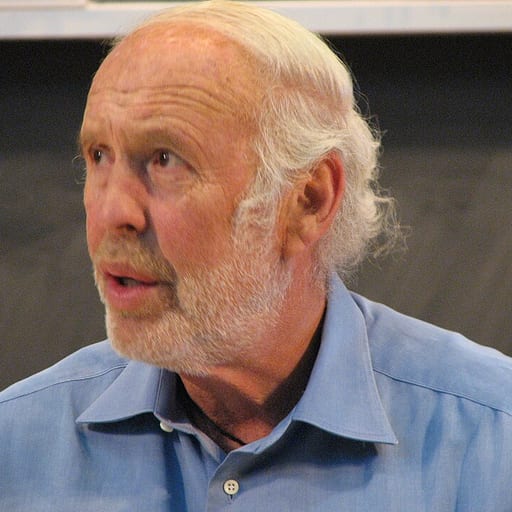
Photo: Matthew Ryan CC BY-SA 2.0 Original cropped
Quotes
196 basic records of 1,307
Quotes are word for word from the source.
Global brain fracturing
I think that people are just more tuned in, right? To this than they were in the past because of the Internet. Because we've kind of built this global brain that is fracturing a little bit.
Our noteJim discusses how the internet has changed the way ideas and memes spread globally.
Focus and exposure
So pay attention, focus and travel and while you're traveling, pay attention and focus.
Our noteJim summarizes the importance of being present and seeking new experiences.
Conviction against consensus
I was absolutely certain that writing the book, What Works on Wall Street, would make my career. Everyone in my family disagreed.
Our noteJim discusses pursuing his book project despite his family's disapproval and concerns about his career path.
Curiosity as competitive advantage
The world that is becoming is a world of ... It's the world where the curious person is going to be king or queen.
Our noteJim predicts that curiosity will be the most valuable trait in the post-industrial economy.
Mass customization era
We go from mass production to mass customization and the ability to, as you note ... You can keep your job, you can experiment with these tiny experiments, keep field notes, and not do it all at once.
Our noteJim discusses how the modern world allows for personalized career paths through small experiments.
Clarity through writing
it also gives you a really quick clue that ... I don't have the faintest clue what I'm actually talking about here, or wow, I really do have a pretty good idea about how to proceed.
Our noteJim discusses how writing reveals the depth or lack of one's understanding.
Onboarding others to AI
If you have parents, or you have friends, who are skeptical or not interested, just put... And it doesn't matter which one, by the way. Put any of the large language models or the generative stable diffusion models on their phone, they will flip out.
Our noteJim encourages sharing AI technology with older generations or skeptics to show them its potential.
Beyond AI cliches
We often hear the cliche: AI isn't going to take your job. A human using AI will. That's a cliche and it's missing the bigger picture.
Our noteJim challenges the common narrative about AI and job security.
Incumbent panic response
the first reaction of the established players often is panic action through legal or other means.
Our noteJim observes how dominant companies react to disruptive innovations that threaten their market share.
The exception fallacy
We have the same problems with falling into traps, with thinking, "That's true of everyone else, but not me. I am the only exception."
Our noteReflecting on how even experts are susceptible to the 'blind spot' of thinking they are unbiased.
Innovation explosion
I think we are going through a Cambrian-like explosion of innovation, creativity, and many of that will find its way into a pitch deck.
Our noteJim describes the current era of rapid technological and creative advancement.
Speed of innovation
that type of system tends to make greater advances in a shorter period of time than those where the coding encoders are not allowed.
Our noteJim compares the development speed of open source systems like Linux to closed systems.
Managing creative talent
But other than that, it's very much in my spirit of let creative people be creative. And they, for the most part, are not terribly good rule followers.
Our noteJim discusses his philosophy on managing fellows and creative individuals.
Learning to unlearn
So, I think table stakes today is going to be, you're going to have to learn how to unlearn. And that sounds weird.
Our noteJim emphasizes the importance of discarding old knowledge to make room for new innovations.
AI data analysis
we simply cannot analyze an array of a hundred million variables in seconds, which allows us to see into latent spaces which were opaque to us in the past.
Our noteJim describes how AI tools allow humans to analyze massive datasets that were previously impossible to process.
Hidden information
there is so much information in those null sets that we don't really have access to, because human OS doesn't want to work on a project where you're not going to get published
Our noteJim discusses the value of 'via negativa' and information found in failed experiments.
You are seeing 426 basic records. Membership answers from all 2,844 of this master's records.
See membershipMore masters in this field
See the whole fieldInvesting and capital allocation



These records are our compilation of public statements and sources. We are not affiliated with or endorsed by Jim O'Shaughnessy or any related company. If something should come down, tell us. Takedown request form