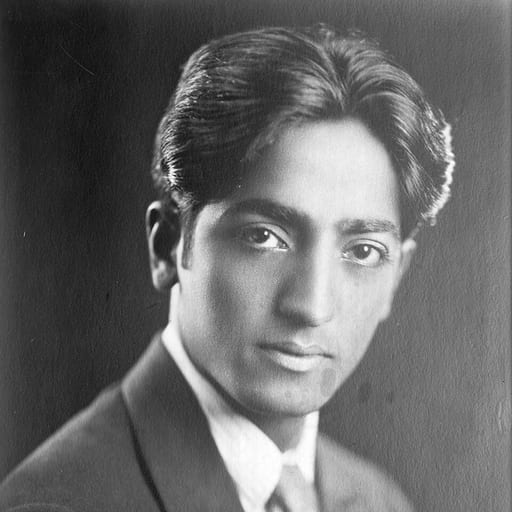
Jiddu Krishnamurti
지두 크리슈나무르티
Indian philosopher and speaker on freedom from conditioning
244 records in all
- Principles 66
- Episodes 58
- Quotes 120
3 free questions a day, no sign-up.
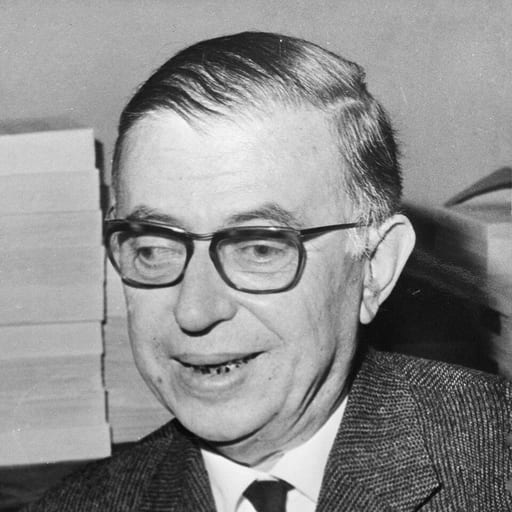
Photo: Unknown author Public domain Original cropped
Quotes
18 basic records of 120
Quotes are word for word from the source.
Ineffectiveness of fear
A teacher who tries to frighten his boys into doing what he wishes does not see that they only obey him while he is there
Our noteHe explains why using fear as a management tool fails in the long run.
Contentment in Work
Only the man who is really contented and happy can have his mind free to teach well.
Our noteHe notes that a teacher's mental state and financial security directly affect their ability to perform.
Nurturing individual talent
The teacher should not desire to gain credit for himself by forcing a boy along his own line, but should consider the special talent of each boy, and the way in which _he_ can gain most success.
Our noteKrishnamurti discusses the importance of tailoring education to a student's unique capacities rather than the teacher's ego.
Inspiring confidence
The value of the teacher depends upon his power of inspiring confidence, and he loses this when he gives way to irritability.
Our noteThe text emphasizes that emotional stability is crucial for maintaining the trust of subordinates or students.
Passion for work
Unless the teacher is interested in his work, and loves it beyond all other work, he will not be able to be really one-pointed.
Our noteThe necessity of loving one's craft to achieve high levels of concentration.
Constant discrimination
discrimination must still be made between the right and the wrong, the important and the unimportant, the useful and the useless, the true and the false
Our noteHe describes the necessity of choosing the useful over the useless in every step.
Individual responsibility
To bring about order and peace, we must begin with ourselves and not with society, not with the State, for the world is ourselves
Our noteHe was explaining how individual greed and competition create a miserable society.
No psychological certainty
Psychologically, there is nothing in the world that you can put your faith, your trust, or your belief in. Neither your gods, nor your science can save you, can bring you psychological certainty
Our noteHe addresses the fact that external authorities fail to provide true psychological security.
Danger of comparison
Throughout life, from childhood, from school until we die, we are taught to compare ourselves with another; yet when I compare myself with another I am destroying myself.
Our noteHe explains how social comparison destroys individual potential.
Root of fear
One is never afraid of the unknown; one is afraid of the known coming to an end.
Our noteHe was addressing the psychological nature of fear.
Continuous self-observation
To learn about oneself, a living thing, you have to watch, learn anew each minute.
Our noteHe emphasizes the need for constant awareness to understand the self.
The trap of recognition
Recognition implies previous knowledge, otherwise you cannot recognize. I cannot recognize you if I had not met you yesterday. Therefore when I say this is truth, I have already known it and therefore it is not truth.
Our noteHe discusses why seeking truth based on past memory is hypocritical.
Nature of goodness
goodness can never come into being if there is any form of violence or struggle.
Our noteHe was explaining that goodness is not merely the opposite of evil.
Truth is dynamic
You cannot find truth through anybody else. How can you? Surely, truth is not something static; it has no fixed abode; it is not an end, a goal.
Our noteKrishnamurti explains why truth cannot be found through others or as a fixed goal.
Unlearning for inquiry
To inquire into what is meditation, the mind must free itself from what it has learnt about meditation, and the freeing of the mind from what it has learnt is the beginning of meditation.
Our noteDefining meditation as a process of unlearning rather than following a technique.
Truth cannot be bought
Truth is not to be bought any more than love can be bought.
Our noteEmphasizing that spiritual or fundamental truth cannot be acquired through transactions or effort.
Causeless passion
In the state of passion without a cause, there is intensity free of all attachment; but when passion has a cause, there is attachment, and attachment is the beginning of sorrow.
Our noteDistinguishing between emotional enthusiasm for a specific thing and pure, unattached passion.
Action Without Formulas
Its action is not based on some idea or formula. As the river, with a tremendous volume of water behind it, cleanses itself as it flows, so does the mind cleanse itself when once it has come upon this religious sacredness.
Our noteHe compares a self-purifying mind to a river that cleanses itself through movement.
You are seeing 37 basic records. Membership answers from all 244 of this master's records.
See membershipMore masters in this field
See the whole fieldPhilosophy and wisdom traditions

These records are our compilation of public statements and sources. We are not affiliated with or endorsed by Jiddu Krishnamurti or any related company. If something should come down, tell us. Takedown request form