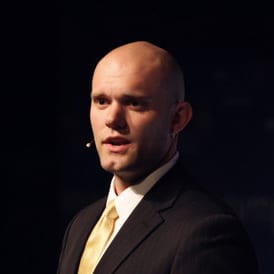
James Clear
제임스 클리어
Author of Atomic Habits
1,012 records in all
- Principles 344
- Episodes 184
- Quotes 484
3 free questions a day, no sign-up.
Photo: James Clear CC BY-SA 4.0 Original cropped
Quotes
73 basic records of 484
Quotes are word for word from the source.
Persistence versus quitting
One of the hardest things in life is to know when to keep going and when to move on.
Our noteJames discusses the tension between the need for grit and the necessity of quitting things that fail.
Tracking for progress
Elite performers will often measure, quantify, and track their progress in various ways. Each little measurement provides feedback. It offers a signal of whether they are making progress or need to change course.
Our noteClear explains why top performers use measurement to guide their actions.
Long term focus
maintaining focus on the same project month after month is not natural for me. I've learned a lot about my strengths and weaknesses during the process, and I'll be sharing more about that once it's all said and done.
Our noteJames reflects on the difficulty of maintaining focus during the long process of writing his book.
Intelligence and Creativity
Being in the top one percent of intelligence has no correlation with being fantastically creative.
Our noteClear explains that extreme intelligence doesn't guarantee extreme creative success.
Focus and Comparison
Truly minding your own business has nothing to do with comparison. It means knowing what you stand for, distancing yourself from the unimportant and unnecessary drama that has a way of seeping into your day
Our noteClear explains the deeper meaning of minding one's own business to avoid stress.
Focus on process
The Seinfeld Strategy works because it helps to take the focus off of each individual performance and puts the emphasis on the process instead.
Our noteJames explains why focusing on the daily habit is more effective than worrying about quality.
Environmental Design
By designing your environment to encourage the good behaviors and prevent the bad behaviors, you make it far more likely that you'll stick to long-term change.
Our noteClear emphasizes the importance of architecting one's surroundings for success.
Showing up anyway
The difference is that they still find a way to show up despite the feelings of boredom.
Our noteSuccessful people feel the same lack of motivation but choose to act regardless.
Mastering the basics
Success in the gym, as with most things in life, comes down to mastering the basics.
Our noteJames explains that fundamental principles drive success in fitness and life.
Consistency over intensity
The goal is not to bench press 300 pounds. The goal is to be the guy who never misses a workout.
Our noteJames emphasizes the importance of showing up over hitting specific performance metrics.
Avoid burnout
Training to failure is a good way to wear yourself down, not build yourself up.
Our noteJames warns against pushing to the absolute limit every time you work.
Optimizing daily habits
I believe Atomic Habits is the most comprehensive and practical guide on how to optimize your habits and get 1 percent better every day.
Our noteJames Clear describes the core value proposition of his book Atomic Habits.
Environment and Decisions
It is much easier to make the right decision if you are surrounded by better choices.
Our noteClear suggests improving habits by subtracting distractions and surrounding oneself with better options.
Sustainable Growth Pace
The company leaders chose a pace that they could sustain, so the business could grow while maintaining the culture and profitability. They set an upper bound limit for their growth.
Our noteJames explains how Southwest Airlines maintained long-term profitability by limiting their expansion speed.
Progress vs Achievement
Here's the problem: a focus on achievement in the here and now usually comes at the expense of slower, more consistent progress.
Our noteClear explains why focusing on immediate results can hinder long-term growth.
Choosing to create
The only reason my article ended up on the first page is because I chose to write something. In a broader sense, I chose to build something, to make something, and to share something.
Our noteJames explains how his article reached the first page of Google results.
No permission needed
You don't need permission to create. You don't need to be "gifted" or a "genius" or "brilliant" to contribute to the world around you - you just need to choose to build something.
Our noteEncouraging readers to start building without waiting for external validation.
Mastery through consistency
As you may expect, Angelou's creative genius didn't expose itself without hard work. She was a true master of habits, routines, and consistency.
Our noteClear explains that Maya Angelou's success was built on rigorous habits rather than raw talent alone.
Expanding mental models
One of the best ways to do this is to expand the set of mental models you use to think.
Our noteJames Clear explains how to train the brain to think more effectively.
Defining Time Assets
TIME ASSETS are actions or choices you make today that will save you time in the future.
Our noteDefining the concept of time assets as a productivity strategy.
Protecting sacred time
every productive artist embraced the idea of protecting a sacred time each day when they could work on their own agenda.
Our noteHe notes a common trait among successful people regardless of their specific daily schedule.
When to Go Big
If you want to build a new identity for yourself , then you should start small. But if you have a goal that requires approval from someone else, then you should try something bold
Our noteJames distinguishes between internal habit building and external requests.
The Paradox of Failure
It's very hard to fail completely, if you aim high enough. But it is very easy to feel like a failure, even if you are much better than you were at the start.
Our noteJames talks about the psychological trap of high expectations.
Product design investment
Food companies will spend millions of dollars to discover the most satisfying level of crunch in a potato chip. Their scientists will test for the perfect amount of fizzle in a soda.
Our noteClear explains how much effort food companies put into sensory engineering.
Habits and Choices
When you compare yourself to those who have experienced similar levels of luck, the difference is in your habits and choices.
Our noteClear emphasizes that personal agency determines success among peers with similar backgrounds.
User Experience Design
I think a lot about what it would be like to visit JamesClear.com as a first-time reader. Could I find everything easily? Would it be pleasant to read? What parts of the experience would be distracting?
Our noteJames Clear explains his focus on optimizing the reader's experience on his website.
Timeless Content Strategy
I try my best to write about topics that will stand the test of time. What effects will hold forever? What ideas are actually useful in the long-run?
Our noteClear discusses his strategy of focusing on evergreen topics rather than fleeting trends.
Environment design audit
look around and ask yourself, "What behaviors are obvious here? What behaviors are easy here? What is this space designed to encourage?"
Our noteJames suggests auditing your physical space to see what habits it promotes.
Consistency as adaptability
Consistency is adaptability. Don't have enough time? Do the short version. Don't have enough energy? Do the easy version.
Our noteJames redefines mental toughness and consistency as the ability to adapt.
Power of consistency
Consistency enlarges ability, right? And so by being more consistent, you enlarge your capacity to handle more. You enlarge your ability and broaden your skill set. You build your base of strength to handle the harder thing later.
Our noteJames explains how being consistent builds the foundation for future growth and harder challenges.
You are seeing 153 basic records. Membership answers from all 1,012 of this master's records.
See membershipMore masters in this field
See the whole fieldMindset and resilience




These records are our compilation of public statements and sources. We are not affiliated with or endorsed by James Clear or any related company. If something should come down, tell us. Takedown request form