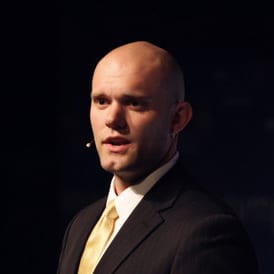
James Clear
제임스 클리어
Author of Atomic Habits
1,012 records in all
- Principles 344
- Episodes 184
- Quotes 484
3 free questions a day, no sign-up.
Photo: James Clear CC BY-SA 4.0 Original cropped
Quotes
73 basic records of 484
Quotes are word for word from the source.
Gaining an edge
To be consistent means you show up on the days when it's not perfect. In many ways, I feel like that's the only place that you gain an edge.
Our noteJames discusses how showing up during difficult times creates separation from the competition.
Self directed habits
The real question is not whether you will gain new habits, it's whether you can design them, right? Or be in control of them. Whether it can be self-directed.
Our noteJames talks about the importance of consciously designing your behaviors rather than letting them happen passively.
Perfectionism trap
In the quest to produce something great, I fell into a deep spiral of research and reading.
Our noteJames describes how perfectionism led to procrastination on his book project.
Experience based decisions
The result is that Peyton Manning can make snap decisions that are based on thousands of hours of experience.
Our noteClear describes how expertise allows for rapid, accurate decision-making.
Measure your results
The only way to figure out what works and what doesn't is to measure your results
Our noteClear emphasizes the importance of data in identifying progress.
The Power of No
I became better at saying no and turned down multiple offers to partner with people on new businesses or otherwise spread myself too thin.
Our noteJames reflects on how saying no helped him simplify his business life.
Growth and Systems
Fast growth forces you into a higher cost environment and if you don't have the systems and ability to handle those costs, you'll end up paying for it.
Our noteJames warns about the hidden costs and systemic requirements of scaling a business too quickly.
Challenge and growth
If you know enough about something to make the optimal decision on the first try, then you're not challenging yourself.
Our noteClear argues that immediate success often means the task was not challenging enough.
Memory and Bias
The easier it is to remember, the more likely we are to create a strong relationship between two things that are weakly related or not related at all.
Our noteExplaining how the ease of recall tricks our brain into seeing patterns.
Ignoring Non-Events
We are incredibly poor at remembering things that do not happen. If we don't see it, we assume it has no impact or rarely happens.
Our noteDiscussing our natural tendency to ignore events that lack a notable outcome.
Designing small behaviors
If you pick the right small behavior and sequence it right, then you won't have to motivate yourself to have it grow.
Our noteDiscussing how to build habits without relying on willpower.
The Self-Control Paradox
The people with the best self-control are typically the ones who need to use it the least. It's easier to practice self-restraint when you don't have to use it very often.
Our noteJames explains that disciplined people rely on environment rather than willpower.
Eliminating Bad Habits
One of the most practical ways to eliminate a bad habit is to reduce exposure to the cue that causes it.
Our noteA practical tip for breaking cycles of negative behavior.
Mastering the fundamentals
the biggest difference between success and failure comes from mastering the fundamentals.
Our noteThe author emphasizes that core habits outweigh optimized strategies for most people.
Ignore unnecessary requirements
You don't need more credentials to build a business. And you don't need awesome weightlifting shoes to become a good weightlifter.
Our noteJames lists things people think they need but actually don't to get started.
Ultimate Productivity Hack
The ultimate productivity hack is saying no. Not doing something will always be faster than doing it.
Our noteJames Clear explains why saying no is the most effective way to save time.
Building Self Belief
I only know of one way to develop a belief in yourself: prove your abilities over and over with small wins.
Our noteClear explains how consistent small achievements lead to a stronger sense of self-confidence.
The Result Trap
The desire to achieve results quickly fools you into thinking that the result is prize. Slow growth teaches you the truth...
Our noteHe warns against the obsession with quick results and advocates for valuing the growth process.
Systems Over Goals
This year, I made big strides toward becoming more process-oriented and focusing on the system rather than the goal.
Our noteJames reflects on shifting his mindset from being achievement-focused to being process-oriented.
Mastering the Craft
The only way to get better at the craft is to do the craft, and I spent too much time doing other things.
Our noteHe admits that his photography didn't improve because he didn't spend enough time actually practicing it.
Identity and Habits
I believe that it's more important to become the type of person that you want to become than it is to achieve a particular result.
Our noteJames discusses how habits are about building identity rather than just hitting milestones.
Courage to start
We believe that having the courage to start is more important than succeeding because the people who consistently get started are the ones who end up finishing.
Our noteHe discusses why the act of starting is the most critical predictor of eventual success.
Defining Deliberate Practice
While regular practice might include mindless repetitions, deliberate practice requires focused attention and is conducted with the specific goal of improving performance.
Our noteJames Clear explains the fundamental difference between mindless repetition and purposeful improvement.
Self Assessment Bias
In other words, we are poor judges of our own performance decreases even as we are going through them.
Our noteDiscussing how sleep-deprived individuals fail to notice their own cognitive decline.
Cumulative Sleep Debt
if you get 6 hours of sleep per night for two weeks straight, your mental and physical performance declines to the same level as if you had stayed awake for 48 hours straight.
Our noteExplaining the severe impact of moderate sleep deprivation over time.
Process over goals
I also know that the process is more important than the goal . I'm going to enjoy this one, but I'll be back in the gym on Monday.
Our noteJames reflects on maintaining a long-term perspective even after achieving a major milestone.
Eliminate the useless
If something isn't benefitting you, then eliminate it.
Our noteHe advises cutting out information sources that don't improve your life or business decisions.
The Invisible Hand
Environment is the invisible hand that shapes human behavior. We tend to believe our habits are a product of our motivation, talent, and effort.
Our noteDiscussing how external surroundings influence our daily habits more than we realize.
Schedule important tasks
Rather than hoping that I'll make the right choice each day, I've found much more success by scheduling the things that are important to me.
Our noteJames discusses why scheduling beats relying on daily motivation.
Mindset and performance
A confident and positive mindset can be both the cause of your actions and the result of them. The link between physical performance and mental attitude is a two-way street.
Our noteJames Clear explains how behavior and mindset influence each other.
You are seeing 153 basic records. Membership answers from all 1,012 of this master's records.
See membershipMore masters in this field
See the whole fieldMindset and resilience




These records are our compilation of public statements and sources. We are not affiliated with or endorsed by James Clear or any related company. If something should come down, tell us. Takedown request form