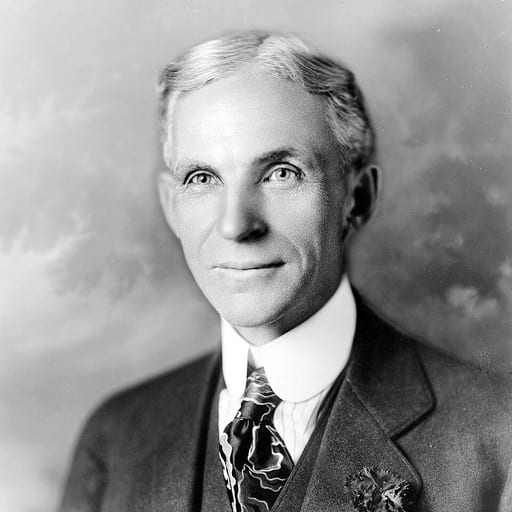
Hall of Masters

Henry Ford

헨리 포드

Founder of Ford Motor Company; the moving assembly line and the Model T

863 records in all

  • Principles 250
  • Episodes 353
  • Quotes 260
Ask with this master's words

3 free questions a day, no sign-up.

Photo: Fred Hartsook  Public domain  Original  cropped

Episodes

53 basic records of 353

Episodes are real events from public sources, summarised by us.

  • Expansion into Australia

    Henry Ford granted manufacturing rights for the British Empire to Canadian investors, leading to the founding of Ford Australia. They began by assembling Model T cars from kits in a disused wool warehouse while their factory was under construction.

    LessonStarting with assembly kits in temporary facilities is a low-risk way to enter a new geographic market.
  • Exit from Manufacturing

    After 88 years, Ford Australia announced it would stop local manufacturing due to high costs and poor sales. The company had suffered massive financial losses totaling A$600 million over five years before deciding to become a full importer.

    LessonEven long-standing operations must be closed if manufacturing costs become uncompetitive and losses unsustainable.

  • Acquisition of Ford Britain

    Ford Motor Company in the US decided to buy the remaining 46% of its British subsidiary to gain full ownership. The deal was completed in early 1961, making it a wholly owned subsidiary.

    LessonFull ownership simplifies corporate structure and aligns international branches with the parent company's goals.

  • Modernization of the Cork Plant

    Ford announced a £2 million investment to rebuild and modernize its assembly plant in Cork, Ireland. This move aimed to ensure the facility met the highest European quality standards.

    LessonContinuous investment in infrastructure is necessary to maintain competitive quality levels in global markets.

  • The Failure of Soviet Production

    Russia attempted to run factories by committees and removed skilled administrators, leading to total production failure and starvation. Eventually, they had to offer large sums to bring back the experts they had initially driven out.

    LessonExperience and technical expertise are indispensable for maintaining production and organizational health.

  • Racing for Advertising

    Although Ford disliked racing, he realized the public only valued cars that showed speed. He built a fast car and beat the national champion, Alexander Winton, to gain the only kind of attention the market cared about.

    LessonSometimes you must engage in popular trends you dislike just to get the public's attention for your product.

  • The Failure of the Expensive Model

    Ford departed from his successful small car program to design a big fifty-horsepower car. Due to the 1907 panic and the shift to this expensive model, sales dropped significantly to 6,398 cars.

    LessonStraying from a successful core product to chase luxury markets can be dangerous during economic instability.

  • Model T Cylinder Casting

    In 1910, casting was a manual, skilled process involving shovels and wheelbarrows. Ford transformed this by using machinery and a moving conveyor system, allowing 95 percent of the work to be done by unskilled laborers.

    LessonStandardizing a process allows you to scale production without needing an army of rare experts.

  • 1914Hiring

    The Five Dollar Day Policy

    Ford implemented a minimum wage of five dollars a day and an eight-hour workday. Along with this, he established a policy that no one would be refused or discharged due to their physical condition.

    LessonHigh wages and inclusive hiring can coexist if the factory is organized for maximum productivity.

  • 1921Risk

    Inventory Revaluation Crisis

    In 1921, Ford faced high inventory levels due to poor transportation infrastructure. They learned that buying ahead for speculative purposes led to financial trouble when prices eventually dropped.

    LessonSpeculation on raw materials distracts from the core business and increases financial risk.

  • The Voluntary Customer Refund

    In one year, the company's profits exceeded expectations so significantly that Ford felt they had overcharged their customers. He decided to voluntarily return fifty dollars to every person who had purchased a car that year.

    LessonTrue service means returning excess profit to the customer to build long-term loyalty and value.

  • 1921Brand

    The Decline of Baseball Attendance

    Following scandals involving gambling and Jewish influence, baseball faced a significant reduction in public support. This mirrored a similar crisis in 1875 when rowdyism and disorder caused attendance to fall heavily.

    LessonA business or sport must maintain its integrity to survive as a respectable form of entertainment.

  • The Artificial Rise of Whispering

    The song 'Whispering' was initially rejected by the public and did not catch on for a long time. Promoters persistently hammered it into the public's ears until it finally achieved popularity through sheer familiarization.

    LessonPersistence in marketing can sometimes overcome an initial lack of public interest.

  • The Fusion of Otto Rosalsky

    Judge Otto A. Rosalsky faced potential vulnerability due to his involvement in a scandal. To ensure his re-election, he was placed as the 'Fusion' candidate on both Democratic and Republican tickets, eliminating any real opposition.

    LessonEliminating competition through strategic alliances can protect a vulnerable position.

  • The Impeachment of Governor Sulzer

    Governor Sulzer was initially supported by Jewish interests who kept careful track of his campaign funds. When he acted against their wishes by pardoning a specific individual, those same supporters used their financial records to testify against him and secure his impeachment.

    LessonFinancial support often comes with strings attached that can be used to destroy the recipient if they become disobedient.

  • The Three-Way Political Hedge

    During the 1912 presidential election, the partners of Kuhn, Loeb & Company supported all three candidates: Wilson, Taft, and Roosevelt. This ensured the firm had influence regardless of the election outcome.

    LessonDiversifying political support can safeguard a business against the volatility of election cycles.

  • Skepticism Toward the Early Factory

    Ford started a small factory with only a dozen mechanics and began purchasing materials to build cars. Despite having a few cars on the streets, many observers predicted the venture would fail.

    LessonEarly-stage ventures often face skepticism from the public, but initial doubt is not a predictor of ultimate success.

  • Observing Industrial Inefficiency

    제임스 플라워 공장에서 일하며 헨리는 부품들이 규격화되지 않아 조립할 때마다 다시 깎아야 하는 비효율을 목격했어요. 그는 주먹구구식 공정 관리와 낭비되는 시간, 노동력을 보며 시스템의 문제점을 깨닫기 시작했어요.

    LessonPay attention to recurring friction and waste in your industry; these are opportunities for future innovation.

  • Testing the Early Steam Engine

    농장 일이 안정되자 헨리 포드는 5년 전에 만들었던 조잡한 증기 엔진을 다시 꺼냈어요. 비록 연기와 불꽃을 내뿜으며 덜컹거렸지만, 그것은 마당을 돌아다니며 작동했어요.

    LessonEven crude early prototypes are valuable steps in a creator's technical journey.

You are seeing 130 basic records. Membership answers from all 863 of this master's records.

See membership

More masters in this field

See the whole field

Founders and company builders

These records are our compilation of public statements and sources. We are not affiliated with or endorsed by Henry Ford or any related company. If something should come down, tell us. Takedown request form