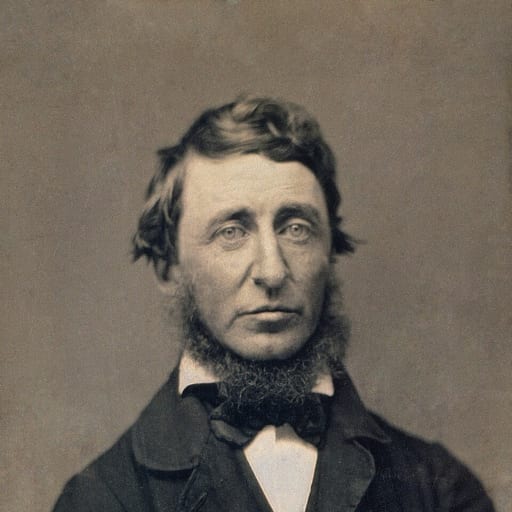
Henry David Thoreau
헨리 데이비드 소로
Author of Walden and Civil Disobedience
909 records in all
- Principles 298
- Episodes 287
- Quotes 324
3 free questions a day, no sign-up.
Photo: Benjamin D. Maxham active 1848 - 1858 Public domain Original cropped
Quotes
49 basic records of 324
Quotes are word for word from the source.
Presence in work
Of course it is of no use to direct our steps to the woods, if they do not carry us thither.
Our noteThoreau discusses the importance of being mentally present in one's current environment or task.
Pitfalls of exclusivity
To enjoy a thing exclusively is commonly to exclude yourself from the true enjoyment of it.
Our noteHe warns that private ownership and exclusivity can diminish the actual value of an experience.
Modern Relevance
It is too late to be studying Hebrew; it is more important to understand even the slang of today.
Our noteThoreau emphasizes the importance of understanding the current environment over ancient academic pursuits.
Environmental foundation
A town is saved, not more by the righteous men in it than by the woods and swamps that surround it.
Our noteHe emphasizes that the health of a community depends on its natural surroundings.
Nature of genius
Genius is a light which makes the darkness visible, like the lightning's flash, which perchance shatters the temple of knowledge itself
Our noteHe describes how true genius disrupts existing structures rather than just adding to them.
Failure of coercion
Whatever part the whip has touched is thenceforth palsied.
Our noteHe observes that motivation driven by force or fear destroys the natural vigor and spirit of the subject.
Value of ignorance
What we call knowledge is often our positive ignorance; ignorance our negative knowledge.
Our noteHe challenges the idea that accumulating facts is the same as gaining true wisdom.
Change your perspective
I might have walked about the foot of the tree for threescore years and ten, and yet I certainly should never have seen them.
Our noteHe reflects on how staying at ground level prevents us from seeing new horizons and discoveries.
Morning routine
An early morning walk is a blessing for the whole day.
Our noteNoting the positive impact of a morning walk on productivity.
Demand better standards
Let every man make known what kind of government would command his respect, and that will be one step toward obtaining it.
Our noteThoreau discusses how citizens can improve their government.
Patience in persuasion
You can hardly convince a man of an error in a lifetime, but must content yourself with the reflection that the progress of science is slow. If he is not convinced, his grandchildren may be.
Our noteThoreau reflects on the slow pace of changing people's minds and the progress of human knowledge.
Individual path
If a man does not keep pace with his companions, perhaps it is because he hears a different drummer. Let him step to the music which he hears, however measured or far away.
Our noteDefending the right to follow one's own unique pace and direction in life.
Power of solitude
I never found the companion that was so companionable as solitude. We are for the most part more lonely when we go abroad among men than when we stay in our chambers.
Our noteHe discusses the benefits of being alone for deep thinking and work.
Meaningful labor
To have done anything by which you earned money merely is to have been truly idle or worse. If the laborer gets no more than the wages which his employer pays him, he is cheated, he cheats himself.
Our noteThoreau argues that work should provide more than just financial compensation.
Mental clarity
It is important to preserve the mind's chastity in this respect.
Our noteHe emphasizes the need to keep the mind free from trivial information.
Life as a masterpiece
The bravest deed, which for the most part is left quite out of history, - which alone wants the staleness of a deed done, and the uncertainty of a deed doing, - is the life of a great man.
Our noteThoreau posits that a well-lived life is the ultimate creative act, surpassing any historical record.
Fueling for work
The Indian reminding us that he could not work without eating, we stopped to breakfast on the main shore southwest of Deer Island.
Our noteThe guide insists on stopping for a meal to maintain the energy needed for paddling.
Navigating difficult conditions
It will not do to meet them at right angles, for then they will wash in both sides, but you must take them quartering.
Our noteThoreau describes the technical skill required to paddle a canoe through high waves.
Identifying market potential
We thought it quite a discovery, and that it might well be dried and sold in the shops.
Our noteThoreau and his companion realize a wild vine could be a viable commercial product.
Subjective perception
Generally speaking, a howling wilderness does not howl; it is the imagination of the traveler that does the howling.
Our noteThoreau observes that the fears and difficulties we perceive are often products of our own minds.
Nature and infrastructure
Nature must have coöperated with art here. However, I suppose they would tell you that this name took its origin from the fact that the chief work of roadmakers in those woods is to make the swamps passable.
Our noteThoreau reflects on the difficult process of 'swamping' or making roads through the Maine woods.
Marking the path
I proposed that I should push through with what speed I could, leaving boughs to mark my path, and find the lake and the Indian, if possible, before night
Our noteThoreau decides to move ahead to find help while leaving markers for his slower companion.
Expect the unexpected
When camping in such a wilderness as this, you are prepared to hear sounds from some of its inhabitants which will give voice to its wildness.
Our noteThoreau describes the psychological preparation needed to face the sounds and sights of the wilderness.
Motivation for work
The chopper fells trees from the same motive that the mouse gnaws them--to get his living.
Our noteComparing human industry to animal survival instincts.
Risk management rules
I made it a rule to carry my knapsack when I walked, and also to keep it tied to a crossbar when in the canoe
Our noteExplaining a simple safety protocol to prevent the loss of essential supplies.
Respecting external forces
Nevertheless, when you get out on one of those lakes in a canoe like this, you do not forget that you are completely at the mercy of the wind, and a fickle power it is.
Our noteThoreau reflects on the vulnerability of a small craft against the elements.
Responsibility in crisis
I thought what I should do the next day if I did not find him, and how his relatives would feel if I should return without him.
Our noteThoreau reflects on the weight of responsibility when his companion goes missing in the wilderness.
Environment and work
it would be difficult to pursue any sedentary occupation in the woods at this season; you cannot see to read much by the light of a fire through a veil
Our noteHe explains how environmental factors like insects and poor lighting prevent focused work.
Risk of institutions
The government itself, which is only the mode which the people have chosen to execute their will, is equally liable to be abused and perverted before the people can act through it.
Our noteThoreau warns that government structures can be corrupted before they serve their purpose.
Value of non-interference
It is excellent, we must all allow; yet this government never of itself furthered any enterprise, but by the alacrity with which it got out of its way.
Our noteHe argues that progress comes from individual initiative, not bureaucratic management.
You are seeing 137 basic records. Membership answers from all 909 of this master's records.
See membershipMore masters in this field
See the whole fieldPhilosophy and wisdom traditions
These records are our compilation of public statements and sources. We are not affiliated with or endorsed by Henry David Thoreau or any related company. If something should come down, tell us. Takedown request form