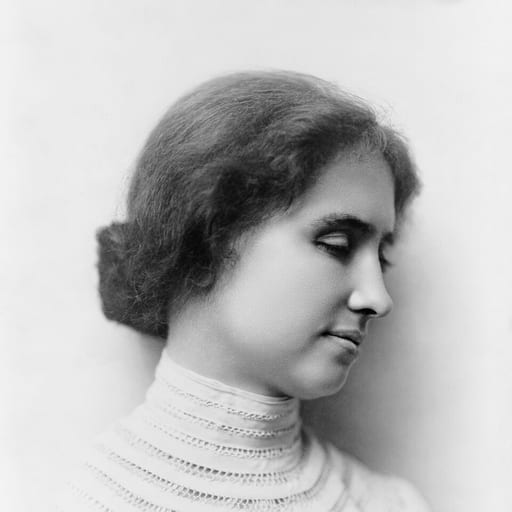
Helen Keller
헬렌 켈러
Deafblind author and activist
766 records in all
- Principles 223
- Episodes 184
- Quotes 359
3 free questions a day, no sign-up.
Photo: Unknown author Public domain Original cropped
Quotes
54 basic records of 359
Quotes are word for word from the source.
Active engagement
If, in the course of a conversation, the friend next to her has ceased for some moments to spell into her hand, the question comes inevitably, "What are you talking about?
Our noteHelen refuses to be left out of the flow of information and social interaction.
Tactile memory technique
When a passage interests her, or she needs to remember it for some future use, she flutters it off swiftly on the fingers of her right hand.
Our noteHow she uses physical movement to reinforce memory.
The power of naming
She has learned that EVERYTHING HAS A NAME, AND THAT THE MANUAL ALPHABET IS THE KEY TO EVERYTHING SHE WANTS TO KNOW.
Our noteAnne Sullivan describes the moment Helen Keller realized that words represent objects in the physical world.
Contextual learning
I find she grasps the import of whole sentences, catching from the context the meaning of words she doesn't know; and her eager questions indicate the outward reaching of her mind and its unusual powers.
Our noteSullivan observes how Helen uses context to decode language and expand her understanding.
Learning by doing
The only thing for me to do in a perplexity is to go ahead, and learn by making mistakes.
Our noteSullivan describes her approach to educational difficulties when no advice is available.
Resourceful communication
She has the true language-impulse, and shows great fertility of resource in making the words at her command convey her meaning.
Our noteSullivan describes Helen's creative ability to use a limited vocabulary to express complex ideas.
Mastery through immersion
I do not think anyone can read, or talk for that matter, until he forgets words and sentences in the technical sense.
Our noteSullivan explains that true communication happens when the mechanics of language become secondary to the thought.
Power of interest
The child's eagerness and interest carry her over many obstacles that would be our undoing if we stopped to define and explain everything.
Our noteSullivan notes that Helen's desire to communicate outweighs the need for perfect technical understanding.
Focusing on essence
I am seldom conscious of physical qualities, and I do not remember whether the fingers of a hand are short or long, or the skin is moist or dry.
Our noteShe explains that she prioritizes the character and spirit of a person over their literal physical measurements.
Value of labor
The hand symbolizes power and the excellence of work. The mechanic's hand, that minister of elemental forces, the hand that hews, saws, cuts, builds, is useful in the world equally with the delicate hand that paints
Our noteKeller reflects on how all forms of manual work contribute equally to civilization.
imperfection of senses
My few senses long ago revealed to me their imperfections and deceptivity.
Our noteHelen Keller discusses how even physical senses can be misleading and imperfect.
Independent perception
Without the shy, fugitive, often unobserved sensations and the certainties which taste, smell, and touch give me, I should be obliged to take my conception of the universe wholly from others.
Our noteHelen emphasizes the importance of direct sensory experience in forming one's own worldview.
Active participation
Rather than be shut out, I take part in it by discussing it, imagining it, happy in the happiness of those near me who gaze at the lovely hues of the sunset or the rainbow.
Our noteShe discusses her choice to engage with the world's beauty through others' experiences.
Value of perception
It was the awakening of my soul that first rendered my senses their value, their cognizance of objects, names, qualities, and properties.
Our noteShe explains that raw senses are useless without an underlying conscious mind.
Limits of consciousness
self-knowledge is the condition and the limit of our consciousness.
Our noteHelen reflects on how our internal understanding dictates our perception of the world.
Adapting to others
He must learn to see with their eyes, to hear with their ears, to think their thoughts, to follow their ideals.
Our noteHelen describes the necessity for a deaf-blind person to adapt to the majority's world.
Suspending disbelief
We leave outside the portals of Sleep all troublesome incredulities and vexatious speculations as to probability.
Our noteHelen describes how the mind accepts even the most fantastic dream scenarios without questioning their possibility.
Mental relief
In a flash, in the winking of an eye they snatch the burden from my shoulder, the trivial task from my hand
Our noteHelen explains how dreams instantly relieve her of the stress and mundane tasks of her waking life.
Measuring happiness
Most people measure their happiness in terms of physical pleasure and material possession. Could they win some visible goal which they have set on the horizon, how happy they would be!
Our noteHelen discusses how people mistakenly tie their happiness to external goals and material wealth.
True purpose of education
The student of to-day is not asked if he has learned his grammar. Is he a mere grammar-machine, a dry catalogue of scientific facts, or has he acquired the qualities of manliness?
Our noteKeller discusses how modern education should focus on character rather than rote memorization.
Openness to new ideas
His supreme lesson is to grapple with great public questions, to keep his mind hospitable to new ideas and new views of truth, to restore the finer ideals
Our noteShe emphasizes the importance of intellectual hospitality and tackling significant challenges.
Resilience After Failure
I have failed many times since; but I have never felt so disheartened as I did before that sturdy preacher gave me my lesson in the "fashion of the smiling face.
Our noteReflecting on how Robert Louis Stevenson's writing helped her overcome a period of deep discouragement.
Mental Discipline
"Drill your thoughts," he said; "shut out the gloomy and call in the bright.
Our noteShe quotes historian John Richard Green on the importance of controlling one's focus.
Definition of optimism
Optimism is the harmony between man's spirit and the spirit of God pronouncing His works good.
Our noteShe explains the spiritual foundation of her optimistic worldview.
You are seeing 115 basic records. Membership answers from all 766 of this master's records.
See membershipMore masters in this field
See the whole fieldMindset and resilience


These records are our compilation of public statements and sources. We are not affiliated with or endorsed by Helen Keller or any related company. If something should come down, tell us. Takedown request form