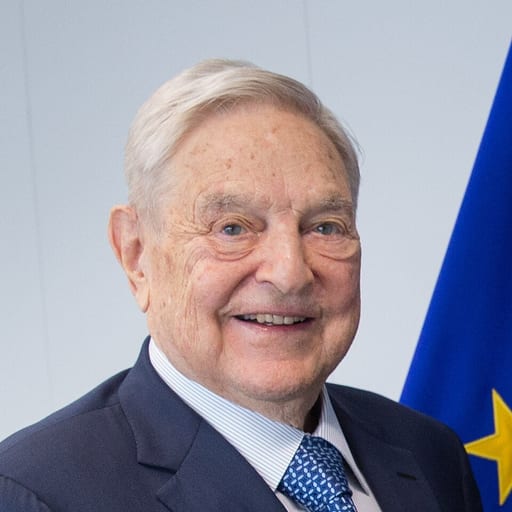
George Soros
조지 소로스
Hedge fund investor and philanthropist; theory of reflexivity
921 records in all
- Principles 312
- Episodes 195
- Quotes 414
3 free questions a day, no sign-up.
Photo: Aris Oikonomou / European Commission CC BY 4.0 Original cropped
Quotes
62 basic records of 414
Quotes are word for word from the source.
Unintended consequences
When the euro was introduced it was expected to create convergence but it brought divergence instead.
Our noteSoros notes that the actual outcome of the euro was the opposite of its goal.
Confronting Harsh Reality
The main lesson I learnt from my father is that it is better to confront harsh reality than to close your eyes to it.
Our noteSoros reflects on the fundamental life lesson he learned from his father during the war.
Profit maximization
They follow only one guiding principle: maximize profits irrespective of the consequences.
Our noteDescribing the core motivation of Facebook's leadership.
Power versus will
The U.S. had the power to break the pattern but lacked the political will.
Our noteSoros reflects on the gap between having resources and the willingness to use them.
Flaws of market fundamentalism
excessive faith in the self-regulating financial markets that Soros calls market fundamentalism inspired flawed institutional structures that call out for reform.
Our noteHe critiques the over-reliance on self-regulating markets as a basis for building institutions.
Prioritizing Multiple Crises
Obviously five crises cannot all be solved at the same time. There is a need to give preferential treatment to some of them without neglecting any.
Our noteSoros discusses the necessity of focus when an organization or entity faces several simultaneous challenges.
Market Volatility
Booms and busts are endemic in financial markets. Instead of moving like a pendulum, markets can move like a wrecking ball, knocking over one economy after another.
Our noteSoros explains the destructive nature of inherent market instability.
Self-reinforcing misconceptions
During the self-reinforcing phase, the misconception may be tested and reinforced. This widens the gap leading to an eventual reversal.
Our noteHe describes the dangerous phase where a false belief seems to be working before it fails.
Cost of delay
The later it comes, the more devastating the consequences.
Our noteSoros warns about the dangers of letting a boom-bust process reach its extreme before correcting.
Systemic reform
There is no question that the welfare system needs to be reformed so that it moves people from dependency to work.
Our noteSoros acknowledges the need for welfare reform that encourages employment.
Conditions for negotiation
The sticking point is Hamas's unwillingness to recognize the existence of Israel; but that could be made a condition for an eventual settlement rather than a precondition for negotiations.
Our noteSoros discusses how to approach negotiations with a difficult adversary.
Market efficiency timing
They believe that markets tend to be right, but usually only over the medium term.
Our noteThe author describes the shared perspective of Soros and other masters on market behavior.
Predicting market turns
The worldwide stock boom was seen generally as unsound and unsustainable, but few people correctly predicted the sudden turn of events.
Our noteDiscussing the unexpected nature of the 1987 stock market crash.
Incremental Progress
The EU has been built step-by-step, with its architects knowing in advance that each step was inadequate and that additional steps would be needed.
Our noteSoros describes the historical philosophy behind the construction of the European Union.
Iterative progress
They set themselves limited objectives and firm timelines and then mobilized the political will for a small step forward, knowing full well that when they achieved it, it will prove inadequate and require a further step.
Our noteDescribing the iterative process of building complex systems through successive steps.
Complexity and understanding
I can say from personal experience that nobody could have understood the problems in all their complexity at the time they arose.
Our noteAcknowledging that complex systemic problems are often impossible to fully grasp in real-time.
Effective Prevention Strategies
We need to invest more in preventing crime with strategies that work - deploying mental-health professionals in crisis situations, investing in youth job programs, and creating opportunities for education behind bars.
Our noteSoros advocates for proactive investment in root causes rather than just reactive punishment.
Market Limits
the invisible hand will not get us to a happy equilibrium.
Our noteDiscussing why government policy is necessary to achieve full employment rather than relying solely on market forces.
Burden of adjustment
The details differ, but the idea is the same: creditors are shifting the entire burden of adjustment onto debtors, while the "center" avoids its own responsibility for the imbalances.
Our noteHe describes how financial crises often unfairly penalize the periphery to protect the center.
Admitting mistakes
If the administration cannot recognize and admit its mistakes, it cannot correct its policies.
Our noteSoros discusses the necessity of self-correction in leadership and policy.
Correcting Mistakes
But we must remain open to the possibility that we may be wrong so that we can correct our mistakes.
Our noteHe emphasizes the importance of fallibility and the ability to change course when wrong.
Facing Reality
To pass the test, we must face reality instead of finding solace in false certainties.
Our noteSoros argues that long-term success requires dealing with facts rather than comforting illusions.
Market Price Distortion
The introduction of a significant buyer will result, not in price discovery, but in price distortion.
Our noteSoros explains why government intervention in toxic assets can ruin market signals.
Mission of inclusion
The Fund's goal is to include Roma in the education process.
Our noteDescribing the primary objective of the Roma Education Fund.
Correcting mistakes
Once we realize that imperfect understanding is the human condition, there is no shame in being wrong, only in failing to correct our mistakes.
Our noteSoros reflects on the importance of recognizing human fallibility.
Boring good investing
If investing is entertaining, if you're having fun, you're probably not making any money. Good investing is boring.
Our noteSoros explains the emotional reality of successful investing.
Avoiding moral errors
the fact that the terrorists are manifestly evil does not make whatever counter-actions we take automatically good.
Our noteCritiquing the logic of the war on terror.
Exploiting the environment
Companies earn their profits by exploiting their environment. Mining and oil companies exploit the physical environment; social media companies exploit the social environment.
Our noteSoros discusses how different industries extract value from their surroundings.
Commitment to Strategy
All the pieces need to fit together, and the chances of success remain slim. But as long as there is a strategy that might succeed, everyone who wants the EU to survive should rally behind it.
Our noteSoros emphasizes the importance of backing a viable strategy even when the odds are low.
Policy failure consequences
The administration's policies failed to deal with the underlying problems, and by protecting the banks rather than mortgage holders, they exacerbated the gap between America's haves and have-nots.
Our noteSoros explains how the 2008 bailout worsened economic inequality.
You are seeing 138 basic records. Membership answers from all 921 of this master's records.
See membershipMore masters in this field
See the whole fieldInvesting and capital allocation



These records are our compilation of public statements and sources. We are not affiliated with or endorsed by George Soros or any related company. If something should come down, tell us. Takedown request form