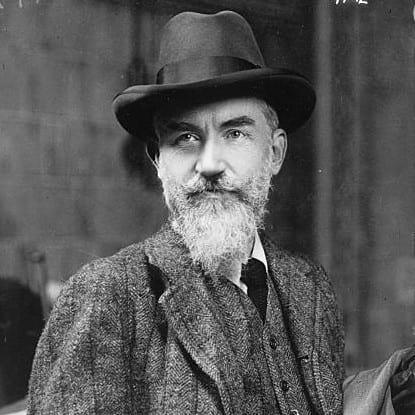
George Bernard Shaw
조지 버나드 쇼
Irish playwright, critic and Nobel laureate
784 records in all
- Principles 265
- Episodes 230
- Quotes 289
3 free questions a day, no sign-up.
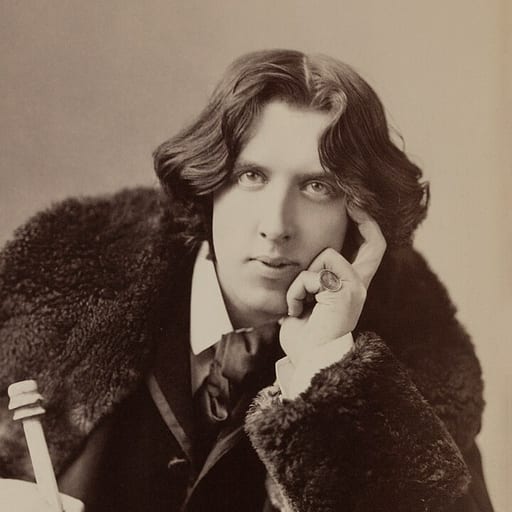
Photo: Bain News Service, publisher Public domain Original cropped
Quotes
43 basic records of 289
Quotes are word for word from the source.
Constructive criticism
The salvation of the world depends on the men who will not take evil good-humouredly, and whose laughter destroys the fool instead of encouraging him.
Our noteShaw discusses the role of the new school of drama.
Danger of indifference
The worst sin towards our fellow creatures is not to hate them, but to be indifferent to them: that's the essence of inhumanity.
Our noteA character speaks about human relations in The Devil's Disciple.
Seeking opposing views
To understand a saint, you must hear the devil's advocate; and the same is true of the artist.
Our noteShaw discusses the necessity of hearing all sides to understand a subject.
Addressing basic needs
I can't talk religion to a man with bodily hunger in his eyes.
Our noteDiscussing the priority of physical survival over spiritual matters.
Daily compromises
What is all human conduct but the daily and hourly sale of our souls for trifles?
Our noteQuestioning the small moral sacrifices people make for income and status.
The drive of desire
As long as I have a want, I have a reason for living. Satisfaction is death.
Our noteShaw discusses the necessity of having unfulfilled desires to maintain a purpose in life.
Serving customer demand
The business of a public library is not to supply the public with the books the committee thinks good for the public, but to supply the public with the books the public wants.
Our noteShaw argues against censorship and for providing what the audience actually desires.
Cure for misery
The secret of being miserable is to have leisure to bother about whether you are happy or not. The cure for it is occupation, because occupation means pre-occupation
Our noteShaw suggests that staying busy is the key to avoiding existential unhappiness.
Seizing opportunities
What is life but a series of inspired follies? The difficulty is to find them to do. Never lose a chance: it doesn't come every day.
Our noteDiscussing the nature of life and taking chances.
Attracting talent
Revolutionary movements attract those who are not good enough for established institutions as well as those who are too good for them.
Our noteAnalyzing the types of people drawn to revolutionary movements.
Avoid over-engineering products
it is waste of labor to make a machine that will last ten years, because it will probably be superseded in half that time by an improved machine answering the same purpose.
Our noteShaw explains why building for eternal durability is often a mistake in a changing world.
Avoid imposing ideals
And you will vitiate the experiment if you make the slightest attempt to abort it into some fancy figure of your own: for example, your notion of a good man or a womanly woman.
Our noteWarning against forcing children to fit preconceived notions of what they should become.
Learning from opponents
men who know their opponents and understand their case, quite commonly respect and like them, and always learn something from them.
Our noteShaw explains the benefit of engaging with dissenting opinions instead of avoiding them.
Purpose of institutions
The school remains what it was in my boyhood, because its real object remains what it was. And that object, I repeat, is to keep the children out of mischief: mischief meaning for the most part worrying the grown-ups.
Our noteShaw critiques the educational system as a form of childcare rather than true education.
Rewards of learning
freedom of movement in a city is the reward of learning how to read public notices, and to count and use money.
Our noteShaw explains how practical skills grant individuals greater autonomy in society.
Natural Market Fit
If Shakespear, or for that matter, Newton and Leibnitz, are allowed to find their readers and students they will find them.
Our noteShaw argues that great works find their audience naturally without being forced on people.
Understanding the audience
The child cannot conceive that its blame or contempt or want of interest could possibly hurt its parent, and therefore expresses them all with an indifference which has given rise to the term _enfant terrible
Our noteShaw explains why children often unintentionally hurt their parents' feelings through sincere indifference.
Engaging content
nobody, except under threat of torture, can read a school book. The reason is that a school book is not a work of art.
Our noteHe explains why traditional educational materials fail to capture attention.
Hostility toward excellence
Do not for a moment suppose that uncultivated people are merely indifferent to high and noble qualities. They hate them malignantly.
Our noteShaw observes that a lack of cultural education leads to active resentment of high quality rather than simple ignorance.
Failure of restriction
You have not stifled a single passion nor averted a single danger: you have depraved the passions by starving them, and broken down all the defences which so effectively protect children brought up in freedom.
Our noteShaw criticizes parents who try to protect children by shielding them from art and reality.
Training for success
Freedom and wealth are difficult and responsible conditions to which men must be accustomed and socially trained from birth.
Our noteShaw discusses why sudden freedom or wealth often fails those unprepared for it.
The cost of control
Liberty is the breath of life to nations; and liberty is the one thing that parents, schoolmasters, and rulers spend their lives in extirpating for the sake of an immediately quiet and finally disastrous life.
Our noteShaw discusses how authority figures sacrifice long-term freedom for short-term compliance.
Underestimating market demand
When it first appeared I was ungrateful enough to remonstrate with its publisher for printing, as I thought, more copies than the most sanguine Wagnerite could ever hope to sell.
Our noteShaw reflects on his initial skepticism about the sales potential of his book.
Steady sales growth
But the result proved that exactly one person buys a copy on every day in the year, including Sundays; and so, in the process of the suns, a reprint has become necessary.
Our noteShaw explains how consistent, daily sales led to the need for a second edition.
Filling knowledge gaps
All I pretend to do in this book is to impart the ideas which are most likely to be lacking in the conventional Englishman's equipment.
Our noteShaw defines his unique value proposition as a commentator with a specific background.
Limits of power
He, the greatest of gods, has been unable to control his fate: he has been forced against his will to choose between evils, to make disgraceful bargains, to break them still more disgracefully
Our noteShaw describes the god Wotan's struggle with compromise and fate.
Hope in adversity
The unlucky stranger, left brooding by the hearth, has nothing to console himself with but an old promise of his father's that he shall find a weapon to his hand when he most needs one.
Our noteShaw describes Siegmund's desperate situation before finding the sword Nothung.
Belief in destiny
She has always felt, she says, that her miseries will end in the arms of the hero who shall succeed in drawing it forth.
Our noteSieglinda explains her hope that a hero will come to rescue her.
Tools for heroic will
Mimmy can make mischievous swords; but it is not with dwarf made weapons that heroic man will hew the way of his own will through religions and governments and plutocracies
Our noteThe limitations of conventional tools when trying to break through systemic barriers.
Prerequisites for Liberty
Liberty is an excellent thing; but it cannot begin until society has paid its daily debt to Nature by first earning its living.
Our noteShaw explains that economic survival must precede the luxury of absolute liberty.
You are seeing 118 basic records. Membership answers from all 784 of this master's records.
See membershipMore masters in this field
See the whole fieldCraft, arts and performance


These records are our compilation of public statements and sources. We are not affiliated with or endorsed by George Bernard Shaw or any related company. If something should come down, tell us. Takedown request form