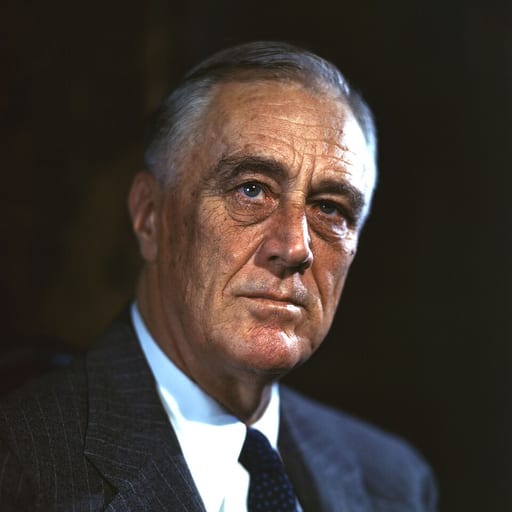
Franklin D. Roosevelt
프랭클린 D. 루스벨트
US president who led through the Great Depression and World War II
945 records in all
- Principles 282
- Episodes 224
- Quotes 439
3 free questions a day, no sign-up.
Quotes
66 basic records of 439
Quotes are word for word from the source.
Reciprocity in relationships
If you treat people right they will treat you right - ninety percent of the time.
Our noteRoosevelt shares a rule of thumb for dealing with others.
Need for speed
But it may be that an unprecedented demand and need for undelayed action may call for temporary departure from that normal balance of public procedure.
Our noteRoosevelt discusses the necessity of swift action during a national crisis.
Facing Sudden Crisis
Yesterday, December 7th, 1941 - a date which will live in infamy - the United States of America was suddenly and deliberately attacked by naval and air forces of the Empire of Japan
Our noteRoosevelt announces the surprise attack on Pearl Harbor to Congress.
Transparent communication
I want to tell you what has been done in the last few days, why it was done, and what the next steps are going to be.
Our noteRoosevelt explains his goal of clarifying complex government actions to the average citizen during a crisis.
Restoring confidence
I can assure you that it is safer to keep your money in a reopened bank than under the mattress.
Our noteEncouraging the public to return to the formal banking system by emphasizing its relative safety.
Experimental mindset
I have clearly stated that this method is in a sense experimental, but so far as we have gone we have reason to believe that it will produce good results.
Our noteHe acknowledges the experimental nature of the new Farm Act while remaining optimistic.
Speed of Execution
The blanket agreements, however, which I am sending to every employer will start the wheels turning now, and not six months from now.
Our noteDiscussing the need for immediate action rather than waiting for perfect industry codes.
Small Business Importance
These smaller employers are indeed a vital part of the backbone of the country, and the success of our plans lies largely in their hands.
Our noteAcknowledging the critical role of small businesses in economic recovery.
Funding ready projects
Washington has the money and is waiting for the proper projects to which to allot it.
Our noteHe notes that capital is available for local public works once viable plans are presented.
Long term policy
My aim in taking this step is to establish and maintain continuous control. This is a policy and not an expedient.
Our noteRoosevelt emphasizes that his monetary moves are part of a deliberate long-term strategy.
Practical Leadership
I believe in practical explanations and in practical policies. I believe that what we are doing today is a necessary fulfillment of what Americans have always been doing
Our noteRoosevelt emphasizes the importance of practical action over complex theoretical labels.
Customer Confidence
A business that loses the confidence of its customers and the good- will of the public cannot long continue to be a good risk for the investor.
Our noteRoosevelt explains why public utility companies must maintain public trust to remain viable.
Open Feedback Loop
Feel free to criticize. Tell me of instances where work can be done better, or where improper practices prevail.
Our noteRoosevelt encourages citizens to report inefficiency to improve government operations.
Restoring Confidence
Fear is vanishing and confidence is growing on every side, renewed faith in the vast possibilities of human beings to improve their material and spiritual status
Our noteRoosevelt reflects on the psychological recovery of the nation during the Great Depression.
Respect for labor
We insist that labor is entitled to as much respect as property.
Our noteEmphasizing that human effort deserves the same legal and social standing as capital.
Economic freedom
The Fourth of July commemorates our political freedom--a freedom which without economic freedom is meaningless indeed.
Our noteArguing that political rights require a foundation of economic security to be real.
First hand knowledge
Anyone charged with proposing or judging national policies should have first-hand knowledge of the nation as a whole.
Our noteRoosevelt emphasizes the importance of leaving the office to see the real situation.
Domestic market potential
American industry has searched the outside world to find new markets--but it can create on its very doorstep the biggest and most permanent market it has ever had.
Our noteHighlighting that increasing the purchasing power of local workers creates a massive new customer base.
Cost of idleness
Lost working time is lost money. Every day that a workman is unemployed, or a machine is unused, or a business organization is marking time, it is a loss to the nation.
Our noteRoosevelt explains why unemployment and unused industrial capacity are direct financial losses to the economy.
Integrity in leadership
I must never let the greater interest of all the people down, merely because that might be for the moment the easiest personal way out.
Our noteRoosevelt reflects on the temptation to take the easy path instead of doing what is right for the majority.
Inventory and pricing mistakes
Last year the leaders of private enterprise pleaded for a sudden curtailment of public spending, and said they would take up the slack. But they made the mistake of increasing their inventories too fast and setting many of their prices too high for their goods to sell.
Our noteRoosevelt explains how private sector leaders contributed to the economic downturn in 1937.
Deliberate Decision Making
I have no illusions about the gravity of this step. I have not taken it hurriedly or lightly. It is the result of months and months of constant thought and anxiety and prayer.
Our noteRoosevelt explains the weight of his decision to protect American defense zones.
Continuous productivity
We shall not stop work for a single day. If any dispute arises we shall keep on working while the dispute is solved by mediation, or conciliation or arbitration--until the war is won.
Our noteRoosevelt emphasizes the importance of uninterrupted labor during a national crisis.
Decisive use of power
The American people can also be sure that I shall not hesitate to use every power vested in me to accomplish the defeat of our enemies in any part of the world where our own safety demands such defeat.
Our noteRoosevelt discusses the necessity of using executive power to protect the nation during total war.
Inner satisfaction in work
all of us can have that deep and permanent inner satisfaction that comes from doing the best we know how--each of us playing an honorable part in the great struggle to save our democratic civilization.
Our noteRoosevelt encourages citizens by validating the importance of every individual's contribution to the war effort.
Armchair experts
The trouble with the typewriter strategists is that while they may be full of bright ideas, they are not in possession of much information about the facts or problems
Our noteCriticizing commentators who offer military advice without access to real data.
Total Effort Required
We will win this war only as we produce and deliver our total American effort on the high seas and on the battle fronts. And that requires unrelenting, uninterrupted effort here on the home front.
Our noteRoosevelt emphasizes that victory depends on the continuous production of resources at home.
Risks of Interruption
A stopping of the coal supply, even for a short time, would involve a gamble with the lives of American soldiers and sailors and the future security of our whole people.
Our noteHe explains how a break in the supply chain endangers the entire organization's mission.
Unified operations
For the longer this war goes on the clearer it becomes that no one can draw a blue pencil down the middle of a page and call one side "the fighting front" and the other side "the home front."
Our noteHe emphasizes that the support system is inseparable from the frontline execution.
Strategic Planning
We discussed all the manifold military plans for striking at Japan with decisive force from many directions, and I believe I can say that he returned to Chungking with the positive assurance of total victory
Our noteRoosevelt describes his meeting with Chiang Kai-shek to coordinate the war effort in the Far East.
You are seeing 142 basic records. Membership answers from all 945 of this master's records.
See membershipMore masters in this field
See the whole fieldLeaders in history and crisis
These records are our compilation of public statements and sources. We are not affiliated with or endorsed by Franklin D. Roosevelt or any related company. If something should come down, tell us. Takedown request form