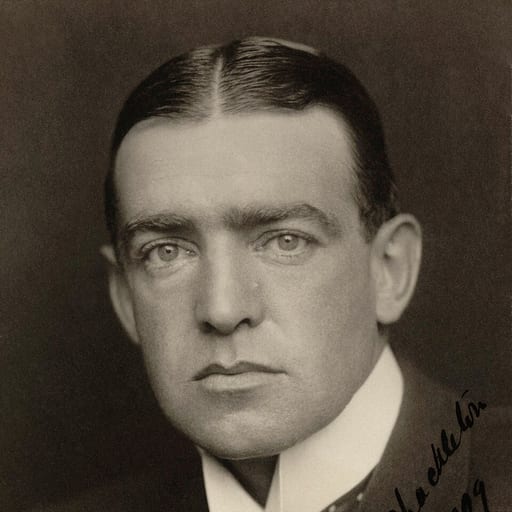
Ernest Shackleton
어니스트 섀클턴
Antarctic explorer who brought every man of the Endurance expedition home
799 records in all
- Principles 251
- Episodes 331
- Quotes 217
3 free questions a day, no sign-up.
Photo: George Charles Beresford / Adam Cuerden Public domain Original cropped
Quotes
33 basic records of 217
Quotes are word for word from the source.
Worst case preparation
It must even be possible to eat these foods without any cooking, because the fuel may be lost or exhausted.
Our noteHe emphasizes the need for products that work even when essential resources fail.
Selecting a base
I was soon satisfied that Cape Royds would be an excellent place at which to land our stores, and after taking soundings we pulled out towards the ship which had slowly been coming in.
Our noteShackleton was scouting the Antarctic coast for a suitable place to build their winter quarters.
Calculated logistical risk
It was a risk to take ponies from the far north through the tropics, and then across two thousand miles of stormy sea on a very small ship, but we eventually established ourselves at the winter quarters with eight ponies.
Our noteShackleton explains the difficulty and risk involved in transporting livestock for the expedition.
Using obstacles for navigation
Though they have many disadvantages, they are occasionally very welcome; for sometimes it is impossible to see the way to steer unless one takes the line of sastrugi and notes the angle
Our noteShackleton explains how wind-furrows in the snow, though annoying, can actually help with steering in low visibility.
Shared Responsibility
all the party had to do a certain amount of work for the common weal, apart from their own scientific duties.
Our noteThe leader describes how every member contributed to the basic upkeep of the camp.
Building reserves
To economise we saved three lumps of sugar each day so that in time we might build up a reserve stock, while Quan with his marvellous digestion preferred to eat a yard of creosoted rope
Our noteShackleton contrasts the men's disciplined rationing with the ponies' wasteful and strange eating habits.
Focus on present
No man of us could even guess what wonders might be revealed to us in our march south, and our imaginations took wings until a stumble in the snow or the sharp pangs of hunger brought back our attention to the needs of the immediate present.
Our noteThe team balances the awe of discovery with the harsh physical realities of their journey.
Resource management
By this time we were fully conscious that food was to be the key to our success or failure to reach the Pole, and we began to save food in order to spin it out
Our noteShackleton realizes that strict rationing is the only way to sustain their long-term goal.
Extreme prioritization
we resolved to make each week's food last ten days, and to throw away everything except the most absolute necessities.
Our noteThe team committed to extreme scarcity to extend their operational runway.
Survival milestones
Continually we seemed to be fighting for the same thing, to struggle on from one depot to the next to save ourselves from starvation.
Our noteThe grueling return journey where survival depended on reaching food depots.
Persistent forward motion
Still, there was nothing to do except to push ahead, and once we thought that we saw a party coming over to meet us, but to our sorrow the "party" turned out to be a group of penguins at the ice edge.
Our noteDespite exhaustion and hallucinations, the team kept moving toward their goal.
Preparing for variability
Evidently the Barrier surface varies remarkably, and the traveller must be prepared for either a very hard or a very soft surface, both of which he may encounter in the same day's march.
Our noteReflecting on the unpredictable terrain, Shackleton emphasizes the need for constant readiness for changing conditions.
Strategic resource allocation
How to reach the Pole was still our engrossing subject of discussion, and on November 1 we decided that our only hope of reaching it, was by travelling on half-rations
Our noteShackleton discusses the necessity of cutting rations to achieve their ultimate goal.
Scarcity and discipline
At first, on this expedition, when biscuits were more plentiful we had munched them boldly, regardless of the loss of crumbs. Not so at this time, when crumbs were collected most carefully
Our noteShackleton reflects on how their behavior changed as resources became scarce.
Adjusting to reality
It would, therefore, be necessary to travel farther in that direction than we had expected, if we were to reach our goal.
Our noteThe team realized the Magnetic Pole had shifted, requiring a longer journey than planned.
Choosing efficient methods
we decided that pulling the sledge was less exhausting than the sailing had proved to be.
Our noteThe team evaluates which method of movement is actually more sustainable for their long-term progress.
Recognizing capacity
He had, throughout the whole journey, shown excellent capacity for leadership, and when I spoke to him he at first demurred, but finally said he would act for a time.
Our noteShackleton describes Mawson's reaction to being asked to lead during a critical moment.
Deciding next steps
We also talked about what it would be best to do if the Nimrod did not appear, and determined that we ought to tackle the journey to Hut Point
Our noteThe team plans their survival strategy in case the rescue ship fails to find them.
Urgency in execution
If we were to try to complete our work there was no time to be lost, for the season was far advanced and the condition of the ice was already a matter of anxiety.
Our noteShackleton explains the need for speed when the Antarctic season began to close in.
Value in failure
I think that though failure in the actual accomplishment must be recorded, there are chapters in this book of high adventure, strenuous days, lonely nights, unique experiences, and, above all, records of unflinching determination
Our noteReflecting on the outcome of the expedition despite not reaching the original goal.
Expectation versus reality
I had been prepared for evil conditions in the Weddell Sea, but had hoped that in December and January, at any rate, the pack would be loose
Our noteHe reflects on how the ice conditions were much tougher than he had anticipated for the season.
Persistent Iteration
The operation would be repeated until a short dock was cut, into which the ship, acting as a large wedge, was driven.
Our noteShackleton details the repetitive process of ramming the ice to create a path for the ship.
Assessing environmental risks
Killer-whales were becoming active around us, and I had to exercise caution in allowing any one to leave the ship.
Our noteHe describes the danger posed by predators to his crew during the expedition.
Critical survival question
The vital question for us was whether or not the ice would open sufficiently to release us, or at least give us a chance of release, before the drift carried us into the most dangerous area.
Our noteShackleton identifies the primary risk factor for the ship's survival in the Weddell Sea.
Taking control
At any rate, we were on the move at last, and if dangers and difficulties lay ahead we could meet and overcome them. No longer were we drifting helplessly at the mercy of wind and current.
Our noteThe relief of finally being able to row toward safety instead of drifting on a floe.
Decisive action
Obviously we must make land quickly, and I decided to run for Elephant Island.
Our noteThe crew was exhausted and the weather was worsening, requiring a change in course.
Prioritizing speed
I regarded speed as essential. Sometimes collisions were not averted.
Our noteThe boats were navigating through dangerous ice pack to reach safety.
Delegation with limits
I told him he could try, but he must not lose sight of the _James Caird
Our noteShackleton gave Worsley permission to scout ahead while maintaining a safety connection.
Moving forward
The only thing was to go ahead and hope for the best.
Our noteHe describes the feeling of being unable to help a struggling boat while battling the storm.
Celebrating small wins
After all, another stage of the homeward journey had been accomplished and we could afford to forget for an hour the problems of the future.
Our noteThe crew finds brief contentment after reaching a new beach despite their dire situation.
You are seeing 121 basic records. Membership answers from all 799 of this master's records.
See membershipMore masters in this field
See the whole fieldLeaders in history and crisis
These records are our compilation of public statements and sources. We are not affiliated with or endorsed by Ernest Shackleton or any related company. If something should come down, tell us. Takedown request form