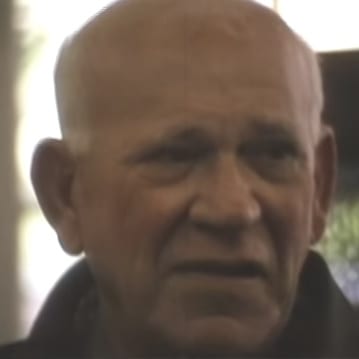
Eric Hoffer
에릭 호퍼
Longshoreman philosopher, author of The True Believer
113 records in all
- Principles 30
- Episodes 13
- Quotes 70
3 free questions a day, no sign-up.
Photo: White House of the President of the United States; uploaded to YouTube by TheLBJLibrary Public domain Original cropped
Quotes
11 basic records of 70
Quotes are word for word from the source.
Clarity of thought
There is not an idea that cannot be expressed in 200 words. But the writer must know precisely what he wants to say.
Our noteHoffer explaining the importance of knowing one's message.
Maintaining self-esteem
The maintenance of self-esteem is a continuous task which taxes all of the individual's powers and inner resources. We have to prove our worth and justify our existence anew each day.
Our noteHoffer writing about the autonomous individual's struggle.
Self deception
We lie loudest when we lie to ourselves.
Our noteA short observation on the intensity of internal dishonesty.
Internal literacy
No one is truly literate who cannot read his own heart.
Our noteDefining true literacy as the ability to understand one's own motivations.
Unemployed intellectuals
Nothing is so unsettling to a social order as the presence of a mass of scribes without suitable employment and an acknowledged status.
Our noteHe explains the danger of having many educated people without clear roles in society.
Managing the untalented
Actually, it is the ability to give scope to the untalented that is most vital in maintaining social stability.
Our noteHoffer argues that social stability depends on how a system treats those without special talents.
Fate of movements
Up to now, America has not been a good milieu for the rise of a mass movement. What starts out here as a mass movement ends up as a racket, a cult, or a corporation.
Our noteHoffer observes how social movements in America tend to become institutionalized or commercialized.
The nature of freedom
The desire for freedom is an attribute of a "have" type of self. It says: leave me alone and I shall grow, learn, and realize my capacities.
Our noteHoffer compared the desire for freedom with the desire for power.
Talent as persistence
At the core of every true talent there is an awareness of the difficulties inherent in any achievement, and the confidence that by persistence and patience something worthwhile will be realized. Thus talent is a species of vigor.
Our noteDiscussing why talent requires effort and application rather than just inspiration.
Thinking as caricature
To think out a problem is not unlike drawing a caricature. You have to exaggerate the salient point and leave out that which is not typical.
Our noteExplaining the process of illustrating a principle by focusing on salient points.
Persistence in thinking
What counts most is holding on. The growth of a train of thought is not a direct forward flow. There is a succession of spurts separated by intervals of stagnation, frustration, and discouragement.
Our noteHoffer explains that intellectual progress requires enduring periods of frustration.
You are seeing 19 basic records. Membership answers from all 113 of this master's records.
See membershipMore masters in this field
See the whole fieldPhilosophy and wisdom traditions


These records are our compilation of public statements and sources. We are not affiliated with or endorsed by Eric Hoffer or any related company. If something should come down, tell us. Takedown request form