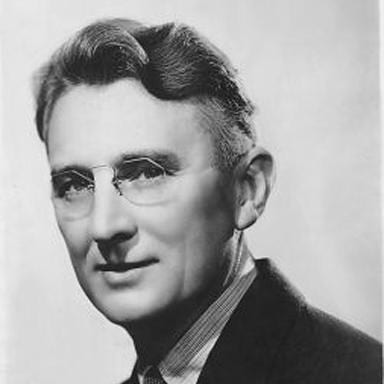
Dale Carnegie
데일 카네기
Author of How to Win Friends and Influence People
561 records in all
- Principles 166
- Episodes 95
- Quotes 300
3 free questions a day, no sign-up.
Photo: Unknown author Public domain Original cropped
Quotes
45 basic records of 300
Quotes are word for word from the source.
Qualities for success
Flaming enthusiasm, backed up by horse sense and persistence, is the quality that most frequently makes for success.
Our noteDefining the combination of traits that lead to achievement.
Character and criticism
Any fool can criticize, condemn and complain - and most fools do. But it takes character and self-control to be understanding and forgiving.
Our noteContrasting common criticism with the strength required for diplomacy.
The secret of success
"If there is any one secret of success," says Henry Ford, "it lies in the ability to get the other person's point of view and see things from that person's angle as well as from your own."
Our noteQuoting Henry Ford on the importance of empathy in relationships.
Genuine interest
You can make more friends in two months by being interested in them, than in two years by making them interested in you.
Our noteExplaining how to build relationships effectively.
Action Before Study
The first thing for the beginner in public speaking is to speak--not to study voice and gesture and the rest. Once he has spoken he can improve himself by self-observation or according to the criticisms of those who hear.
Our noteHe advises beginners to start speaking immediately rather than getting bogged down in theory.
Expect success
If you believe you will fail, there is no hope for you. You will. Rid yourself of this I-am-a-poor-worm-in-the-dust idea. You are a god, with infinite capabilities.
Our noteCarnegie warns against the self-fulfilling prophecy of expecting failure and encourages a powerful mindset.
Commanding the start
Do not make haste to begin--haste shows lack of control. Do not apologize. It ought not to be necessary; and if it is, it will not help. Go straight ahead.
Our noteCarnegie gives tactical advice on how to project authority and confidence from the very beginning.
Danger of Monotony
Monotony reveals our limitations. In its effect on its victim, monotony is actually deadly--it will drive the bloom from the cheek and the lustre from the eye as quickly as sin
Our noteHe explains how a lack of variation destroys the impact of a message and the speaker's energy.
Power of Low Pitch
One of the secrets of Mr. Bryan's eloquence is his low, bell-like voice. Shakespeare said that a soft, gentle, low voice was "an excellent thing in woman;" it is no less so in man
Our noteHe advises speakers to avoid overly high pitches, noting that low voices are often more pleasing and powerful.
Power of Pace
when a speaker delivers a whole address at very nearly the same rate of speed he is depriving himself of one of his chief means of emphasis and power.
Our noteCarnegie explains why varying the speed of delivery is essential for effective public speaking.
Authentic intensity
But remember that the emotion in the matter must warrant the intensity in the manner, or the effect will be ridiculous.
Our noteCarnegie warns that delivery style must match the emotional weight of the message.
Power of Pausing
one of the most important means of developing power in public speaking is to pause either before or after, or both before and after, an important word or phrase.
Our noteCarnegie explains the fundamental technique of using silence to emphasize key points in a speech.
Follow your course
You will succeed best by daring to follow your own course--if you are individual enough to blaze an original trail.
Our noteHe encourages speakers to trust their own interpretation rather than strictly following rules.
Thought over punctuation
Thought is greater than punctuation. It must guide you in your pauses.
Our noteCarnegie emphasizes that the meaning of the words should dictate the timing of pauses.
Conviction in subject
Live with your subject until you are convinced of its importance.
Our noteHow to acquire the vital factor of force in communication.
Driving immediate action
When you want to get action, do not fear to use dynamite.
Our noteUsing forceful delivery when the goal is to move the audience to act.
Power of Emotion
The speeches that will live have been charged with emotional force. Prosperity and peace are poor developers of eloquence.
Our noteDiscussing how great crises often produce the most memorable and effective speeches.
Effective Speaking
The speaker who would speak efficiently must develop the power to arouse feeling.
Our noteA core requirement for anyone looking to influence others through speech.
Power of enthusiasm
Strange as it may seem when the story is told in cold print, the speaker's enthusiasm had swept his audience with him, and they crushed around his stand with outstretched "quarters" in their anxiety to be the possessors of these magical plates!
Our noteDescribing how a street salesman's sheer enthusiasm convinced a crowd to buy useless copper plates.
Natural vocal delivery
The voice is a delicate instrument, and you must not handle it with hammer and tongs. Don't _make_ your voice go--_let_ it go.
Our noteCarnegie advises on how to use the voice without causing strain.
Practice with joy
Practise your voice exercises in an attitude of joy.
Our noteCarnegie advises on the physical and mental state required for effective skill development.
Preparation for speaking
It is always well to rest and be entirely refreshed before attempting to deliver a public address.
Our noteCarnegie emphasizes the importance of physical vitality for a resonant and charming voice.
Causes of bad speech
Slovenly pronunciation results from either physical deformity or habit.
Our noteCarnegie identifies the root causes of poor articulation in speakers.
Clear speech
He who is too lazy to speak distinctly should hold his tongue.
Our noteCarnegie emphasizes the importance of distinct articulation in public speaking.
Lifelong learning
It is the work of a lifetime to learn the accents of a large vocabulary and to keep pace with changing usage
Our noteHe discusses the ongoing effort required to master correct pronunciation.
Importance of delivery
The crown, the consummation, of the discourse is its delivery. Toward it all preparation looks, for it the audience waits, by it the speaker is judged.
Our noteCarnegie emphasizes that the final delivery is the most critical part of any speech.
Reading vs speaking
public reading is not public speaking. Yet there are so many who grasp this broken reed for support that we must here discuss the "read speech"--apologetic misnomer as it is.
Our noteCarnegie argues that reading from a manuscript is a poor substitute for true speaking.
Price of success
You may "make a fool of yourself" once or twice, but is that too great a price to pay for success?
Our noteHe encourages speakers to risk embarrassment while practicing extemporaneous delivery.
Preventing empty minds
The real solution of the problem of what to do with an empty head is never to let it become empty.
Our noteCarnegie emphasizes the importance of continuous learning to avoid being caught without ideas.
Definition of thinking
Thinking is doing mental arithmetic with facts. Add this fact to that and you reach a certain conclusion. Subtract this truth from another and you have a definite result. Multiply this fact by another and have a precise product.
Our noteCarnegie explains that thinking is a logical, mathematical process of combining facts to reach conclusions.
You are seeing 84 basic records. Membership answers from all 561 of this master's records.
See membershipMore masters in this field
See the whole fieldSales and persuasion

These records are our compilation of public statements and sources. We are not affiliated with or endorsed by Dale Carnegie or any related company. If something should come down, tell us. Takedown request form