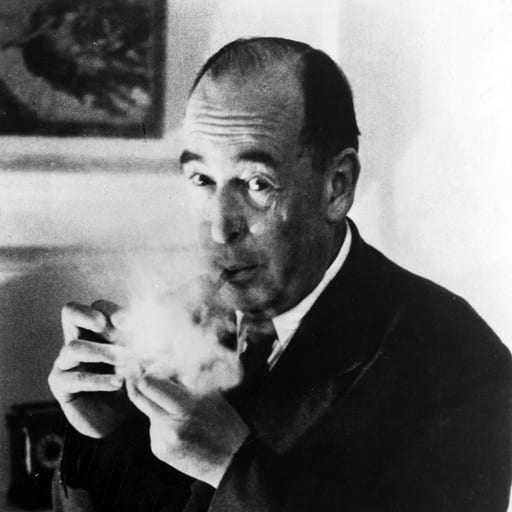
C. S. Lewis
C. S. 루이스
British writer and scholar; author of The Chronicles of Narnia
189 records in all
- Principles 58
- Episodes 40
- Quotes 91
3 free questions a day, no sign-up.
Photo: John S. Murray Public domain Original cropped
Quotes
14 basic records of 91
Quotes are word for word from the source.
Importance of friendship
Friendship is the greatest of worldly goods. Certainly to me it is the chief happiness of life.
Our noteLewis was advising a young man on where to live and what to prioritize.
Skepticism of media
You see, whenever they deal with anyone (or anything) I know myself, I find they're always a mass of lies & misunderstandings: so I conclude they're no better in the places where I don't know.
Our noteLewis was explaining why he does not form opinions based on newspaper reports.
Dangers of repetition
If you make the same guess often enough it ceases to be a guess and becomes a Scientific Fact. This is the inductive method.
Our noteDiscussing how repeated assumptions can be mistaken for proven facts.
Small choices matter
The choice of ways so small, the event so great, Should thus entwine.
Our noteA poem about how tiny deviations in path lead to vastly different outcomes.
The illusion of benevolence
Everyone feels benevolent if nothing happens to be annoying him at the moment.
Our noteObserving how human goodness is often dependent on comfortable circumstances.
Intellect and emotion
Without the aid of trained emotions the intellect is powerless against the animal organism.
Our noteDiscussing the necessity of character training beyond mere logic.
Foundations of science
Men became scientific because they expected law in Nature; and they expected law in Nature because they believed in a Legislator.
Our noteExplaining the historical relationship between faith and scientific inquiry.
Danger of absolutes
The most dangerous thing you can do is to take any one impulse of your own nature and set it up as the thing you ought to follow at all costs.
Our noteLewis warns against letting a single instinct override all other moral considerations.
Standards of judgment
A man does not call a line crooked unless he has some idea of a straight line. What was I comparing this universe with when I called it unjust?
Our noteLewis reflects on his former argument against God based on the universe's injustice.
Focus on present duty
To play well the scenes in which we are "on" concerns us much more than to guess about the scenes that follow it.
Our noteComparing human life to actors on a stage who do not know the plot.
Testing Beliefs
You never know how much you really believe anything until its truth or falsehood becomes a matter of life and death to you.
Our noteLewis argues that true conviction is only revealed when one faces a real crisis.
Expanding your perspective
The man who is contented to be only himself, and therefore less a self, is in prison. My own eyes are not enough for me, I will see through those of others.
Our noteDiscussing how reading literature allows a person to transcend their own limited experience.
Action versus intention
It's so much easier to pray for a bore than to go and see one.
Our noteA witty observation on the difficulty of practical charity compared to private devotion.
Logical argument first
You must show that a man is wrong before you start explaining why he is wrong. The modern method is to assume without discussion that he is wrong and then distract his attention
Our noteLewis critiques the logical fallacy he calls Bulverism.
You are seeing 29 basic records. Membership answers from all 189 of this master's records.
See membershipMore masters in this field
See the whole fieldPhilosophy and wisdom traditions

These records are our compilation of public statements and sources. We are not affiliated with or endorsed by C. S. Lewis or any related company. If something should come down, tell us. Takedown request form