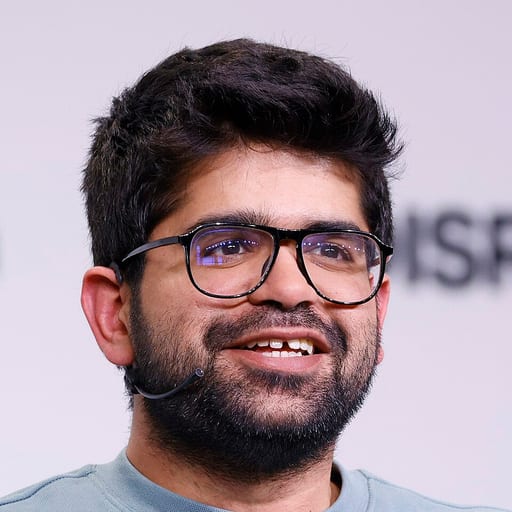
Aravind Srinivas
아라빈드 스리니바스
Co-founder and CEO of Perplexity AI
109 records in all
- Principles 53
- Episodes 29
- Quotes 27
3 free questions a day, no sign-up.
Quotes
10 basic records of 27
Quotes are word for word from the source.
Next generation models
The next generation model will be smarter. (00:12:08) You can do these amazing things like planning, query, breaking it down to pieces, collecting information, aggregating from sources, using different tools.
Our noteDiscussing the future capabilities of AI models in search and planning.
Product layer focus
there's still a lot of work to do on the product layer in terms of how the information is best presented to the user, and how you think backwards from what the user really wanted
Our noteEmphasizing that the product experience is as important as the underlying AI model.
Avoiding direct competition
In fact, I feel the primary difference of Perplexity from other startups that have explicitly laid out that they're taking on Google is that we never even tried to play Google at their own game.
Our noteAravind describes Perplexity's strategy of not trying to build a better version of Google's existing product.
Rethinking UI
The disruption comes from rethinking the whole UI itself. Why do we need links to be occupying the prominent real estate of the search engine UI? Flip that.
Our noteDiscussing how changing the interface is a key part of disrupting established search engines.
The Margin Trap
There's literally no reason to go chase something lower margin instead of expanding whatever high margin business you already have.
Our noteAravind explains why dominant companies like Google are slow to innovate in lower-margin areas.
Maintaining user trust
The trick is to really figure out how to do it in a way that doesn't make users lose trust in your product, and yet build something that can connect people with the right source of information.
Our noteAravind discusses the challenge of integrating advertisements into an AI-driven search product without compromising quality.
Contrarian competition strategy
they didn't compete with the other search engines by doing the same thing. They flipped it like they said, "Hey, everyone's just focusing on text-based similarity, traditional information extraction and information retrieval, which was not working that great.
Our noteHe reflects on why Google's early approach was superior to its competitors.
Unbounded human curiosity
Curiosity is unbounded in this world. Every person in the world is curious, but not all of them are blessed to translate that curiosity into a well-articulated question.
Our noteAravind explains why Perplexity suggests related questions to help users express their curiosity.
Growth trade-offs
When you're growing, when you're trying to grow the user base but also retain your existing users, making sure you're not, how do you balance the trade-offs?
Our noteHe discusses the difficulty of balancing features for new users versus power users.
Focus on product utility
What matters is, the answer works. The answer is fast, accurate, readable, nice, the product works. And nobody, if you really want AI to be widespread where every person's mom and dad are using it, I think that would only happen when people don't even care what models aren't running under the hood.
Our noteAravind emphasizes that users care about results and speed more than the underlying technology.
You are seeing 22 basic records. Membership answers from all 109 of this master's records.
See membershipMore masters in this field
See the whole fieldAI and frontier tech





These records are our compilation of public statements and sources. We are not affiliated with or endorsed by Aravind Srinivas or any related company. If something should come down, tell us. Takedown request form