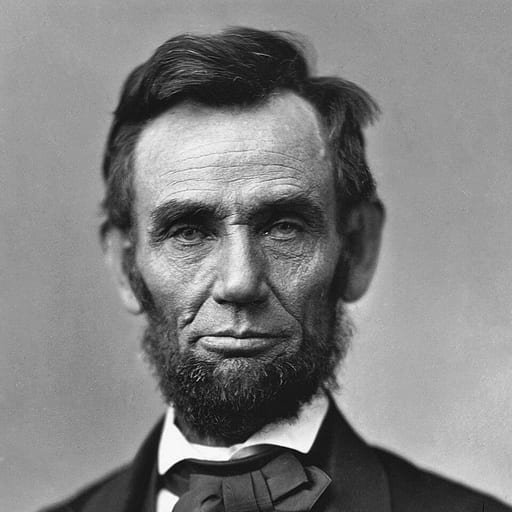
Abraham Lincoln
에이브러햄 링컨
16th US president; led the Union through the Civil War
990 records in all
- Principles 338
- Episodes 201
- Quotes 451
3 free questions a day, no sign-up.
Photo: Alexander Gardner Public domain Original cropped
Quotes
68 basic records of 451
Quotes are word for word from the source.
Respecting dissent
Yet in all our rejoicing let us neither express, nor cherish, any harsh feeling towards any citizen who, by his vote, has differed with us.
Our noteLincoln speaks to supporters after an election victory about maintaining unity.
Pragmatic justice
The severest justice may not always be the best policy.
Our noteWriting a response to the Second Confiscation Act passed by Congress.
Vigilant action
Beware of rashness, but with energy and sleepless vigilance go forward and give us victories.
Our noteAdvising General Joseph Hooker on how to lead the army.
Admitting mistakes
I now wish to make the personal acknowledgment that you were right, and I was wrong.
Our noteWriting to General Grant about his successful military strategy at Vicksburg.
Achieving collective action
In a great national crisis like ours unanimity of action among those seeking a common end is very desirable - almost indispensable. And yet no approach to such unanimity is attainable unless some deference shall be paid to the will of the majority simply because it is the will of the majority.
Our noteLincoln discusses the necessity of following the majority will to achieve unity during a crisis.
Handling harsh feedback
Did Stanton say I was a damned fool? Then I dare say I must be one, for Stanton is generally right and he always says what he means.
Our noteLincoln responds to reports that his Secretary of War called him a fool.
Accurate problem assessment
If I be right, the first thing is to get a just estimate of the evil - then we can provide a cure.
Our noteLincoln speaks about the difficulty of settling the national controversy over slavery.
No middle ground
If slavery is right, it ought to be extended; if not, it ought to be restricted, there is no middle ground.
Our noteLincoln discusses the impossibility of compromising on a fundamental moral and political issue.
Avoid false compromise
Let us be diverted by none of those sophistical contrivances wherewith we are so industriously plied and belabored - contrivances such as groping for middle ground between the right and the wrong
Our noteRejecting the idea of finding a middle ground on a clear moral issue like slavery.
Learning for survival
He accepted, procured a compass and chain, studied Flint and Gibson a little, and went at it. This procured bread, and kept soul and body together.
Our noteLincoln was describing how he took up surveying to support himself after his store failed.
Vigilance against folly
While the people retain their virtue and vigilance, no administration, by any extreme of wickedness or folly, can very seriously injure the government in the short space of four years.
Our noteHe was reassuring citizens about the resilience of the constitutional system.
Means and ends
when an end is lawful and obligatory the indispensable means to it are also lawful and obligatory.
Our noteJustifying the actions taken to maintain the Union.
Collective Betterment
It is not "Can any of us imagine better?" but "Can we all do better?" Object whatsoever is possible, still the question recurs, "Can we do better?
Our noteLincoln urges Congress to focus on practical, collective improvement over individual ideals.
Indispensable measures
I felt that measures, otherwise unconstitutional, might become lawful, by becoming indispensable to the preservation of the constitution, through the preservation of the nation.
Our noteHe explains why he took actions that seemed to exceed his constitutional authority.
Adapting to events
I claim not to have controlled events, but confess plainly that events have controlled me.
Our noteLincoln reflects on his leadership during the three years of the Civil War.
Deflecting credit
I myself was near the front, and had the high pleasure of transmitting much of the good news to you; but no part of the honor, for plan or execution, is mine.
Our noteHe was giving credit to the military for recent victories.
Breaking bad promises
But, as bad promises are better broken than kept, I shall treat this as a bad promise, and break it, whenever I shall be convinced that keeping it is adverse to the public interest.
Our noteDiscussing his commitment to the new Louisiana government and the flexibility required for the public good.
Sharing your work
Your polite note of yesterday, requesting for publication a copy of the address on the life and public services of Gen. Taylor, is received; and I comply with the request very cheerfully.
Our noteLincoln responded to a request to publish his manuscript for the public to read.
Path of Duty
It is much for the young to know that treading the hard path of duty as he trod it will be noticed, and will lead to high places.
Our noteHe encourages the younger generation by highlighting that consistent hard work leads to recognition.
Prioritizing urgent issues
I do not consider it necessary at present for me to discuss those matters of administration about which there is no special anxiety or excitement.
Our noteLincoln explains why he is focusing only on the most critical national tensions during his address.
Sustainable governance
A majority held in restraint by constitutional checks and limitations, and always changing easily with deliberate changes of popular opinions and sentiments, is the only true sovereign of a free people.
Our noteLincoln defines the necessity of a balanced majority rule to avoid anarchy or despotism.
Facing mental crisis
Whether I shall ever be better, I cannot tell; I awfully forebode I shall not. To remain as I am is impossible; I must die or be better, it appears to me.
Our noteLincoln expresses the severity of his depression and the necessity of change for survival.
Humility in leadership
In my judgment, such of us as have never fallen victims have been spared more from the absence of appetite, than from any mental or moral superiority
Our noteLincoln argues against looking down on those struggling with addiction during a temperance speech.
Justice and weakness
Suppose it is true that the negro is inferior to the white in the gifts of nature; is it not the exact reverse of justice that the white should for that reason take from the negro any part of the little which he has had given him?
Our noteLincoln argues against using perceived weakness as a justification for exploitation.
Calm but firm
We mean to be as deliberate and calm about it as it is possible to be, but as firm and resolved as it is possible for men to be.
Our noteLincoln describes the Republican party's patient but resolute approach to political opposition.
Empathy in conflict
We mean to remember that you are as good as we; that there is no difference between us other than the difference of circumstances.
Our noteLincoln addresses his political opponents, emphasizing shared humanity despite deep ideological divides.
Clear alignment
The good old maxims of the Bible are applicable, and truly applicable, to human affairs; and in this, as in other things, we may say that he who is not for us is against us
Our noteLincoln discusses the necessity of shared principles when forming political alliances.
Cost of indecision
In an effort at such compromise we should waste time which the enemy would improve to our disadvantage; and that would be all.
Our noteLincoln explains why pursuing a paper compromise without military leverage is a waste of time.
Handling Criticism
No good advice would go unheeded. No candid criticism would offend him. No honest opposition, while it might pain him, would produce a lasting alienation of feeling between him and the opponent.
Our noteLincoln's openness to feedback and his ability to maintain relationships despite professional disagreements.
Sustainable Strategy
Lincoln's policy was, on the whole, the wisest and safest; that a policy of heroic methods, while it has sometimes accomplished great results, could in a democracy like ours be maintained only by constant success
Our noteThe realization that aggressive, high-risk strategies are fragile compared to those aligned with public sentiment.
You are seeing 149 basic records. Membership answers from all 990 of this master's records.
See membershipMore masters in this field
See the whole fieldLeaders in history and crisis

These records are our compilation of public statements and sources. We are not affiliated with or endorsed by Abraham Lincoln or any related company. If something should come down, tell us. Takedown request form